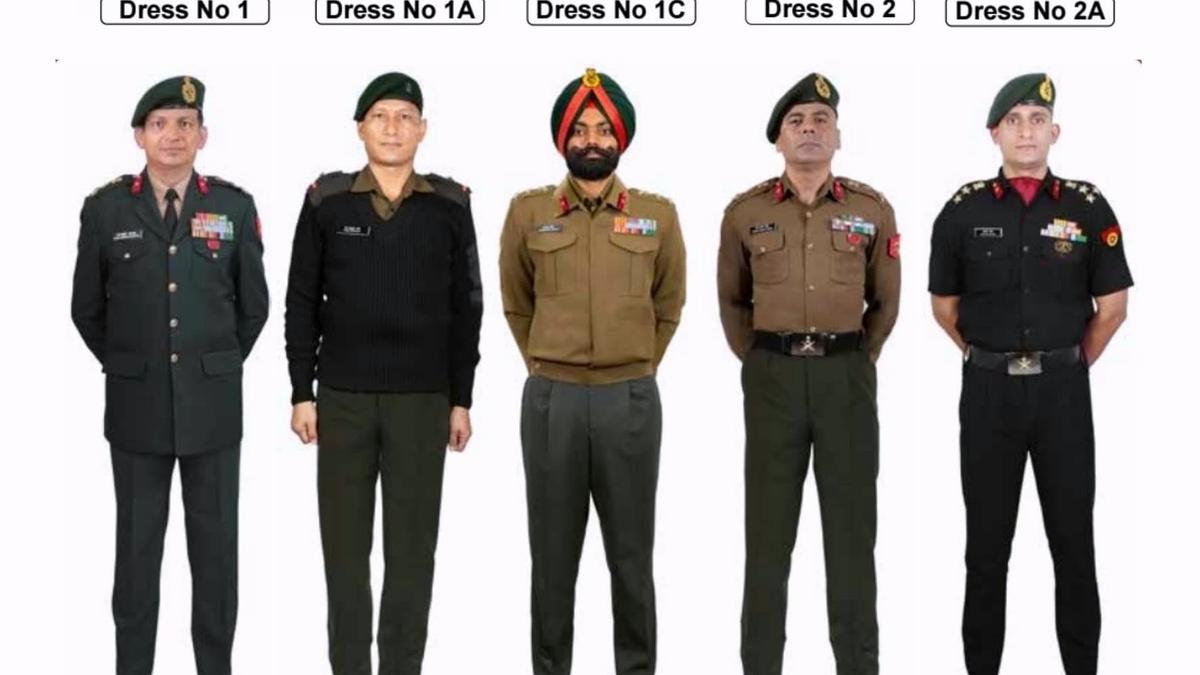

The Army has announced the phased withdrawal of legacy patterns such as Dress No. 3A, which will be discontinued by June 30, 2029. The changes are aimed at enhancing uniformity, practicality and ease of implementation across the force. Photo: Special Arrangements
In a significant move aimed at modernising military traditions and reinforcing an indigenous identity, the Indian Army has introduced Army Uniforms–2026, a revised dress regulations pamphlet that progressively removes residual colonial-era practices, terminology and non-essential accoutrements.
The new policy reflects the Army’s effort to align its dress regulations with contemporary Indian values while maintaining the service’s rich traditions and professional standards. The Army has described the uniform as a symbol of identity, discipline, order and collective belonging.
The revised dress regulations, released eight years after the last edition, reflect the Army’s ongoing effort to align military traditions and practices with contemporary Indian ethos.

According to the document, the uniform projects professionalism, integrity, credibility and dependability, while adherence to prescribed dress standards reinforces military discipline.
A notable feature of the revised regulations is the introduction of a common Uniform Numbering Scheme for the Army, Navy and Air Force. The initiative is intended to improve clarity, interoperability and synergy among the three services while simplifying references to various dress categories.
The Army has retained four broad categories of uniforms—Ceremonial Dress, Working Dress, Mess Dress and Combat Dress. Unique dress numbers have been assigned to each uniform for ease of identification and administration.
Reflecting India’s evolving national identity and contemporary ethos, the latest edition of the Army Uniforms Pamphlet introduces several key changes aimed at shedding remnants of colonial-era practices. Among the notable reforms are the inclusion of the traditional Bandi Jacket as part of formal civil attire, removal of the pouch belt from Mess Dress Nos. 5 and 6, making sword carriage by the Reviewing Officer optional, and discontinuing outdated terminology such as “Royal”.
The Army said these measures form part of a broader effort to modernise dress regulations while preserving the service’s dignity, functionality and long-standing traditions. The changes represent a calibrated review of colonial-era vestiges, aligning military customs more closely with India’s sovereign identity and contemporary values.
The Army Uniforms–2026 pamphlet also seeks to simplify and rationalise existing dress regulations. The Army has announced the phased withdrawal of legacy patterns such as Dress No. 3A, which will be discontinued by June 30, 2029. The changes are aimed at enhancing uniformity, practicality and ease of implementation across the force.
In addition, the revised document incorporates improved functionality, clearer visual references and gender-neutral representation, reflecting the requirements of a modern and professional military. The Army has emphasised that the guidelines are not merely instructions on attire but a reaffirmation of its institutional identity and ethos.
The document mentioned that the pamphlet represents a balanced approach between preserving tradition and embracing change. Periodic reviews under the Adjutant General’s Branch will ensure that the regulations remain responsive to evolving operational requirements and organisational priorities in the years ahead.
Published – June 14, 2026 01:49 pm IST
Leave a Reply