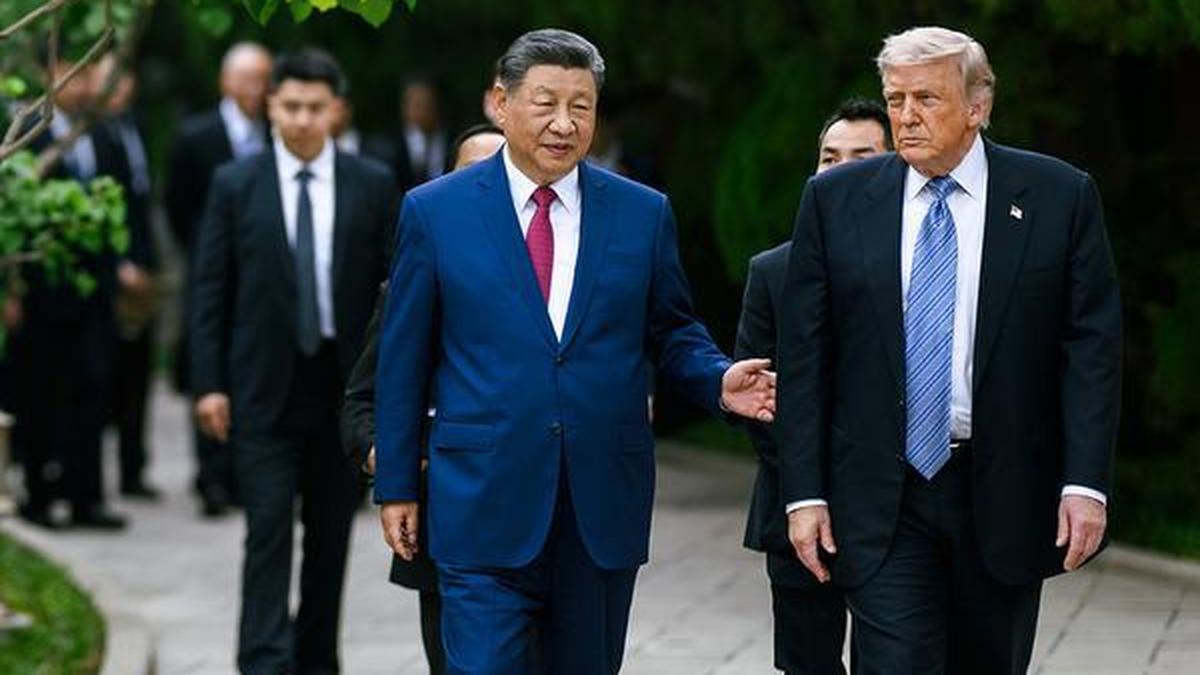
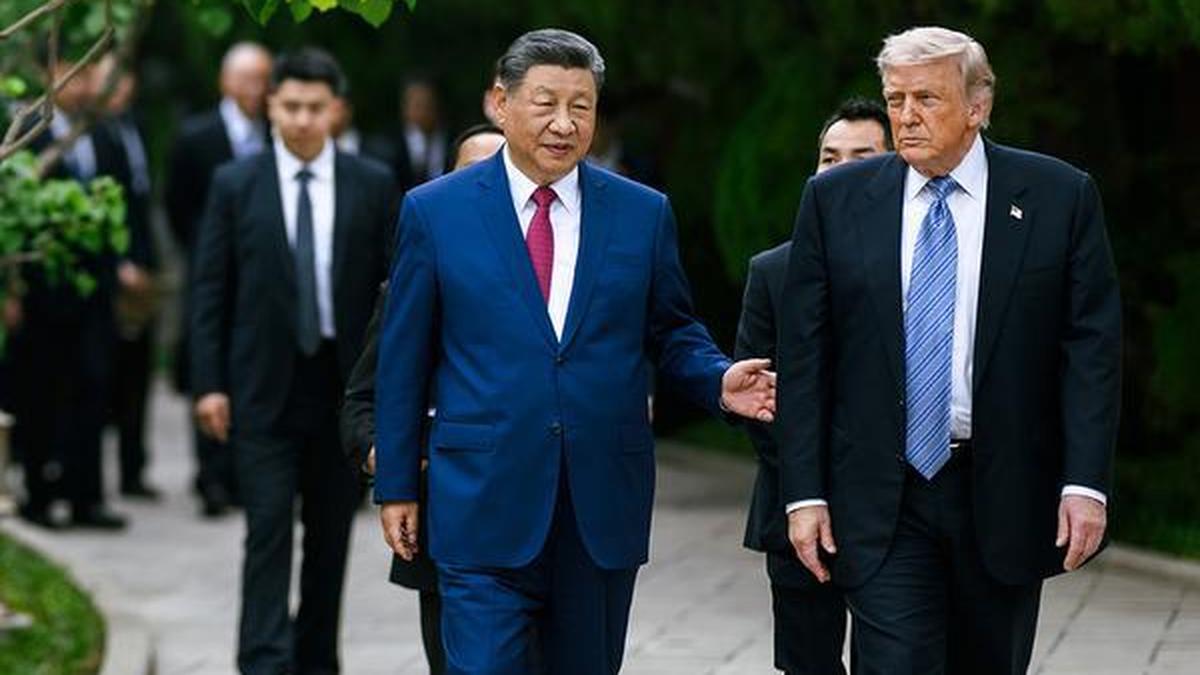
U.S. President Donald Trump and Chinese President Xi Jinping, take a walk through Zhongnanhai Garden, in Beijing on Friday.
| Photo Credit: ANI
U.S. President Donald Trump completed his visit to the People’s Republic of China(PRC) on May 14 and 15, 2026, a first in nine years. As the most consequential bilateral relation, the entire world watched this visit with great anticipation. However, as things stand, it appears that the visit was a stalemate and little was achieved by way of progress, and the two sides are not even closer to returning to the state of managed rivalry, which in turn was a bare minimum expectation. China frames it as “constructive strategic stability”, but it seems to be unwilling to make any concessions to achieve that and puts the burden of instability squarely on the U.S.
China’s strategic outlook
One of the expressions used by Chinese President Xi Jinping right at the start of his readout, that the “transformation not seen in a century is accelerating across the globe”, merits special attention. While this is not the first time Mr. Xi has used this expression in front of the U.S. President, its last usage led to a binary in which the ball was in the American court to choose whether they wanted confrontation or cooperation. This time, it’s a choice on whether or not the two sides can avoid a Thucydides’ trap that would eventually lead them towards conflicts or confrontations.
This term made its first appearance in December 2017, during China’s ambassadorial work conference, when Mr. Xi said that the world is undergoing “profound changes unseen in a century”. It reflects China’s assessment that the global power transition has entered its most decisive stage and China’s eclipsing of the U.S. is a matter of time. Chinese analysts have assessed that China’s GDP is set to bypass the United States by 2030 and other indicators of powers would follow suit.
The reference to a century is what makes it especially curious. China seems to be thinking that a century ago, driven by the decline of Europe across two world wars, global power made a transatlantic shift, making the U.S. the most powerful country in the world, and made liberalism its most central standpoint. Before that, the 19th century saw a different form of globalisation in the rise of colonialism and imperialism. In a similar fashion, China’s rise is projected as inevitable and its rise as a norm-building power even more certain. It underpins China’s confidence in ascending to what it calls its rightful place in the international system.
This would also lead to an interesting analysis. It seems that China views Brexit and the first election of Donald Trump as U.S. President — driven by a conservative, insecure, to a large extent supremacist and deglobalisation-driven agenda as signs of the certain and inevitable decline of the West, the roots of which were seen in the 2008 financial crisis. After this, China emerged as a new voice of globalisation and began strongly criticising the West for its withdrawal from globalisation, just as the prosperity was beginning to spread away from traditional centres of power.
Reshaping global dynamics
Towards the goal of its rise, China has accelerated its assault on the current international order through various initiatives like the Global Development Initiative (GDI) and the Global Security initiative (GSI). China is using these to discredit the U.S. led order by portraying it to be divisive and disruptive, while presenting its own approach to global security as driven by “common, comprehensive, cooperative and sustainable” security. It also identifies its approach to the idea of development as being more “balanced, coordinated, and inclusive” for the developing world. Through its initiatives and critique of the current order, China is seeking to and in some cases is, leading multilateralism and south-south cooperation, while undercutting the norms of the liberal order.
For countries like India, this increased power rivalry makes life more difficult. In the phase where there was a managed competition between the U.S. and China, other countries worked their way to hedge their bets between the two. However, now they are facing trade wars and tariffs, supply chain volatilities, the risks arising from the U.S.-Israel war on Iran and overall strategic instability. Add to it the rapid rise of artificial intelligence and its potential impact on the job markets, and the result is a volatile mix. A rising power imagining its destiny to be on the horizon and a dominant power in a combative mood may cause more unintended consequences in the years to come.
(Avinash Godbole is a Professor and Associate Academic Dean, JSLH, JGU. Views expressed are personal.)
Published – May 20, 2026 08:00 am IST
Leave a Reply