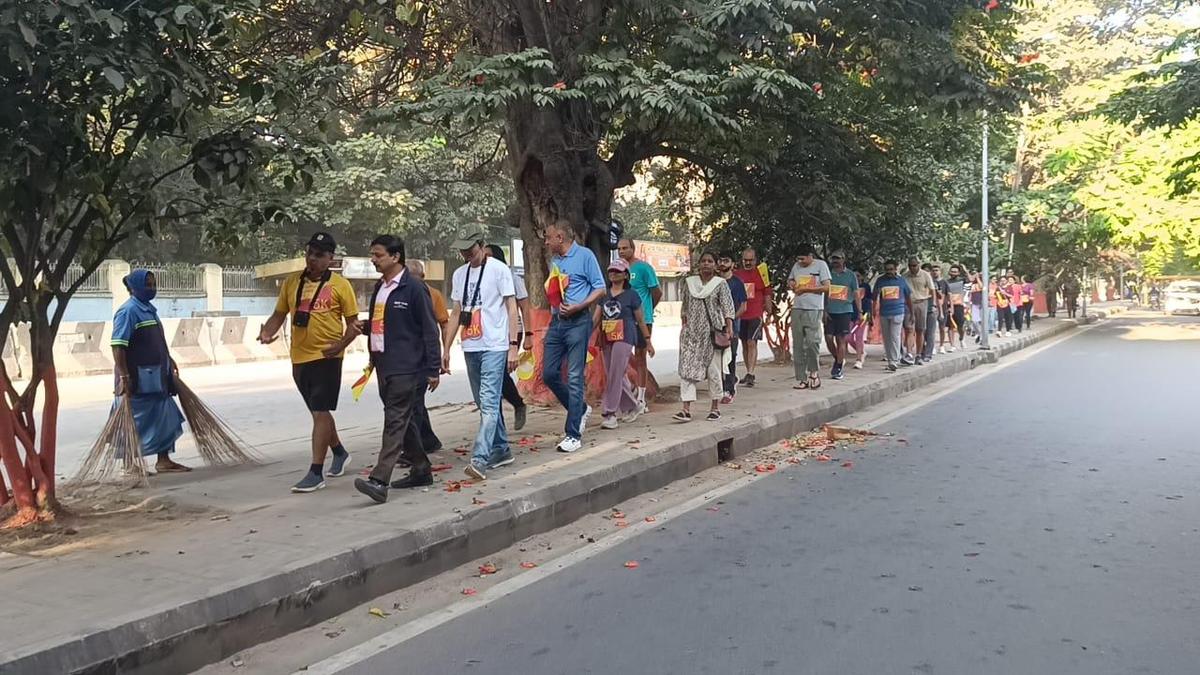
The Supreme Court on Friday (June 19), in a judgment, declared the freedom to walk on demarcated and well-maintained footpaths a fundamental right which has priority over movement by motorised vehicles.
“If a road exists, there must then be a duty to ensure that a footpath is demarcated and maintained for the walkers. This is an enforceable duty. The fundamental right to walk on demarcated footpaths shall override the privilege of a motorised vehicle,” Justice P.S. Narasimha, who authored the judgment, held.
The judgment came in a case of the death of a five-year-old boy who was crushed to death by a truck while walking to the neighbourhood school with his father.
Young activist’s 7,000-km walk highlights climate and animal welfare issues
Justice Narasimha said walking safely and carefree along wide footpaths, without danger lurking at every turn, was the most basic of rights. It is the “simplest of the simple human activity, inextricably connected to life”, Justice Narasimha observed.
The court said the Constitution recognised and guaranteed walking as a fundamental right in its words, “All citizens shall have the right…to move freely throughout the territory of India”.
But over the years, demands of economy, trade and rapid urbanisation have relegated walking to an inconvenience. Moving on wheels have eclipsed human imagination. Governments and local bodies paralleled wide roads and expressways to growth, busily building motorways while leaving little space for the essential pleasure of walking, the court said.

“It could also be elitism to start with, for machines with wheels were only for the rich, but as economies progressed and cheaper motor vehicles were introduced, the entire spectrum of motorised transportation dominated the roads, pushed aside the walkers to the extent that they are treated as a nuisance for the drivers who routinely run over the walkers and their footpaths. This should stop from now on as we declare the fundamental right to walk on demarcated footpaths alongside motorised roads,” the Supreme Court said.
How a simple two-minute walk can help both prevent hypertension and detect it early
Justice Narasimha said walking has deep cultural, social, religious, political, and reformative roots in the Indian imagination. Walking plays a pivotal role in politics and social reform.
“Walking is a struggle for the not-so-fortunate, meditation in motion for many, resistance for others, discovery for the inquisitive, a cohesive strategy for sharp socio-political minds. It certainly did inspire and ignite some of the ideals of the freedom struggle… In that sense, walking is not just motion, it certainly embodies expressional, congregational and associational rights under Article 19(1)(a), Article 19(1)(b) and Article 19 (1)(c),” Justice Narasimha said.
Common spaces in rural and urban landscapes must not be the monopoly of motorised vehicles. The freedom to walk, subject to reasonable restrictions, also deserved ample space.
“In reality, how much does it take to create a well-demarcated footpath wherever a road exists? All that the fundamental right to walk demands is a comfortable space for an easy and carefree walk. Should this not be the minimum of the minimum duty that a municipal authority owes to the citizens,” the apex court asked the government.
It said the Motor Vehicles Act, 1988, had never bothered to recognise the fundamental right to walk.
“In fact, the Motor Vehicles Act has been an impediment and, in many ways, undermined the precious rights of walkers… The Motor Vehicles Act is built upon ‘vehicle’ as the subject of the legislation, while ‘human’ interests are incidental, which a motor vehicle must avoid violating – that’s all, and no further,” Justice Narasimha wrote.
The Supreme Court highlighted the need to lay down a statutory framework, not only for declaring the right to walk a fundamental right, but also to recognise the duty-bearers. The proposed Act must protect, enhance, and provide quick remedies for violations, and also establish a full-time regulator to plan, enforce, and implement the right to walk
“To enhance and effectuate the fundamental right to walk on demarcated footpaths, it is necessary to establish a regulatory body… Institutional expertise is critical, and such a regulator will employ human resources with domain expertise and talent,” Justice Narasimha said.
The court directed its Registry to send a copy of the judgment to the Ministries of Housing and Urban Affairs, Rural Development, Road Transport and Highways, to “reflect on the compelling necessity for initiating the necessary legal framework”.
It said a copy may further be sent to the Law Commission of India for examining the statutory framework for protecting the right, identifying the duty-bearers and provisioning remedies.
Justice Narasimha said Constitutional courts were also obliged to declare and reiterate the right to walk as a fundamental right.
Finding that the child’s father was entitled to compensation of over ₹11 lakh, Justice Narasimha shared the grief of the young father who “lovingly readied his five-year-old son and left home at 9 a.m. to drop him at the neighbourhood school. Who could have ever imagined that it would be the last walk with his son?”
Published – June 19, 2026 03:02 pm IST
Leave a Reply