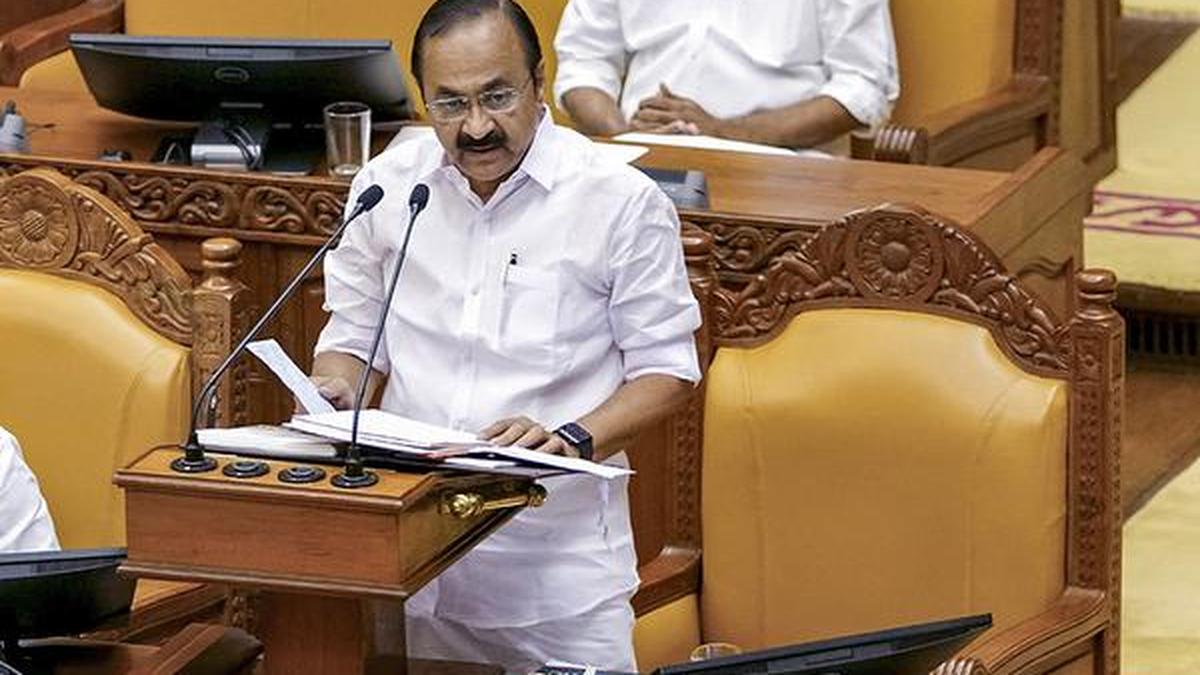
After releasing the “Kerala’s Fiscal Health — A Status Report” (white paper), which raised serious concerns over the State’s rising debt burden while strongly criticising the previous Left government for alleged fiscal mismanagement, the new United Democratic Front (UDF) government on Thursday presented its maiden budget.
The budget estimates the debt-to-GSDP ratio to come down marginally to 33.5% in 2026-27, compared with 34.87% (actuals, 2024-25) or 34.26% (revised estimates, 2025-26).
This is not because debt is expected to fall — the budget in fact projects total outstanding debt to rise 11.6%, from ₹4.89 lakh crore to ₹5.46 lakh crore — but because of its optimistic outlook that GSDP would grow nominally by 14.15% and revenue receipts by 23.8%.
Even if the government’s optimistic projections come true, Kerala will indisputably remain among the States with the highest debt burden. As per the Reserve Bank of India’s (RBI) data, the debt-to-GSDP ratio for all States combined stood at 27.01% in 2024-25. The chart below shows the ten States with the highest debt-to-GSDP ratio in 2024-25.
However, a rather unique Kerala phenomenon, highlighted prominently by the white paper, is its “structural” problem of a high share of “committed expenditure”, which not only leaves little or no room for capital expenditure but also contributes to mounting revenue deficits.
Committed expenditure has three main components: salaries, pensions and interest payments on loans previously taken. The three together account for nearly 78% of the State’s revenue receipts, as per RBI’s data for 2024-25. The share is only 45.4% at the all-India level (excluding Union Territories).
The budget projects it at 72.14% for 2026-27, which would still be the second-highest in the country, after Punjab — whose economy is only about two-thirds the size of Kerala’s. The chart below shows committed expenditure as a share of revenue receipts in States whose GSDP was at least ₹5 lakh crore in 2024-25.
Of the total committed expenditure, salaries and pensions alone account for more than half of the State’s revenue receipts. The budget estimates salary and pension expenditure at ₹88,000 crore in 2026-27, nearly 52% of the estimated revenue receipts of ₹1.7 lakh crore.
The chart below shows how this trend has remained roughly the same in Kerala. The share of committed expenditure in total revenue receipts touched its peak of 81.2% in 2021-22, when the previous government cleared certain backlogs related to salaries and pensions and undertook some one-time COVID-19-related relief measures.
On committed expenditure being a crucial problem, the white paper noted: “The most direct structural explanation for Kerala’s treasury stress is the share of its revenue that is pre-empted before any discretionary decision.”
It further said: “The State spends almost 80% of its resources on salaries, pensions and interest, far more than many other states. It is not right to take taxes from the people and spend most of it on salaries and pensions… Now is the time for hard political decisions,” adding that measures such as increasing the retirement age and limiting pay commission revisions to once every ten years should be considered.
Yet, while the budget speech spelled out either measures or the intent to address most of the problems the white paper had highlighted, it was conspicuously silent on measures to address this “structural problem” — barring the announcement that the government would revamp the National Pension Scheme after reviewing the “ambiguities” in the Assured Pension Scheme announced by the previous government.
The silence is perhaps an acknowledgement of the difficulty in tackling the problem, and of the importance of such high allocations for salaries and pensions in achieving the considerable progress the State has made on human development indicators.
Economist R. Ramakumar cautioned against interpreting the figures solely as evidence of fiscal distress. “If you want to retain a welfare state idea, welfare state requires welfare workers,” he said, pointing out that Kerala employs significantly more teachers, nurses and other public-sector workers than most States.
“Kerala’s achievements are due to this particular kind of salaries that you end up paying,” he said.
Moreover, he said that while the figure of more than 75% highlighted in the white paper has “shock value”, a better parameter would be the share of committed expenditure in the State’s total revenue expenditure, rather than revenue receipts, which would bring the figure down to around 58-60%.
Economist Lekha Chakraborty, meanwhile, said this reflected public expenditure rigidity. “All that we can do is an episodic expenditure (sectoral) compression, given the committed nature of spending. While the state has shown revenue buoyancy, without meaningful public expenditure reforms, this pattern risks perpetuating revenue deficits and constraining Kerala’s ability to sustain its social model,” she added.
As the chart below shows, SOTR and overall revenue receipts have indeed shown notable growth. SOTR has, however, remained below committed expenditure. Moreover, their respective compound annual growth rates (CAGRs) between 2015-16 and the 2026-27 (budget estimates) show that committed expenditure has grown faster than the other two.
Tax buoyancy, meanwhile, has come down in the last few years. The chart below shows SOTR buoyancy, calculated as the ratio between the growth of SOTR and the growth of GSDP. A value above one indicates good buoyancy, while a value below one indicates the State’s inability to raise tax revenues in proportion to economic growth.
The budget speech and the projections for 2026-27 show that the new UDF government is relying on a swift turnaround in tax buoyancy and GSDP growth to help the State come out of the financial distress, while recognising that committed expenditure on salaries and pensions cannot be brought down, at least in the near future.
Published – June 20, 2026 08:13 am IST
Leave a Reply