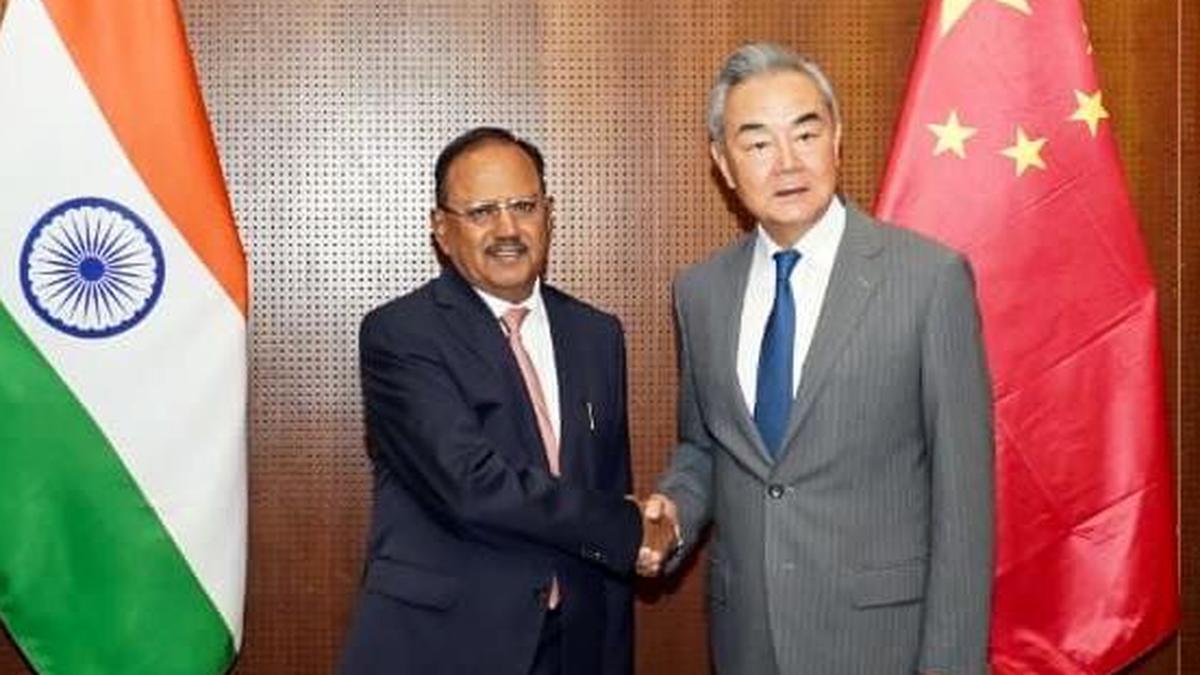
China’s Foreign Minister and Politburo member Wang Yi, in talks with National Security Adviser Ajit Doval in New Delhi on Monday (June 22, 2026), called for both sides “to accelerate the resumption of dialogue mechanisms and promote exchanges” in trade, finance, and other fields, the Chinese Foreign Ministry said in a statement early on Tuesday (June 23, 2026).
He also called for the two sides “to respect each other’s core interests, properly handle sensitive issues, place the China-India boundary issue in its appropriate position, and prevent it from affecting the overall situation of bilateral relations.”

Mr. Wang’s reference to the resumption of dialogue mechanisms being “essential” follows the Chinese Ambassador to India saying earlier this month that most of the dialogue frameworks between India and China still remained stalled. “China and India have nearly 50 government-to-government dialogue mechanisms; unfortunately, most of them remain stalled,” Xu Feihong had said speaking at The Hindu Huddle in Bengaluru.
Mr. Doval had, in Monday’s meeting on the sidelines of the BRICS NSAs meeting in New Delhi, underlined that stable, predictable and constructive bilateral relations contribute to building trust and better understanding between the two sides. A brief statement from New Delhi on Monday said both sides reviewed recent developments in bilateral relations and noted progress towards gradual normalisation in relations.

Indian and Chinese delegations meet on the sidelines of the BRICS NSAs’ Meeting, in New Delhi
| Photo Credit:
ANI
Yet the normalisation process has been in fits and starts with even simpler measures, such as the resumption of direct flights, taking many months of long-winding negotiations. Other dialogue mechanisms are yet to resume, even as both sides are finalising arrangements for Mr. Doval to visit Beijing for the next round of talks with Mr. Wang under the Special Representatives mechanism. That visit will also shed light on whether Mr. Xi will visit India for the BRICS leaders’ summit in September as is expected.
‘Not rivals’
A lengthier Chinese readout of the talks released early on Tuesday said Mr. Wang, who is also Director of the Office of the Central Foreign Affairs Commission, stated in Monday’s talks that “India is an important neighbour of China.”
“Under the joint guidance of President Xi Jinping and Prime Minister Narendra Modi, China-India relations have gradually emerged from their low point and returned to a track of recovery and improvement. The leaders of both countries agree that China and India are partners, not rivals, which forms the most important strategic consensus between the two sides and provides crucial momentum and strategic assurance for the healthy and stable development of China-India relations. As the two most populous economies, China and India must not only view bilateral relations with a long-term perspective but also advance cooperation from a global standpoint,” the statement said.

Mr. Wang said through the efforts of both sides “exchanges between China and India in various fields have gradually resumed, communication and cooperation are progressing in an orderly manner, and the border areas remain generally peaceful and tranquil.”
“These achievements did not come easily and deserve to be cherished all the more,” he said. “Both sides need to take practical actions to implement the important consensus of the two countries’ leaders, assist each other’s development and revitalisation through cooperation, and push the Global South to accelerate its modernisation process. The two sides should respect each other’s core interests, properly handle sensitive issues, place the China-India boundary issue in its appropriate position, and prevent it from affecting the overall situation of bilateral relations.”
He added that it was “essential to accelerate the resumption of dialogue mechanisms and promote exchanges in various fields such as trade, finance, law enforcement and media”.
“Efforts should also be made to actively guide all sectors of society to form correct perceptions, building a solid foundation of public opinion and social support for the improvement of relations between the two countries,” he added.
The Chinese Foreign Minister said with the Global South “including China and India, rising collectively”, the BRICS grouping, as “the front rank of the Global South”, needed to “actively advocate for and advance the process of multipolarisation, safeguard the legitimate rights and interests of developing countries, and promote the development of the international order toward a just and reasonable direction.”
The Chinese statement quoted Mr. Doval as saying Mr. Modi and Mr. Xi, through their meetings in Kazan in October 2024 and Tianjin in August 2025, had “pointed the way forward for the development of bilateral relations through their meetings in Kazan and Tianjin”.
Mr. Doval was quoted as saying they “agreed that India and China are partners, not rivals, and believed that a stable India-China relationship serves the common interests of both sides”. “The Indian side is willing to continue viewing its relations with China from a strategic perspective, work with China to well implement the consensus of the two leaders, view and accelerate the development process of bilateral relations with a forward-looking attitude, properly handle differences, and strive for a win-win situation”.
The Chinese Foreign Ministry statement also quoted Mr. Doval as telling Mr. Wang that “India was one of the earliest countries to recognise New China” and “India’s position on the Taiwan question has not changed in any way”.
Published – June 23, 2026 08:05 am IST
Leave a Reply