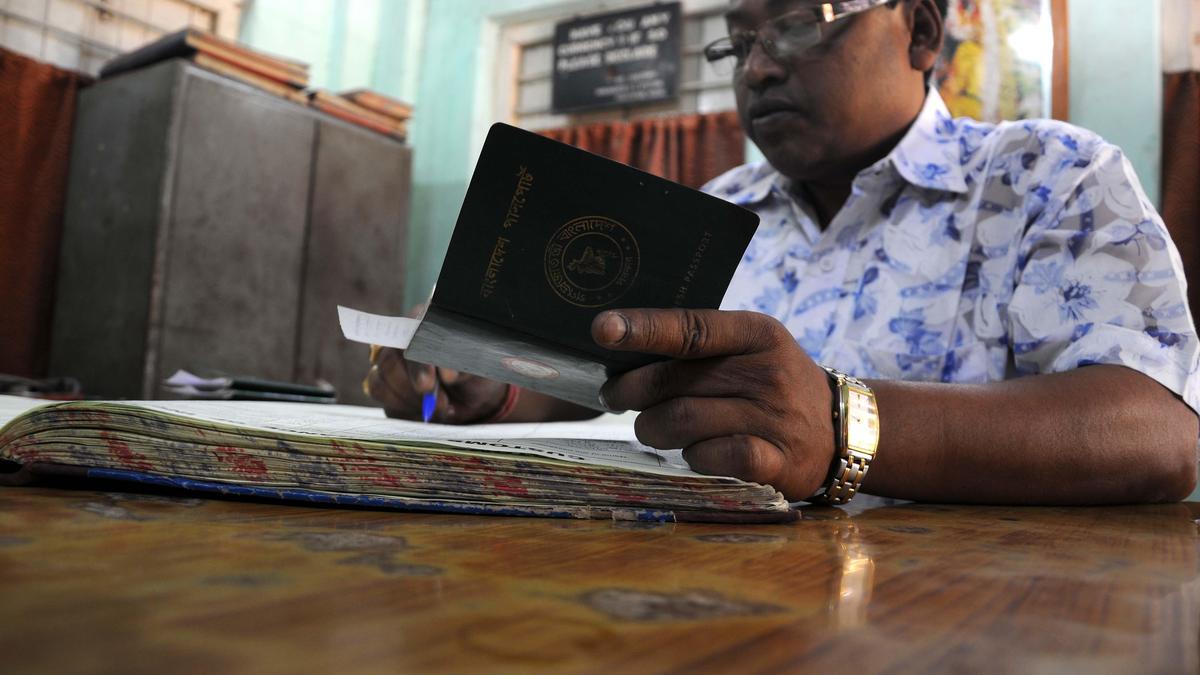
The story so far: The fresh wave of deportation and detention drives targeting undocumented migrants from Bangladesh in several States, including West Bengal, have brought deportation laws to the spotlight. West Bengal Chief Minister Suvendu Adhikari on June 7 said that 4,800 “illegal infiltrators” have been deported to Bangladesh over the past one month. Mr. Adhikari said that “holding centres” have been set up in border districts of the State. He had earlier said that the policy of his government regarding “illegal infiltrators” was to “detect, delete and deport”.
The Gujarat police also detained 362 undocumented Bangladeshi migrants and questioned more than 782 suspected foreign nationals during a State-wide crackdown under “Operation Delta Hunt” launched on June 2, 2026.
According to Union Home Minister Amit Shah, the Union government had constituted a high-level committee on demographic change and was committed to “identifying and deporting every single infiltrator from the country.” These events, along with Assam Chief Minister Himanta Biswa Sarma’s advocacy of a “pushback” policy for undocumented migrants from Bangladesh and Myanmar, including Rohingyas, have drawn attention on issues of deportation and refugee rights.
What is a pushback?
Deportation is a formal legal process that typically involves detention, judicial or quasi-judicial proceedings, and coordination with the receiving country’s authorities. In contrast, Pushbacks generally refer to the return of individuals across a border outside the formal deportation process and without the procedural steps ordinarily associated with deportation. Originally,“pushbacks” is a term from European and American border enforcement, implying someone caught mid-crossing and returned.
The term “pushback” does not have a statutory definition in Indian law. However, recent government policy by Ministry of Home Affairs (MHA) distinguishes between formal deportation proceedings and the immediate “send back” of Bangladeshi or Myanmarese nationals intercepted at the border. The legality of such pushbacks remains contested, particularly where questions arise regarding nationality verification and procedural safeguards.

Police personnel guard a camp where Bangladeshi migrants who allegedly crossed the border illegally are kept for verification before being deported to Bangladesh, at Tentulia village in West Bengal’s North 24 Parganas district on May 28, 2026.
| Photo Credit:
AFP
Who is an illegal migrant?
The word “illegal migrant” is defined in Section 2(1)(b) of the Citizenship Act, 1955 as a person entering the country without valid documents or overstaying the permitted time in country despite having entered with valid documents.

What are the laws around it?
In the context of Assam, Section 6A (Assam Accord) of the Act lays down special provisions for persons of Indian origin who entered Assam between January 1, 1966 and March 25, 1971. Even if declared foreigners, such persons may be permitted to register for citizenship after completing a 10-year waiting period from the date of detection. During this interim period, they are disentitled from exercising voting rights but continue to enjoy all other rights of citizenship. Those who entered after March 25, 1971 and are then found to be foreigners and remain liable for expulsion.
Foreigners Act 1964 essentially dealt with deportation in India before the Immigration and Foreigners Act, 2025, which repealed the Foreigners Act and other colonial laws.
Under the Foreigners (Tribunals) Order, 1964, Foreigners Tribunals were constituted to determine whether an individual was a foreigner. Individuals declared foreigners became liable for expulsion from Indian territory under Section 3(2)(c) of the Foreigners Act, 1946, (now repealed) following a declaration by the Foreigners Tribunal.
A saving provision preserves the validity of rules and actions made under the repealed law, ensuring continuity in the law governing identification and deportation, even though the 1946 Act was repealed.

The Passports Act, 1967 plays a role in the identification of individuals liable for deportation. Authorities can refuse, impound, or revoke passports if the applicant is not an Indian citizen, or if issuance is contrary to public interest, national security, or foreign relations.
Section 12 prescribes offences and penalties for violating passport rules, such as travelling without a valid document, providing false information, or misusing passports.
What are the major provisions of the Immigration and Foreigners Act, 2025?
The Immigration and Foreigners Act, 2025 contains several provisions that are directly relevant to deportation. Though with the consolidation of this law, the four colonial laws were repealed, the process of deportation is not altered.
Section 16 of the Act places the burden of proving Indian citizenship on the individual when questioned by authorities, rather than the state having to prove they are not a citizen.
Under Section 29, the Central Government may order the removal of a foreigner from India if the person has violated the Act or any order made under it, or if there is an “adverse security report” against them. The Act does not define the term “adverse security report.”
The grounds that may lead to deportation are reinforced by other provisions of the Act. Section 21 penalises entry into India without a valid passport or visa, while Section 23 penalises overstaying, violating visa conditions, or entering restricted areas without authorisation. These violations may form the basis for action under Section 29.
The Act also gives the Central Government broad powers under Section 7 to regulate, restrict, or prohibit the continued presence of foreigners in India, including by imposing conditions relating to residence, movement, identity verification, and reporting obligations. In addition, Section 26 authorises police officers not below the rank of Head Constable to arrest, without a warrant, persons suspected of violating the Act.
To support the identification and monitoring of foreigners, Sections 10, 12, and 17 require carriers, accommodation providers, educational institutions, and medical institutions treating foreign patients to furnish prescribed information to the authorities.

How does India deport illegal migrants?
Deportation in India was largely operationalised through internal administrative mechanisms and Standard Operating Procedures (SOPs) by State authorities following directions from the Centre.
Under the deportation policy notified earlier this April by the Union Ministry of Home Affairs (MHA), all states have been asked to set up a special task force in each district to “detect, identify and deport/send back illegal migrants from Bangladesh and Myanmar”, and provide a monthly status report on foreigners who are missing or overstaying their visas.
States have been asked to operationalise “holding centres/camps” with a 10-feet-high boundary ringed with barbed wires, to restrict the movement of such undocumented migrants till they are deported.
“Bangladeshis/Myanmar nationals who are intercepted at India’s land or maritime border, shall immediately be sent back by the designated Border Guarding Forces/ Coast Guard, then and there, after capturing their biometrics (fingerprints and facial photographs) and demographic details on the Foreigners Identification Portal,” the MHA said.
As per Article 36 of the Vienna Convention on Consular Relations, Indian authorities must inform the consular representatives of the foreign national’s country about their arrest or detention.
Indian practice requires asking the arrested foreign national if they wish their consulate to be informed, immediately notifying the Ministry of External Affairs (MEA) and the Ministry of Home Affairs (MHA), and providing detailed particulars to the relevant authorities.
What have the courts said?
The Supreme Court in Louis De Raedt & Ors vs Union Of India And Ors,(1991) stated that a foreigner’s fundamental right is confined to Article 21 for life and liberty. It “does not include the right to reside and settle in this country, as mentioned in Article 19(1)(e), which is applicable only to citizens of this country.”
The Supreme Court, in Louis De Raedt, referencing an earlier Constitution Bench decision, held that “the power of the Government in India to expel foreigners is absolute and unlimited and there is no provision in the Constitution fettering this discretion.”
The Indian Courts have considered the principle of non-refoulement which is an international law principle that prohibits a state from returning a refugee to a country where their life or freedom would be threatened, by encompassing it in Article 21.

In Nandita Haksar v State of Manipur (Manipur High Court), (2021), dealing with Myanmarese asylum seekers, the Court held that Article 21 “would indubitably encompass the right of non-refoulement, albeit subject to the condition that the presence of such asylum seeker or refugee is not prejudicial or adverse to the security of this country.”
In Mohammad Salimullah v Union of India(2021), the Supreme Court observed that “It is also true that the rights guaranteed under Articles 14 and 21 are available to all persons who may or may not be citizens. But the right not to be deported, is ancillary or concomitant to the right to reside or settle in any part of the territory of India guaranteed under Article 19(1)(e).” Article 19(1)(e) is applicable only to citizens of this country.
The Court nevertheless stipulated that deportation must follow the “procedure prescribed for such deportation.”
That shift from court-supervised deportation to administrative pushback is where the legal ambiguity lies. While courts have recognised the government’s power to deport foreigners, they have also held that such deportation must follow the procedure prescribed by law.
Leave a Reply