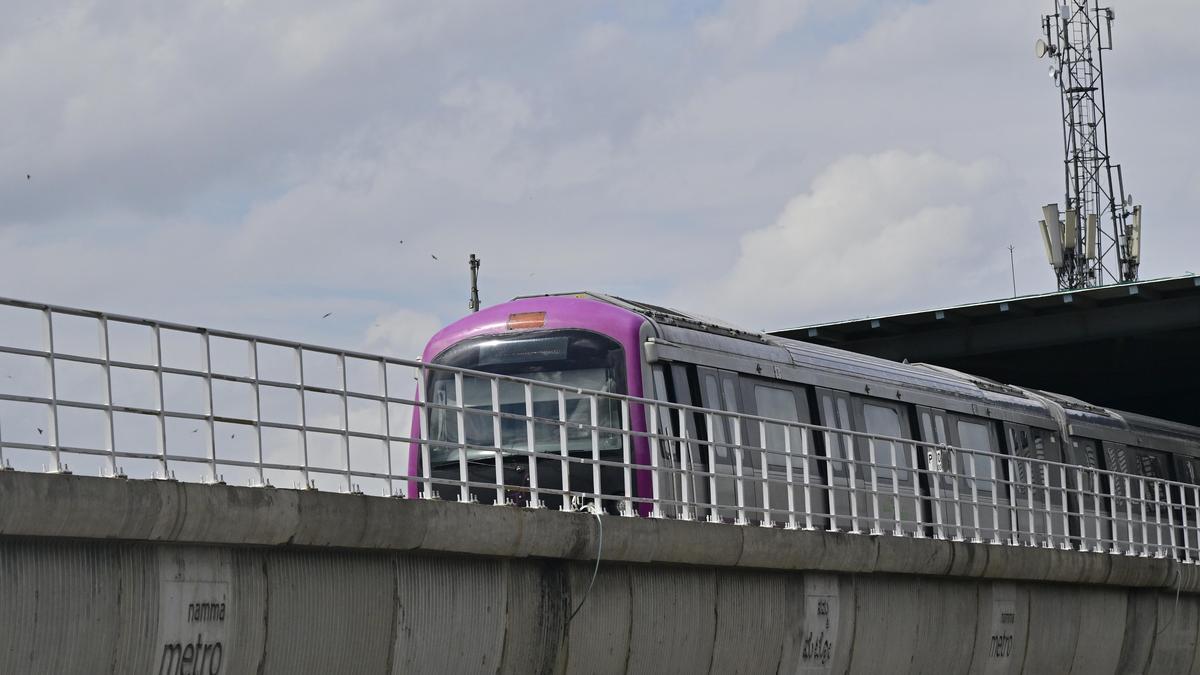
A day after thousands of commuters were left stranded across Bengaluru on Tuesday evening after a technical fault on the underground section of the Purple Line near Cubbon Park Metro Station brought train services to a halt during peak commuting hours, concerns have been raised again over the preparedness of the Bangalore Metro Rail Corporation Limited (BMRCL) to handle major disruptions.
The disruption, which began around 6.30 p.m., affected services on one of the city’s busiest metro corridors connecting Whitefield and Challaghatta. While partial operations were maintained on either side of the affected stretch, services through the underground section remained suspended for several hours, leading to overcrowding at stations and forcing commuters to seek alternative modes of transport.
The incident is the latest in a series of disruptions that have affected Bengaluru’s metro network in recent years. The Purple Line and other corridors have witnessed multiple suspensions and delays caused by signalling failures, brake-related issues, power supply interruptions, and operational glitches. Metro officials said that the disruptions are not uncommon in large urban rail systems and can occur for a variety of reasons.
Series of disruptions
“Heavy rains and gusty winds sometimes cause tree branches to fall on elevated tracks. At times, overcrowding prevents train doors from closing properly. Power supply issues or incidents involving passengers entering the tracks can also lead to service interruptions,” a senior BMRCL official said.
However, officials maintained that Tuesday’s disruption was different and involved a technical fault that required extensive repairs before services could be restored safely.
The incident has also renewed attention on the operational challenges faced by the newly inaugurated Yellow Line. Since entering service, the corridor connecting the southern parts of the city and Electronics City has experienced several technical snags, including brake-system failures.
Common causes of metro disruptions in Bengaluru
Technical faults in trains and signalling systems
Power supply interruptions
Brake-system failures and operational glitches
Overcrowding preventing train doors from closing
Tree branches or debris falling on elevated tracks during heavy rain and winds
Passengers entering or falling onto tracks
Within three months of its inauguration, the Yellow Line reportedly witnessed at least three separate technical incidents, each resulting in delays of up to 45 minutes. However, BMRCL officials dismissed concerns that these were signs of deeper systemic problems. “The issues encountered on the Yellow Line were minor and unrelated to one another. They were not recurring faults in any particular train set,” a senior BMRCL official said.
“The Yellow Line uses a new generation of trains compared to the Purple and Green Lines. As we transition to more advanced systems, occasional technical adjustments are expected. These were teething issues, and all train sets have undergone extensive testing as per established protocols,” the official added, noting that no major technical snags had been reported on the line in recent times.
Ashish Verma, professor, Transportation Planning and Policy at IISc, Bengaluru, said the technical failures cannot be eliminated but can be managed effectively through robust maintenance practices and rapid response mechanisms which are follwed in developed economy.
“Transport agencies must have a well-defined stranded passenger Standard Operating Procedure (SOP) to handle major service disruptions. One of the most effective measures is to establish a pre-arranged coordination mechanism with BMTC and other public transport operators so that alternative bus services can be deployed immediately when metro services are suspended. In cities such as Washington, D.C., planned maintenance is often carried out during weekends, and transit agencies coordinate closely with bus operators to ensure commuters have reliable alternatives. A similar integrated approach would help minimise inconvenience to passengers and improve public confidence during disruptions,” Mr. Verma added.
Communication issues
While the technical fault itself caused inconvenience, many commuters argued that the larger problem was the lack of timely communication from the BMRCL.
Passengers said that there were no clear announcements inside trains or at stations for nearly 45 minutes after the disruption began. Social media updates were also delayed, resulting in large numbers of people continuing to enter metro stations unaware of the service suspension.
“There was so much poor communication. When I reached Indiranagar Metro Station, a security guard told me that train services had stopped because someone had attempted suicide at one of the stations. People were confused, and rumours started spreading,” said Nayantara B., a commuter who was affected by the disruption.
BMRCL officials, however, said announcements regarding delayed services and loop train operations were made once operational teams confirmed the nature of the fault. Officials also pointed out that the corporation’s public relations department subsequently issued media statements and updates.
How BMRCL can better manage major disruptions
Establish a real-time incident response protocol for all Metro disruptions
Issue announcements inside trains, stations, and on social media within minutes of detecting a fault
Create an integrated command system linking BMRCL, BMTC, Traffic Police and civic agencies
Deploy emergency feeder buses immediately to affected stations
Provide passengers with regular updates on restoration timelines
Conduct periodic emergency response drills for operational staff
Coordination gaps
The incident also exposed gaps in the coordination between government agencies tasked with managing public transport during emergencies.
According to sources in the Bengaluru Metropolitan Transport Corporation (BMTC), the agency was informed about the disruption nearly an hour after the BMRCL first detected the fault. Although the BMTC later deployed more than 20 additional buses to Metro stations such as M.G. Road and Indiranagar, crowds continued to build up at several locations until late in the night.
Transport and mobility expert, M.N. Srihari, said that effective crisis management in a large city depends on seamless coordination between agencies. “When a major disruption occurs in a mass transit system, information must flow instantly between all transport agencies. Bengaluru needs an integrated incident-response protocol that enables metro, BMTC, traffic police, and civic authorities to respond as a single coordinated system like the Bengaluru Metropolitan Land Transport Authority,” he said.
P.C. Mohan, Bengaluru Central MP, said that yesterday’s disruption to the Bengaluru metro Purple Line exposed a serious gap in urban mobility preparedness. “When one mode fails, other public transport services must seamlessly absorb demand. Governance is judged not on routine days, but by its response in times of crisis.”
Published – June 24, 2026 09:13 pm IST
Leave a Reply