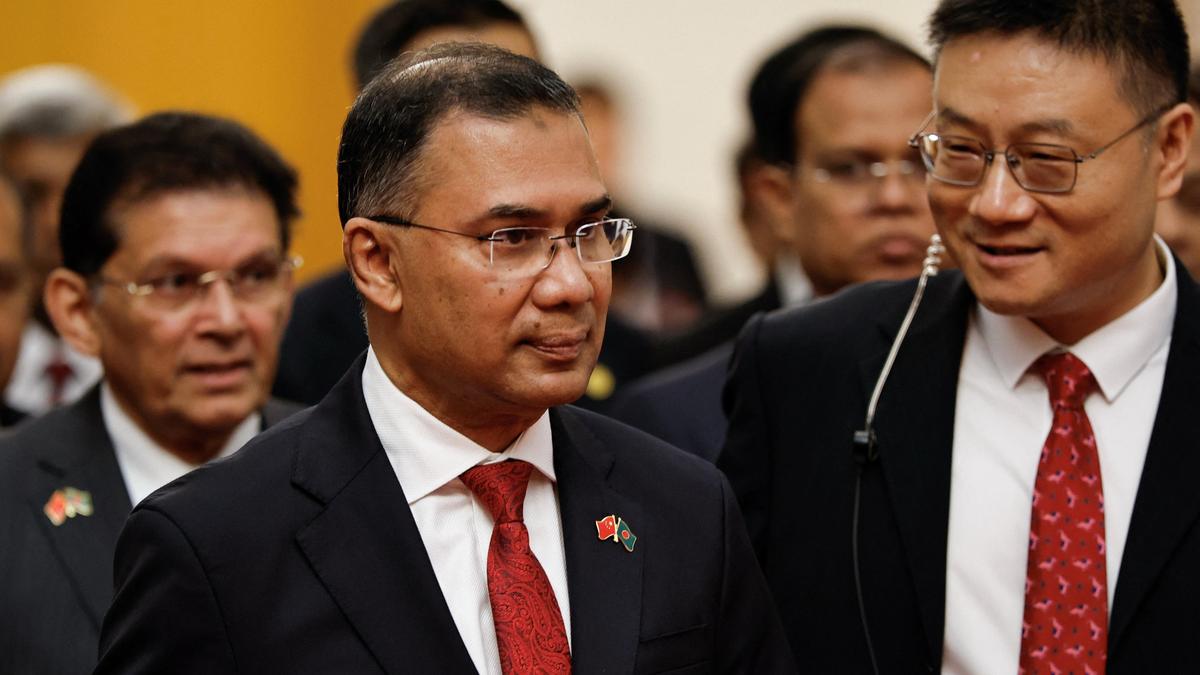
Bangladesh Prime Minister Tarique Rahman has received assurance from China on building the Teesta River Comprehensive Management and Restoration Project. The discussion in this regard took place when Mr. Rahman visited Beijing during June 24-26 and met top Chinese officials, including Premier Li Qiang, President Xi Jinping and Chinese water resources minister Li Guoying.
China has harvested its major rivers for power generation and irrigation, and is considered a major dam builder among the world powers. It is expected to expedite a feasibility study of the Teesta project that aims to change the physical nature of the Teesta inside Bangladesh and turn it into an artery of economic development.

What is the Chinese proposal on Teesta about?
Bangladesh has been in talks with China about managing and developing the Teesta river region for nearly a decade, and the discussion has spanned the government of Prime Minister Sheikh Hasina, which has been taken forward by the current government of the Bangladesh Nationalist Party.
In January this year, under the interim government led by Prof. Mohammed Yunus, Bangladesh Water Development Board (BWDB) and the Chinese state-owned power generation company POWERCHINA signed an extension to an MoU that revived the Bangladesh-China cooperation on the river. The original MoU in this project was signed in 2016 under the Sheikh Hasina government, which had suggested river bank erosion control, flood management, disaster reduction, land reclamation, transportation and environment preservation as some of the features of China’s plans for Teesta.

The MoU included dredging of 140 million cubic metres of riverine sediment, reclamation of 171 square km of land, repairing of 110 km of embankment, constructing 124 km of new embankments and developing 224 km of road network. The project would lead to building of 82 jetty facilities along the Teesta. As a lower riparian project, the Chinese plans cannot disrupt the Teesta upstream in India and it aims to create conditions for Bangladesh to better utilise the water that it gets from India at present.
What is the problem that Bangladesh faces on the Teesta?
Teesta’s water is essential for the farmers of northern Bangladesh, covering districts like Nilphamari, Rangpur, Dinajpur, Bogura, Joypurhat and Gaibandha. Bangladesh’s main complaint is that Teesta’s water reduces to a trickle in the winter months between December and February, when water is required for sowing of paddy and vegetables.
To deal with its water requirements, Bangladesh built the Teesta Barrage, the largest irrigation project of the country, in the 1990s. The Teesta Barrage Irrigation Project (TBIP) was built to help the northern region of Bangladesh, as it had a history of being hit by Teesta’s floods, followed by a long spell of dry season, both of which used to disturb the local agricultural cycle.
India has built barrages and electricity projects upstream in the Teesta that allow it to harvest Teesta’s waters for requirements in West Bengal, Sikkim and Assam. Most prominent among these is the barrage in Gajoldoba in West Bengal, which is a major irrigation project that is controlled by the West Bengal government.
Whenever India holds water for its needs in Gajoldoba or in power generation units in Sikkim, Bangladesh claims that the part of the Teesta on its side goes low on water. For example, last year in November, TBIP had to shut all its gates as the water flow on the Teesta had reduced. The TBIP is used to store water for nearly 55,000 hectares of land, but the reduction of water on the river causes concern for it as lack of water affects both irrigation as well as commercial activities on the river.
What is the importance of Teesta to India?
Teesta originates from the spectacular high altitude Cholamu or Tso Lhamu Lake (5100 metres) in the Himalayan range in Sikkim. As the river flows down, it gathers volume from multiple glaciers and streams, and India has built multiple power generation projects on the river in Sikkim. Apart from Gajoldoba/Gojaldoba in West Bengal, Teesta is used for multiple power projects (at least six major and several smaller) in Sikkim and West Bengal that generate electricity required in the region. The river is also a major tourism attraction and serves as home of migratory birds in West Bengal.
What has been India-Bangladesh negotiations over Teesta?
Bangladesh’s main demand from India has been getting what it considers to be a fair share of the Teesta’s water so that the irrigation project in North Bangladesh can run smoothly. The two sides had negotiated the issue of sharing of Teesta’s water for decades, and the matter was taken up again in 2010 when India prepared a set of principles for sharing of Teesta’s water, and the two sides agreed to an interim agreement.
However, the agreement was not sealed when Prime Minister Manmohan Singh visited Dhaka in 2011, mainly because of objections from Mamata Banerjee, who had spoken about the matter during her election rallies that year. Ms. Banerjee became Chief Minister that year after defeating the Left.

A Joint Statement issued on September 7, 2011, in Dhaka said, “The two Prime Ministers welcomed that there has been progress on the principles and modalities of interim agreements on sharing of waters of Teesta and Feni Rivers on a fair and equitable basis. They directed the concerned officials to work towards concluding the agreements at the earliest.” At the end, it was clear that Kolkata’s objection prevailed over Delhi’s plans.
Subsequently, Sheikh Hasina repeatedly raised the issue during her visits to Delhi and discussed this matter in June 2024 when a technical committee was planned to take the matter forward.
Before that visit, Foreign Secretary Vinay Kwatra had visited Dhaka and conveyed the Indian offer of financing the $1 billion project to dredge and manage the Teesta in Bangladesh. That was the last attempt by India to deal with the issue, as the two sides did not discuss the matter during the 15-month-long interim rule in Dhaka, which was followed by the BNP government led by PM Rahman.
What are India’s concerns on Bangladesh going to China for the Teesta project?
The area of Nilphamari and Rangpur is near Jalpaiguri of India, which is where the “chicken’s neck” is located. POWERCHINA, which has revived the MoU with Bangladesh, is a large organisation experienced in river projects, but it is also related to the strategic sectors of China.

Stationing a large number of Chinese professionals so close to a sensitive area of India will raise eyebrows in India. However, Bangladesh has several internationally supported projects, including the Ruppur nuclear power plant that has engineers and technicians from multiple countries, including Russia and Ukraine. China earlier built the landmark Padma Bridge during Sheikh Hasina’s tenure in 2022. The bridge was built by China Major Bridge Engineering Company.
Published – June 27, 2026 01:30 pm IST
Leave a Reply