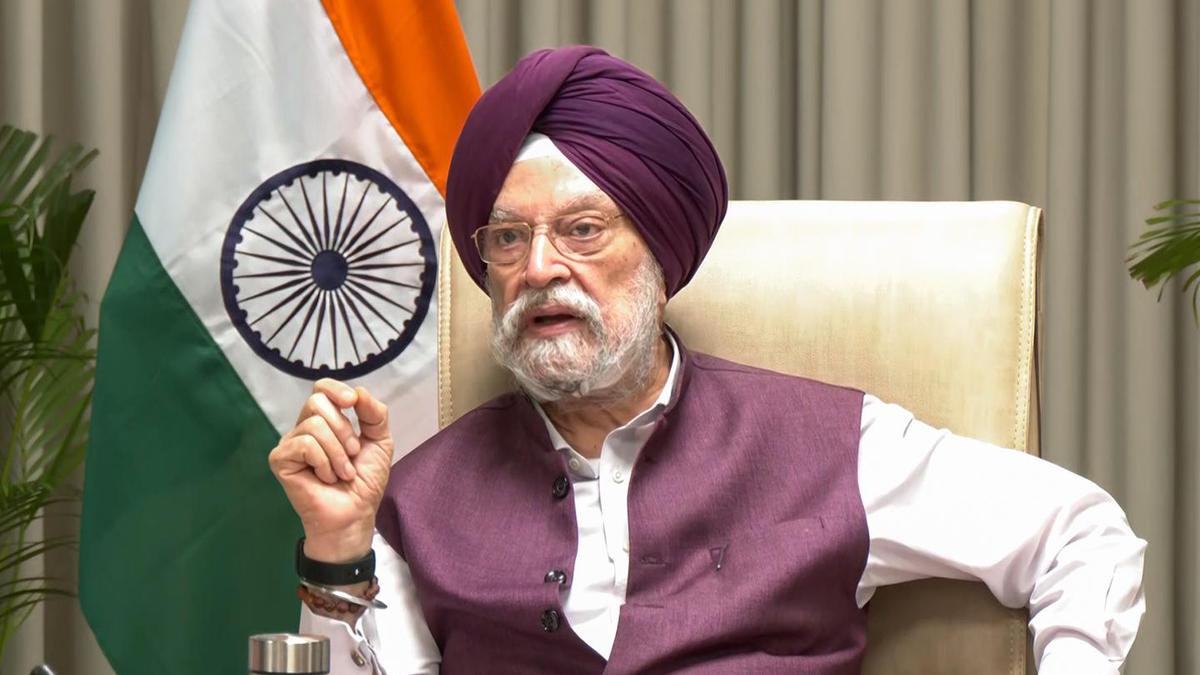

Union Minister Hardeep Singh Puri elaborated that the retail fuels presently being sold in pumps were derived from crude oil that was purchased months in advance.
| Photo Credit: ANI
Prices of petrol and diesel will come down only after the crude oil, which is currently cheaper, reaches Indian shores and refiners, Union Petroleum Minister Hardeep Singh Puri told reporters on Thursday (July 2, 2026). Thus, indicating that an immediate downward revision may not be possible immediately.
The Petroleum Minister also informed that India’s state-run oil-marketing companies incurred a loss of about ₹74,781 crore from the sale of LPG, petrol and diesel in the June-end quarter.

‘Petrol, diesel from crude purchased months ago’
Mr. Puri elaborated that the retail fuels presently being sold in pumps were derived from crude oil that was purchased months in advance when their prices alongside that of their freight and insurance were elevated because of the conflict in West Asia.
As a routine practice, refiners usually seal their crude oil purchases approximately two months in advance before receiving their physical deliveries.
“The petrol and diesel that you buy from the dispensing stations today is [derived from] that crude oil would have been obtained two months ago,” he said, adding, “So, it was bought at the price available then. The price of crude oil [back then] was not this [that is, the presently lower about $70/barrel] price, cost of insurance and freight was also the price back then.”
Mr. Puri further stated, “Today the crude oil that is sold at $70 per barrel or below will arrive much later.”
Benchmark brent crude futures in April this year had peaked to as much as $110 per barrel-mark at the peak of the West Asia crisis.
Thursday evening, brent crude was trading at a more than four-month low of $70.15 per barrel – declining further than the pre-conflict lows.

Financial strain on OMCs
Speaking to reporters, the Petroleum Minister also stated that under-recoveries, that is, the losses because of a difference between price at which the petrol, diesel and LPG was sold and the essential price required to meet cost of production, all combined stood at about ₹1.89 lakh crore in the June-end quarter.
This includes under-recovery of ₹19,905 crore on petrol, approximately ₹1.45 lakh crore on diesel and ₹24,148 crore on LPG.
‘Not worried about oil prices in future, but must prepare’
Reflecting on how prices may pan out in future, Mr. Puri emphasised, “I am not worried about it, but I have to prepare for it,” adding, “Stocking while [crude oil] prices are low, increasing storage space and intensifying outreach to bilateral partners – all that will go hand in hand.”
Separately, in response to a query from The Hindu about expanding storage capacities, Mr. Puri said India is presently holding crude stocks enough for 76 to 80 days. This is inclusive of crude stocks at ports, refineries, pipelines and strategic petroleum reserves.

He added, “However, after going through a suis generis experience of this kind, you do not want to take any chances, and we will increase.”

‘Russian gasoline exports from traders, not OMCs directly’
Further, in response to queries about India’s state-owned OMCs exporting gasoline to Russia, Mr. Puri said that the purchases might be routed through traders and not directly from the OMCs.
“Our output is also purchased by traders. It is entirely possible that the purchase of the concerned Indian-origin products was made from traders,” he added.
Published – July 02, 2026 11:32 pm IST
Leave a Reply