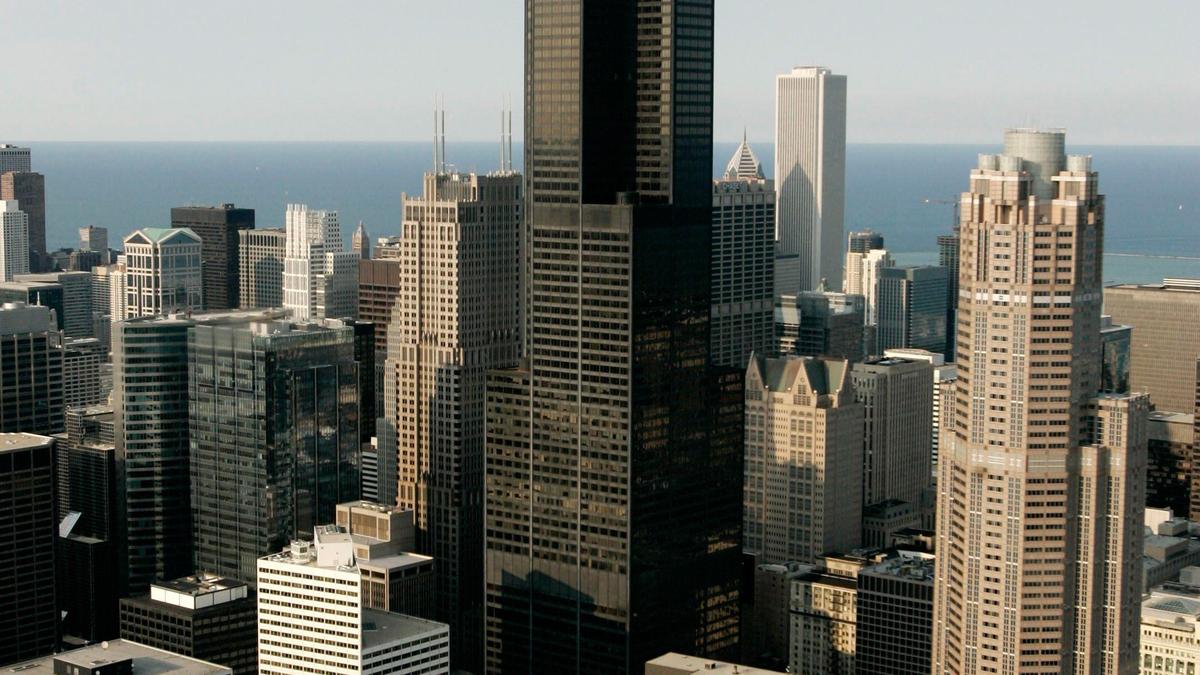
Which is the tallest building in the world? You will answer without hesitation that it is the Burj Khalifa in Dubai, U.A.E. What if I were to ask you which building held that spot before the Burj Khalifa? The fact-seekers and quiz-heads might be able to answer that one (Psst… It is Taipei 101 in Taipei, Taiwan). But what if I were to ask you the one before that? And before that? Even trivia-hunters might not be able to give that easily.
While it might not be easy to recollect each of these buildings, progression in records give a sense of how far things have come. In the case of tallest buildings, it can in fact go back thousands of years to the Great Pyramid in Egypt. Sears Tower is the answer to that fourth and final question (Petronas Towers in Kuala Lumpur, Malaysia, is the answer to the other question) and the building that we will be looking closer at.
25 years of fame
On May 3, 1973, construction workers involved in building Sears Tower bolted the last girder in place, making Sears Tower (now called Willis Tower) the tallest building in the world. A 110-storey skyscraper in downtown Chicago, U.S., the Sears Tower held that place of prominence for nearly a quarter of a century, until Malaysia’s Petronas Towers eventually went past it in 1998-1999.
The first building ever to go past the 1,450 feet mark (that is more than 440m and over a quarter of a mile), the Sears Tower stands out for its unique design (more on that in a bit) and sleek black steel exterior. When it was built, it was the highest permissible height allowed by the Federal Aviation Administration.
Sears, Roebuck and Company was the biggest retail company on the planet in the 1960s. With over 3,50,000 employees, and most of them in the Chicago area, Sears decided to build a central headquarters that also signalled the company’s ambitions and success. The result was the Sears Tower in 1973.
The merchandising department alone occupied nearly 50 floors of the building in its heyday. By 1988, however, merely 15 years after the completion of the building, Sears sold the tower and moved out its 8,000 employees (yes, you read that right!) as part of a restructuring effort.
The skyscraper’s name was changed to Willis Tower in 2009 when a London-based insurance company called Willis Group Holdings struck a deal to lease office space in the tower. The name might have been officially changed, but most people, especially those who’ve lived and worked in its vicinity, continue to call it Sears Tower.
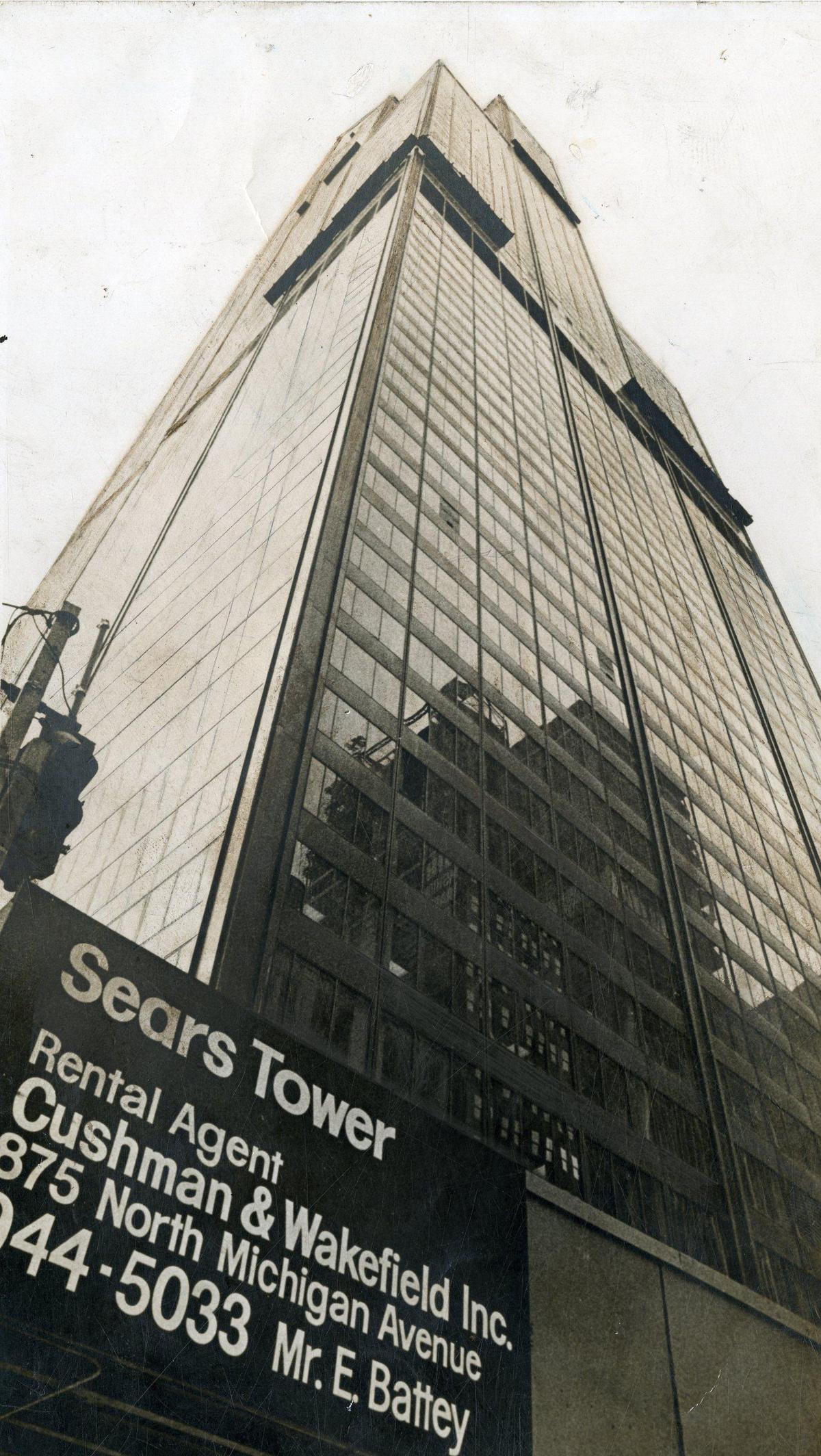
An archival image showing what was then the world’s tallest building – the 110-storey, 1,454-foot Sears Tower in Chicago, Illinois.
| Photo Credit:
The Hindu Archives
An engineering marvel
The engineering-architectural firm SOM (initialism of its original name Skidmore, Owings & Merrill) was behind the construction of the Sears Tower. Colombian-born Peruvian-Canadian-American Bruce Graham was the architect and Bangladeshi-American Fazlur Khan was its structural engineer.
The tower was the result of what was then a revolutionary bundled-tube structural design. When it comes to tube buildings, their structural support comes from a strong network of beams and columns in the outer walls. This means that the rigid outer walls actually act like the walls of a hollow tube.
In the case of Sears Tower, it is in reality a bundle of nine tubes. Considering that this skyscraper is located in Chicago — with its nickname “Windy City” — the bundled-tube structure is among the most efficient designs to withstand wind.
In Chicago, average wind speeds can reach 25 kilometres per hour. Keeping the wind forces in mind, the design is such that the tubes begin to drop off as the building climbs upward, thereby reducing wind forces on it. The top of the tower is designed to sway a maximum of three feet (36 inches) and it actually sways an average of six inches.
Weighing nearly 20 crore kg, the Sears Tower is supported by 114 piles. These piles are sunk deep into the foundation so that the building firmly stands on hard, solid bedrock.
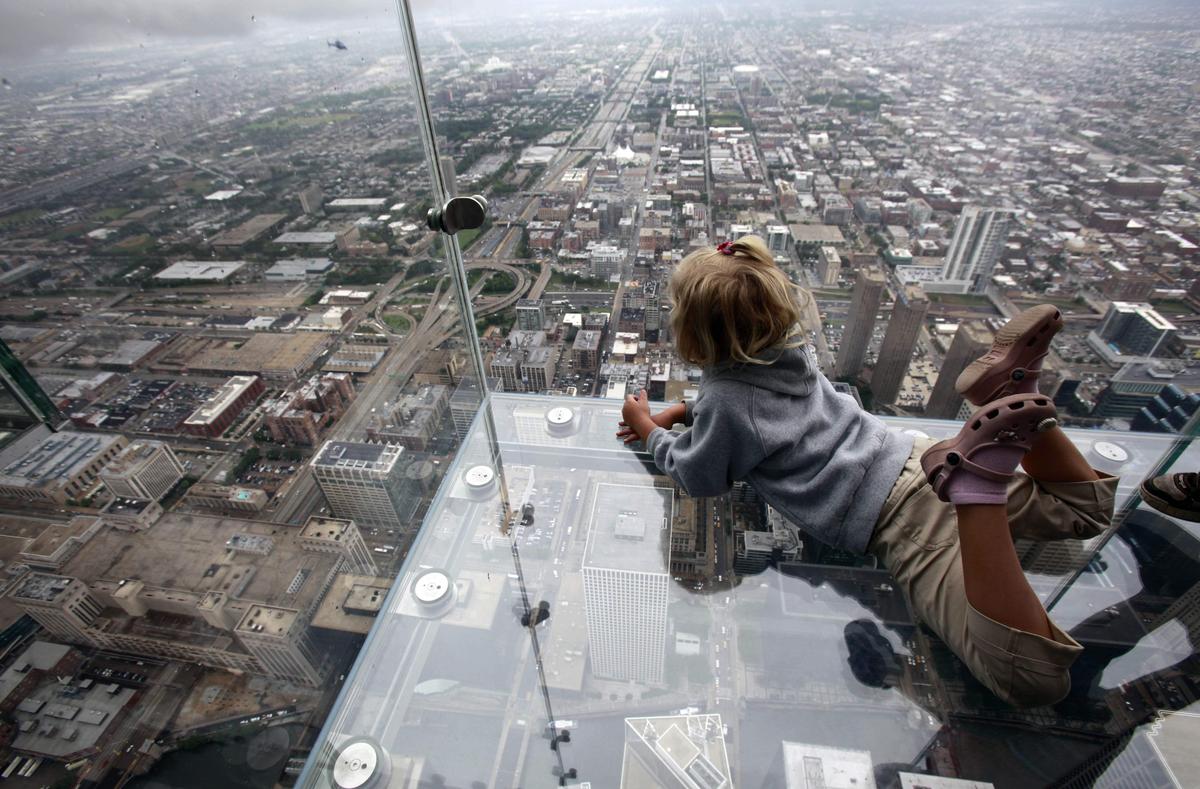
Looking down from “The Ledge” — the glass balconies suspended 1,353 feet in the air and jutting out 4 feet from the Sears Tower’s 103rd floor skydeck — might offer great views. But it wouldn’t let you measure its height!
| Photo Credit:
AP
Here’s another story about tall buildings. A version of this question appeared in an examination: How will you determine the height of a building with the aid of a barometer?
Expected answer: Use the barometer to measure the air pressure at the top and bottom of the building and use the pressure difference to gauge the height of the building.
One student’s answer: Tie the barometer to a string, lower it from top to bottom, and find the height of the building by measuring the length of the string.
While the student claimed full marks, the examiner wasn’t going to have any of it. The matter was raised with the university, and an independent arbiter was appointed.
The arbiter suggested that the student be given six minutes to provide an answer that establishes his competence in physics. Five minutes in, and the student still had not written anything. When asked if he would rather give up, the student stated that he had many answers, and was just thinking which one would work best.
Not one, but more
In the final minute, the student provides a gravity-centric solution: drop the barometer from the top, measure the time it takes to crash (and become useless) and use it to find the height.
As this clearly showcased ability in physics, the arbiter was convinced and the examiner had no choice but to award full marks as well. Before he left, the arbiter remembered that the student mentioned having many more answers, and asks him about the same.
Excited, the students reels them out, one after another. This includes using the barometer’s shadows on a sunny day and then employing simple proportion; tying it to a string and using it as a pendulum to determine the value of gravity at the top and the bottom; and even climbing up the stairs, marking off the height of the building in barometer lengths and adding them!
The student then goes on to say that the best possible way, even if not scientific, would be to knock on the door of the building’s caretaker and trade the barometer with them, in exchange for the height of the building.
Physics fable
When the arbiter asks if the student really doesn’t know the conventional answer, the student gives that too, before adding that he was fed up with instructors who tried to teach him how to think.
While there’s no direct evidence to show that this actually panned out and it probably is an urban legend, the student in this story is often identified as Nobel Prize winning Danish physicist Niels Bohr. Some versions of the story even go on to say that the arbiter in question was New Zealand physicist and chemist Ernest Rutherford.
Even though almost all of this could be the result of someone’s imagination, there’s no denying that independence of mind should also be encouraged, even in formal, educational settings.
Leave a Reply