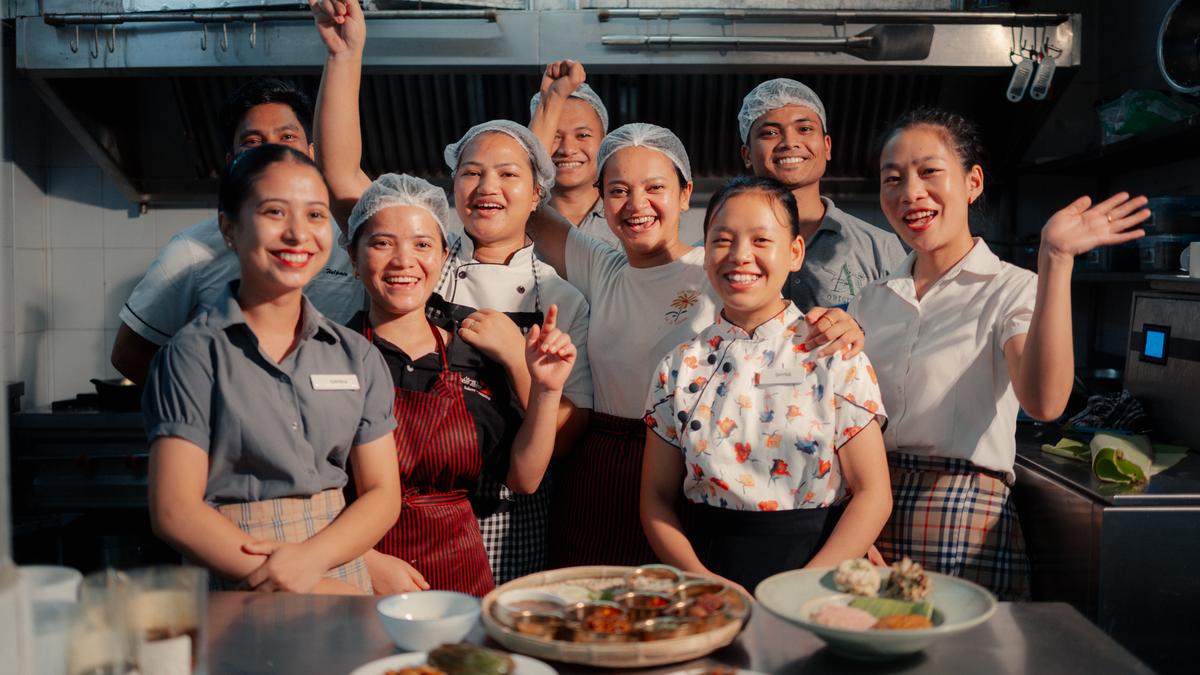
When Ahmedaki Laloo was training to be a chef at Manipal University, she missed the taste of her home state, Meghalaya. “I would tell my mom to send some pickles, fermented bamboo shoots, fish chutney, and condiments,” recalls the Shillong-born chef, who was recently in Chennai, as a part of Zhouyu Hosts, a culinary pop-up series that brings chefs from across India and Asia to the city.
But, like other people from the Northeast, she often worried about what her peers would think of this food: “of people mocking us and saying that my food is stinky,” says Ahmedaki.

A meal at Rynsan in Shillong
| Photo Credit:
Special Arrangement
And yet, something changed when she saw how proud her classmates and friends from other parts of the country were about their food. “They would flaunt it. And then, I realised that if I could have ghee and curry leaves, why couldn’t you eat our food?,” says Ahmedaki.

The realisation had a profound impact on her. After she graduated and worked in several restaurants across the country and returned home in the winter of 2020 to establish A’Origins, a culinary enterprise that seeks to bring this region’s cuisine to the rest of the world. “I wanted to express myself and tell stories through food,” she says.

Food served at Zhouyu Hosts, a culinary pop-up series that brings chefs from across India and Asia to the city.
| Photo Credit:
Special Arrangement
Like Ahmedaki, more and more chefs with roots in Meghalaya are opting to return to their culinary heritage, opening restaurants in their own state that explore indigenous cuisines in fresh and exciting ways, “bringing local cuisine to new light, doing something like what (Peruvian chef and restaurateur, founder of Lima) Virgilio Martínez has done with Peruvian food or (Italian chef and restaurateur, founder of Osteria Francescana) Massimo Bottura with Italian…taking a classic and elevating it to the next level,” says Shillong-based chef Reuben Sooting, the founder of Lady Aiko, India’s first integrated hotpot and Korean barbecue experience.

Ahmedaki Laloo
| Photo Credit:
Special Arrangement
In his opinion, this is a relatively recent phenomenon. “Even 10-12 years ago, the food scene in Shillong was so different. You didn’t have as many restaurants and cafes; on top of that, you never had anyone doing anything with local influences,” says Reuben, who believes that the government policy played an important role in facilitating the change. “The government is now very heavily focused on tourism, which includes our food,” he says. Ahmedaki agrees. “I am truly grateful that the government has been focusing on this. We have been able to express ourselves better because the number of footfalls is increasing every year,” she says.

More and more chefs from Meghalaya are exploring their indigenous cuisines in fresh and exciting ways,
| Photo Credit:
Special Arrangement

For musician and entrepreneur Hammarsing Kharhmar, who co-founded Rynsan in Shillong with his wife, Riyaki Jana, the fact that tourists aren’t just coming to Shillong to “look at our beautiful hills and waterfalls or breathe this clean air” is a positive trend. “They’re saying that I want to eat our food, something that has changed in the last five or ten years,” says Hammarsing, who believes that people are finally beginning to recognise that Shillong isn’t the home of momo chow but instead has a rich, produce-forward food culture. “People are very interested in local cuisine, and this is filtering down, because I’ve seen a lot of new places opening up,” he points out.

Tourism is going beyond Meghalaya’s beautiful hills and waterfalls, believes Hammarsing Kharhmar
| Photo Credit:
Special Arrangement
The emergence of restaurants like Rynsan, which are “telling their own stories, finding ways of articulating this identity that is at once local but also contemporary,” is indicative of a larger shift, according to former journalist and food writer Damini Ralleigh, the co-founder of Delhi’s Indicā, which, among other things, curates gastronomic experiences that highlight diverse food cultures. “For a very long time, cuisines have been looked at zonally, as if states are watertight compartments, with no fluidity across borders. But cultural borders are extremely porous, and those nuances get lost when you talk about cuisines in broad strokes,” she says.

Meghalaya has a rich, produce-forward food culture
| Photo Credit:
Special Arrangement
The Northeast, she feels, is an interesting focal point of this trend, given that mainland India has long viewed it as a single culinary category. “It flattens an entire region’s cultural and ecological history into a monolithic identity, whereas the Northeast, as we all know, comprises many tribes, languages, ecological and agricultural systems and food traditions,” says Damini.

Smoking and pickling are deeply rooted culinary traditions in this region
| Photo Credit:
Special Arrangement
But this perception is changing, she feels, with people more interested in regional culinary nuances, not just in India but globally. For the Northeastern states, including Meghalaya, this shift is especially significant, since it “allows these communities to reclaim their own narrative. They are no longer represented by an outsider’s lens.

It allows them to articulate their own identity and history,” Damini says, a view reiterated by Ahmedaki. “We have always been under the shadow, and it is our responsibility to do justice to what our ancestors have been passing down.”
The writer was in Shillong on the invitation of the Seeti Movement, which had its second edition in Shillong, Meghalaya
Published – July 16, 2026 06:15 am IST
Leave a Reply