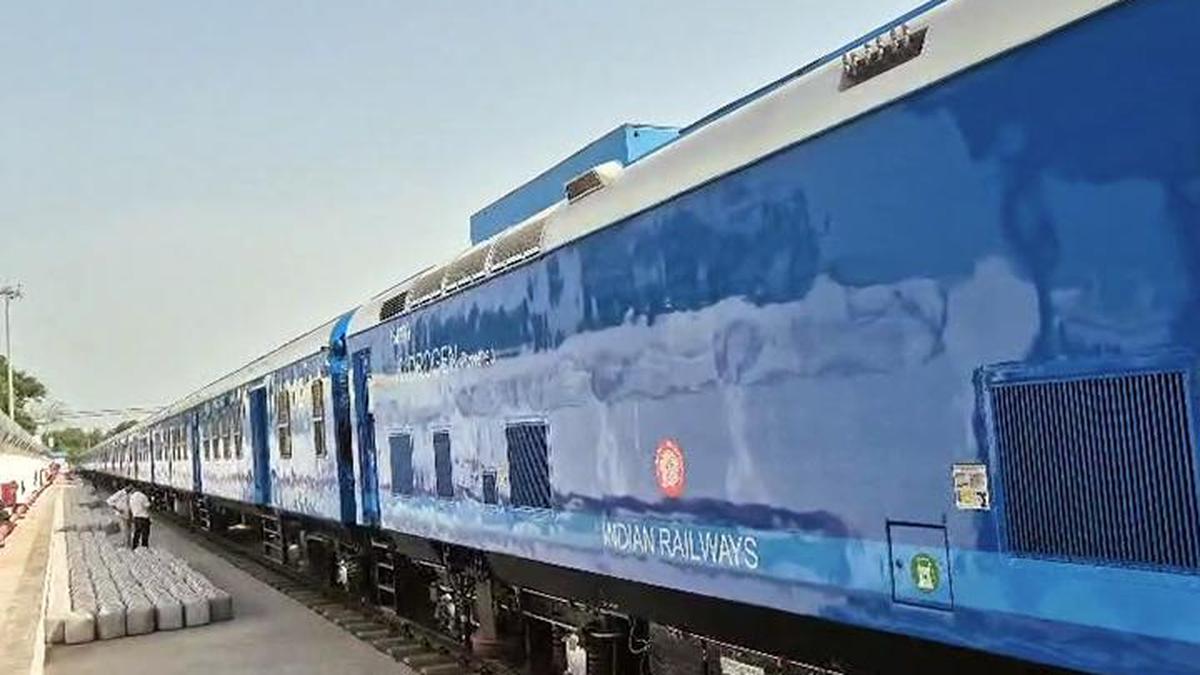
The story so far: Prime Minister Narendra Modi will flag off India’s first Hydrogen powered train running between an 89-km stretch of Jind and Sonipat in Haryana on July 17. “This milestone marks the latest chapter in the evolution of how Indian Railways from coal and steam to cleaner, more sustainable sources of energy,” Union Minister of Railways Ashwini Vaishnaw stated in a media interaction earlier this week.
What is a Hydrogen-powered train?
India’s First Hydrogen Fuel Cell Train is a ten-coach train set with capacity to carry around 2,600 passengers. The train generates its own electricity onboard using hydrogen, the cleanest fuel known.

Unlike conventional electric trains that draw power from overhead lines, the Hydrogen Fuel Cell Trainset generates electricity onboard through a chemical reaction between hydrogen and oxygen, with water vapour as its only by-product. The train is run on operational speed of 75 kmph on the Jind–Sonipat section and a design speed of 110 kmph.
Unlike conventional diesel locomotives that burn fuel to generate mechanical power, a hydrogen train carries a small power plant onboard in the form of a Proton Exchange Membrane (PEM) fuel cell.
Hydrogen stored in the train’s cylinders combines with oxygen from the surrounding air inside the fuel cell, producing electricity that powers the traction motors and turns the wheels. The only direct by-products of this electrochemical reaction are water vapour and heat. There is no combustion, no smoke and no tailpipe carbon emissions.

An interior view of India’s first hydrogen-powered train, the NaMo Green Rail, showing hydrogen storage tanks and fuel cell systems ahead of operations on the Jind-Sonipat route, in Haryana on Wednesday (July 1, 2026).
| Photo Credit:
ANI
The train consists of two Hydrogen Driving Power Cars (DPCs) and eight Trailer Coaches (TCs). Each DPC houses fuel cells, lithium iron phosphate (LFP) batteries and hydrogen storage cylinders that work together to provide traction power, while ensuring reliable operation under varying operating conditions.
The two power cars, one at each end, produce 1,200 kW (1600 hp) of power per DPC, together enough to push the entire train up to 110 km per hour.

Where does the Hydrogen to fuel the train set come from?
The dedicated hydrogen storage, compression and dispensing facility established at Jind will support refuelling operations, Indian Railways has stated. Just like a petrol pump or a CNG station, the train needs a place to refuel.
Firstly, hydrogen is produced on site through electrolysis, in which water is split into hydrogen and oxygen using electricity at the green hydrogen plant, and is then stored safely in dedicated storage tanks.
In the second step, the hydrogen is compressed to 500 bar, enabling a larger quantity to be stored in a smaller volume. Finally, it is dispensed through two independent hydrogen dispensers at a regulated pressure of 350 bar, allowing both Hydrogen Driving Power Cars to be refuelled simultaneously and reducing turnaround time. The facility stores nearly 3,000 kg of hydrogen at a time, sufficient to support regular operations of the train set, and its storage and supply system has been approved by the Petroleum and Explosives Safety Organisation (PESO).
Research Designs and Standards Organisation (RDSO) has formulated the technical specifications and leading the design approval process and the trainset has been integrated by M/s Medha Servo Drives, while Integral Coach Factory (ICF) contributed to the train’s theme and exterior design.

Is it safe to travel on a train running on gas that is inflammable?
Hydrogen is colourless, odourless, tasteless and non-toxic. However, it is highly inflammable and needs to be handled with real care. Because hydrogen cannot be seen or smelled, the entire safety design of this project is built around detecting even the smallest leak instantly.
The train and the plant are fitted with devices that continuously watch for hydrogen leaks, unusual heat, flames, or smoke. Non-stop ventilation keeps air moving through the train at all times, so that even if a tiny amount of hydrogen were to leak, it gets safely carried away and diluted in the open air instead of collecting anywhere.

An interior view of India’s first hydrogen-powered train, the NaMo Green Rail, showing hydrogen storage tanks and fuel cell systems ahead of operations on the Jind-Sonipat route, in Haryana on Wednesday (July 15, 2026).
| Photo Credit:
ANI
There is also an automatic shut off system. If any unusual activity is detected, the system can automatically cut off the hydrogen supply on its own, without waiting for a person to react. The Loco Pilot’s cabin has been specifically designed to keep the Loco Pilot safe, with a special mode that allows the train to be moved to safety in an emergency, and a screen that shows the Loco Pilot the real health of the whole system at all times.
The Jind hydrogen plant itself has similar protections, including leak detectors, flame detectors, automatic shutdown systems, water sprays to control any fire, and fire alarms.

Before commissioning, the entire system underwent an independent third-party safety assessment by TÜV SÜD, Germany, one of the world’s leading technical inspection and certification agencies, an Indian railways spokesperson said.
What is the status of Hydrogen-powered trains globally?
Hydrogen-powered trains are still at a nascent stage globally. Germany became the first country to introduce commercial hydrogen passenger trains, while France, Italy, China, Japan and a few other countries are pursuing pilot projects or limited deployments. However, these trains typically comprise two to four coaches and are intended primarily for regional passenger services.

What is the future of Hydrogen trains in India?
Indian Railways is exploring the deployment of hydrogen technology on heritage railways, including the Kalka–Shimla route, by leveraging the experience gained through the Jind–Sonipat Hydrogen Train project. Indian Railways intends to transition from a pioneering pilot project to a structured national programme for hydrogen-powered rolling stock, which will contribute to the National Green Hydrogen Mission and the country’s long-term Net Zero goal, an Indian Railways spokesperson said.
Published – July 17, 2026 09:10 am IST
Leave a Reply