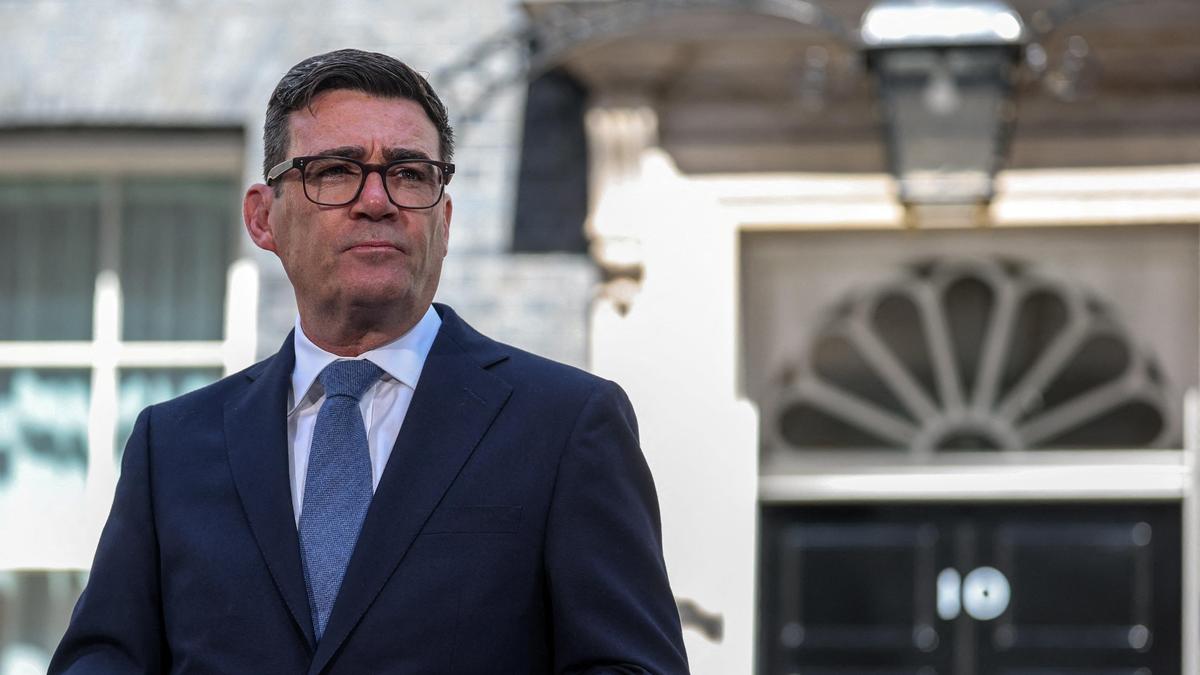
Former Manchester Mayor, Andrew Burnham, was appointed Prime Minister of the U.K. on Monday (July 20, 2026), its seventh in a decade. Mr. Burnham described the moment as a “circuit breaker”, as he promised to usher in a new political and social model for the country, taking power out of London and spreading it across the regions of the U.K.
The outgoing Prime Minister Keir Starmer, who had made history two years ago, when he led the Labour Party in one of the largest victories in modern times, made history again on Monday (July 20, 2026), but this time for becoming the U.K.’s shortest serving Labour Prime Minister in modern history.

Britain’s outgoing Prime Minister Keir Starmer and wife Victoria wave as they leave 10 Downing Street in London on July 20, 2026.
| Photo Credit:
AP
“I go with good grace, I go with a smile, and I go proud of everything that we have achieved,” Mr. Starmer said in brief remarks outside on Downing Street, as he wished his successor “every success”.
Editorial | Downing streak: On the Starmer resignation, British politics
“We will make this moment a circuit breaker for Britain, bringing forward the biggest changes in the last 40 years: a new political model and a new economic model,” Mr. Burnham said outside No.10 Downing Street, minutes after he was ceremonially invited to form a government by Britain’s Monarch King Charles III. Mr Burnham’s wife, the Dutch-born Marie-France van Heel, was also present as were large numbers of the Prime Minister’s supporters, including his mother and Josh Simons, the MP who vacated his Makerfield seat, so Mr Burnham could win it and return to Westminster.
“I am acutely conscious that I am … the seventh Prime Minister since 2016, making this a moment for reflection and new resolution,” Mr. Burnham said, adding that Britain needed to show the world it could regain its stability. He went on to add that Britain had taken wrong turns since the 1980s, with the privatization of economic power and the centralization of political power.
Andy Burnham: U.K.’s latest PM | Infographics
He reiterated his messages from recent months including greater public control of utilities, supporting education young people into work to bring down the welfare bill and spreading power more evenly across the U.K.
“…We will take power out of here and carry it into every postcode in the land,” he said. Mr Burnham had said in recent weeks that he would create a ‘No. 10 North’ — a hub office in Manchester to manage the redistribution of power.
The U.K. would have a new ten year plan, later this year, Mr Burnham said, adding that he would issue more immediate orders starting Tuesday, to help with the cost of living along with details on how he would fund this. His first action in office on Monday would be to “end rough sleeping [homelessness]” in the U.K.
Keir Starmer resigns
The outgoing Prime Minister’s supporters and members of his administration — including Chancellor of the Exchequer Rachel Reeves, Deputy Prime Minister David Lammy and London’s Mayor Sadiq Khan — had gathered outside the black door marked ‘No.10’ to bid farewell to Mr. Starmer and his wife Victoria, who then proceeded to Buckingham Palace to meet with the King.

Mr. Starmer, a centrist, struggled to hold Labour together since 2024, with internecine battles growing over policy differences ranging from welfare spending to Labour not taking a strong enough stance against Israel for its killing of civilians in Gaza.
Mr. Starmer’s credibility within the party took a further hit around his appointment of a controversial U.S. envoy and the resignation of several of his key staffers. His relationship with union leaders began to sour when he was still Leader of the Opposition, after he sacked an MP who had made an unauthorised media appearance alongside rail workers on a picket line. These ties frayed further despite his government passing the Employment Rights Acts 2025 to strengthen certain rights for workers. For instance, Labour lost support among energy workers over net-zero policies.

Reports of his managerial style within the party and the Cabinet also cost Mr. Starmer support from his colleagues. The final blows to Mr Starmer’s position came after Labour lost a crucial byelection to the Greens in the north west of England this year, followed by a major defeat to Reform in English council elections and losses to other parties in the Welsh and Scottish Assembly elections in May.
Mr. Starmer was given an emotional farewell during the weekly parliamentary Prime Minister’s Questions (PMQs) last week, with colleagues and Opposition leaders praising him. In speeches, social media posts and interviews, Mr. Starmer and some of his colleagues — including Mr. Burnham — have sought in recent days to clearly articulate the outgoing Prime Minister’s achievements as a means to give Mr. Starmer’s exit dignity and order.
The message has included Mr. Starmer being responsible for Labour’s return from the political wilderness in 2024, actions to tackle child poverty in the U.K. such as the two-child benefit cap, strengthening workers’ and tenants’ rights, cutting wait times for medical appointments in the public healthcare system, and his support for Ukraine.
Watch | U.K. PM Keir Starmer resigns: What went wrong?
In his farewell address, Mr. Starmer said Britain’s reputation on the world stage had “been greatly enhanced”.
“We face a world now where our enemies will stop at nothing to divide us, because of our values, our freedom, our decency, and frankly, because of our unflinching resolve towards the brave people of Ukraine,” Mr. Starmer said, without naming Russia.
The outgoing Prime Minister had visited both Kyiv and Paris during his last week in office, receiving one of France’s highest national awards, the Légion d’Honneur, from French President Emmanuel Macron for his work in working with France to enhance European security. Mr. Starmer had launched a “reset” of the U.K.’s relations with the European Union following the country’s exit from the bloc under the Conservatives in 2016. Last week, a trade deal with India – talks for which began under the Conservatives – came into force.
As he returned to the backbenches, Mr. Starmer had fought to stay on in post — including by opposing Mr. Burnham’s attempts to contest a byelection in February. However, when a colleague vacated the Makerfield parliamentary seat so Mr. Burnham could contest it, Labour’s leadership team, including Mr. Starmer were compelled to permit it. Mr. Burnham won that election on June 18 and returned to Westminster.
At PMQs last week, Mr Starmer said he “wholeheartedly” supported his successor. Asked what advice he would give the incoming Prime Minister, Mr. Starmer had said that he would provide counsel “privately, when asked, not publicly, when not asked”.
Published – July 20, 2026 04:38 pm IST
Leave a Reply