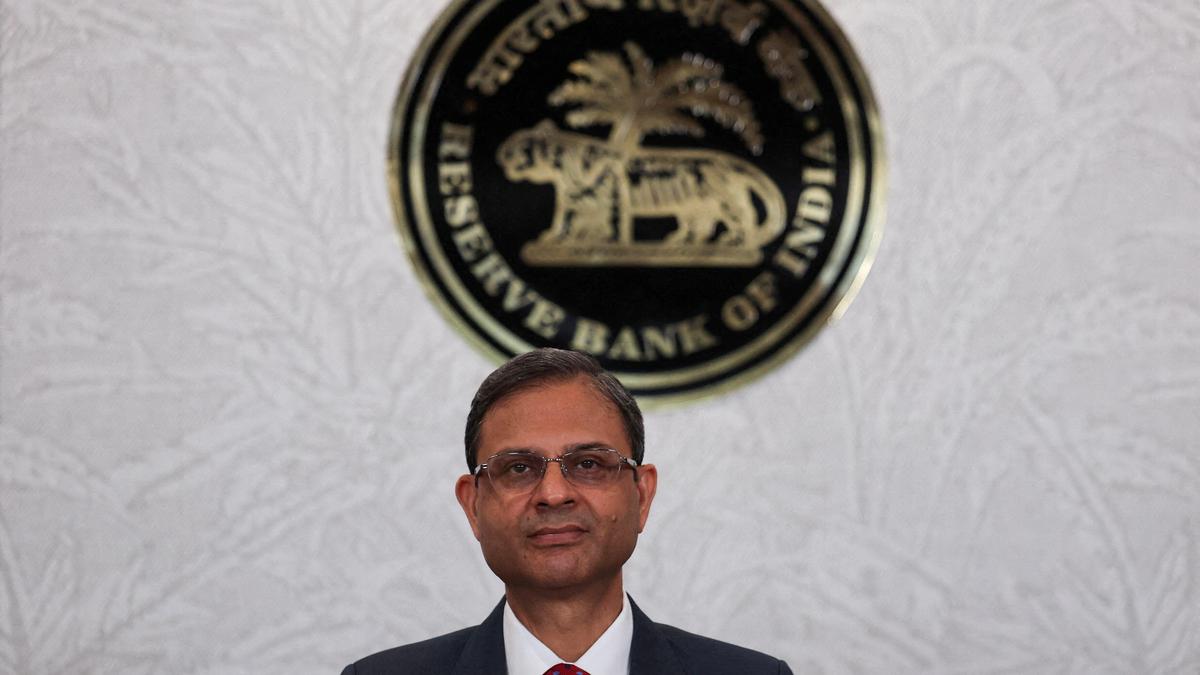
The story so far: The Reserve Bank of India (RBI) Governor Sanjay Malhotra, in a recent interview with Business Line, reiterated that the Indian rupee is “undervalued”. This has drawn attention because central bankers rarely comment on whether a currency is priced fairly. Answering a question from one of the four journalists who on Sunday (July 26, 2026) interviewed him, Mr Malhotra reportedly said, “I would like to reiterate that it would be reasonable to think that the rupee is not overvalued. If anything, one could argue that the rupee has become undervalued both in nominal and in REER (real effective exchange rate) terms.”
Also read | Examining the RBI’s remittances survey
He added that the RBI does not target any specific exchange rate or band for the rupee.
Answering a direct question from Bloomberg journalist Anup Roy during the June 5, 2026, post-Monetary Policy press conference, Mr. Malhotra, though initially disagreeing that he had made any such statement during an interview with The Mint, said, “It is reasonable to think that it [Rupee] may not be overvalued.”
“Some people do say that it is undervalued in terms of REER if they look at. By some accounts, it is undervalued,” he had stated.

The remark came at a time when the rupee had weakened against the U.S. dollar amid global uncertainties, including elevated crude oil prices, geopolitical tensions and capital outflows from emerging markets.
The governor’s assessment is believed to suggest that the recent depreciation does not accurately reflect the underlying strength of the Indian economy. It also offers an insight into how the RBI assesses exchange rate movements beyond the day-to-day fluctuations in the currency market.
What did the RBI Governor say?
Mr. Malhotra said that the rupee is “undervalued” in both nominal terms and based on the Real Effective Exchange Rate (REER). At the same time, he reiterated that the RBI does not target a particular level for the exchange rate.

The RBI’s interventions in the foreign exchange market are aimed at containing excessive volatility and ensuring orderly market conditions rather than defending a fixed value for the rupee, he had stated.
The financial markets have interpreted the remarks as an indication that the central bank believes the rupee has weakened beyond what economic fundamentals would justify.
What does it mean for a currency to be undervalued?
A currency is described as undervalued when its market exchange rate is lower than what is considered consistent with a country’s economic fundamentals.
Exchange rates are influenced by a range of factors, including economic growth, inflation, productivity, trade performance, capital flows and investor sentiment.

Temporary global shocks can also affect currency movements. If such factors cause a currency to weaken beyond its estimated equilibrium value, economists may regard it as undervalued.
In practical terms, the RBI’s assessment is believed to imply that the rupee’s current exchange rate does not fully reflect the resilience of India’s macroeconomic fundamentals.
Why the RBI believes that the rupee is undervalued?
The central bank’s assessment is believed to be based on the divergence between domestic economic conditions and external developments.
India continues to remain one of the fastest-growing major economies with over 6% growth year after year. Inflation has moderated from recent highs, foreign exchange reserves remain substantial to meet 11 months of imports, and the country’s external position has remained relatively stable despite global headwinds.
Editorial | Currency caution: On the Indian rupee’s depreciation
However, the rupee has faced intense pressure because of factors such as higher crude oil prices, geopolitical uncertainties, a stronger U.S. dollar and intermittent outflows of foreign portfolio investment from emerging markets. Foreign Portfolio Investors have drained out billions from the Indian stock market.
These developments have increased demand for dollars while reducing capital inflows into the country. These short-term external pressures appear to have weakened the rupee beyond what India’s underlying economic conditions would warrant. To be precise, the rupee has depreciated 5.8% YTD.
What is Real Effective Exchange Rate (REER) and why is it important?
The governor referred not only to the nominal exchange rate but also to the Real Effective Exchange Rate, or REER.
The nominal exchange rate measures the value of the rupee against another currency, such as the U.S. dollar, Euro, British Pound and others.
Also Read : What is REER?
The REER, however, compares the rupee with the currencies of India’s major trading partners after adjusting for inflation differences. It therefore provides a broader measure of the currency’s competitiveness and purchasing power.
Economists often rely on the REER to assess whether a currency is overvalued or undervalued because it captures changes in relative prices as well as movements against multiple currencies rather than only the U.S. dollar.
The RBI’s reference to the REER indicates that its assessment is based on a broader evaluation of the rupee’s external value.
Does the RBI favour a stronger rupee?
The RBI has consistently maintained that it does not seek either a permanently strong or a permanently weak currency. Its exchange rate policy is market-determined, with intervention limited to curbing excessive volatility.
A stronger rupee lowers the cost of imports thereby helping moderate inflationary pressures. But a weaker rupee tends to improve the competitiveness of exports by increasing exporters’ earnings in domestic currency.

Given these effects, the central bank prefers to avoid abrupt or disorderly movements in either direction rather than pursue a specific exchange rate objective.
What are the broader implications of the Governor’s observation?
It should be viewed primarily as an assessment of India’s economic fundamentals rather than as a signal of an imminent policy shift.
By describing the rupee as undervalued, the RBI is believed to be implying that recent depreciation has been driven largely by external developments rather than by any deterioration in domestic macroeconomic conditions.

The remark may also help anchor market expectations by indicating that the central bank is attentive to exchange rate movements that are inconsistent with underlying fundamentals, according to analysts.
The future trajectory of the rupee will continue to depend on several factors, including international crude oil prices, U.S. monetary policy, global capital flows and geopolitical developments, they stated.
However, the RBI’s assessment underscores its view that the Indian economy remains resilient and that recent weakness in the currency should be seen in the context of global rather than domestic factors.

Conclusion
The recent remarks highlight an important distinction between market movements of the Indian currency and economic fundamentals of the country. While exchange rates are influenced by global financial conditions and investor sentiment in the short term, they are also expected to reflect the strength of an economy over the medium term.
The RBI’s assessment that the rupee is not overvalued but undervalued suggests that the recent depreciation is believed to have exceeded what India’s macroeconomic fundamentals would ordinarily justify.
Published – July 29, 2026 09:18 am IST
Leave a Reply