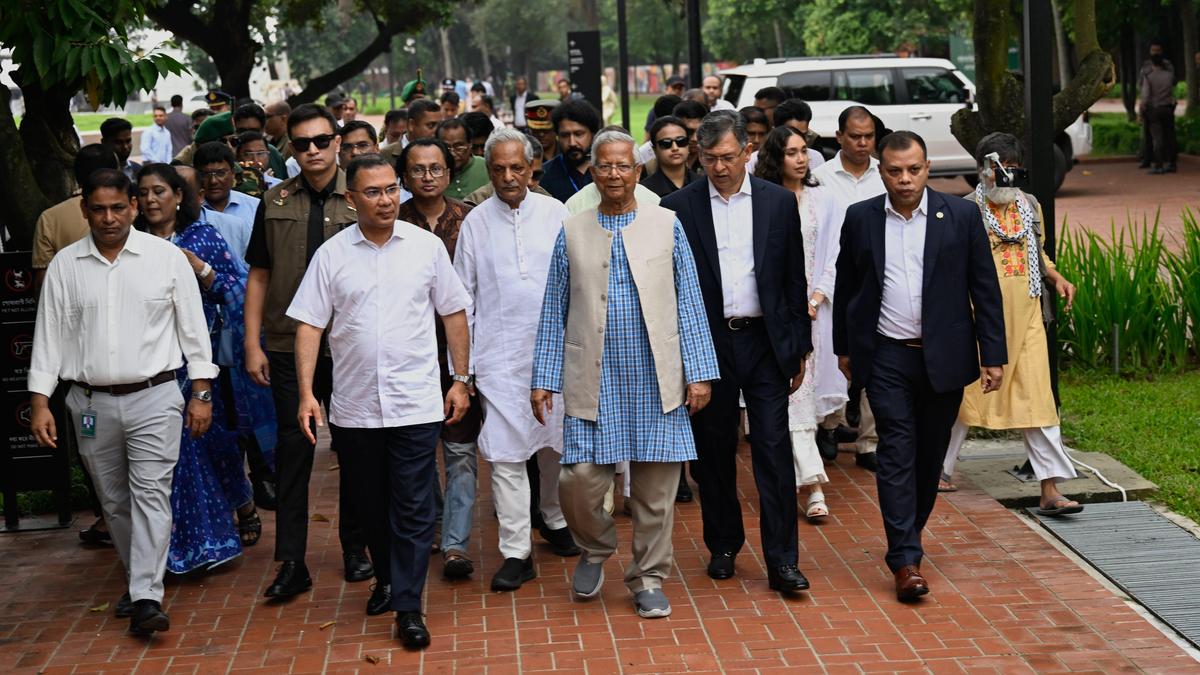
Amid tightened nationwide security, Bangladesh on Wednesday (August 5, 2026) inaugurated a memorial museum at the official residence of ousted Prime Minister Sheikh Hasina for the victims of violence during the anti-government protests in 2024 that toppled her government.
Prime Minister Tarique Rahman inaugurated the ‘July Mass Uprising Memorial Museum’ at Ganabhaban, prime minister’s official residence during Hasina’s regime, coinciding with the day she fled to India on August 5, 2024.
“The killers in the anti-fascist movement will be tried in a transparent, impartial and credible manner following the due process of law,” Mr. Rahman said in a brief address while unveiling the museum’s plaque.
“Justice for every crime is essential to ensure rule of law” Mr. Rahman said as the Interim government chief Muhammad Yunus stood beside him.
The Prime Minister announced that government institutions would be named after slain activists of the uprising and those who were killed during the rule of Hasina’s Awami League since 2009.
The 2024 mass uprising did not belong to any individual, group or political party, he said, adding, the true heroes of the uprising are the democratic people of Bangladesh.
Mr. Rahman toured the museum’s galleries and exhibitions featuring preserved artefacts, photographs, official documents, video footage and memorabilia related to the July Mass Uprising.
Speaking at the museum event, Mr. Yunus said the July Memorial Museum is not just an establishment but the beginning of a new chapter in Bangladesh’s history.
The July Memorial Museum will become the centre of “our history,” Mr. Yunus was quoted as saying by the state-run news agency Bangladesh Sangbad Sangstha (BSS).
“The path of a new Bangladesh will begin from here. If we lose our way, we will start from here,” Mr. Yunus said.
According to a February 2025 UN rights office report, up to 1,400 people were killed between July 15 and August 15 last year, the period dubbed as the ‘July Uprising,’ as Ms. Hasina’s government ordered a security crackdown on protesters.
Three days after Ms. Hasina fled to India following the widespread protests against her government over a controversial quota system in jobs, Mr. Yunus took over as the chief adviser of the Interim government.
A special tribunal set up by Mr. Yunus’ government gave Ms. Hasina a death sentence in November 2025 on charges of “crimes against humanity” and “genocide.” His interim regime, under an executive order, also banned Ms. Hasina’s Awami League that has been in power for many terms since 1971. The decision was endorsed by Mr. Rahman’s Bangladesh Nationalist Party (BNP) government after the February 12 elections.
Family members of several July uprising victims shared their memories and reflections during the event, a report in Dhaka Tribune said.
Bangladesh is commemorating August 5 as the ‘July Mass Uprising Day’ with the government, political parties and socio-cultural organisations organising various programmes to honour the sacrifices of those, including students, who took to the streets against what they described as Ms. Hasina’s “misrule and autocracy,” according to the BSS.
Another Dhaka Tribune report said that a state ceremony marking the second anniversary of the July Mass Uprising descended into protests on Wednesday (August 5, 2026) after audience members accused the government of distorting the movement’s history through an official documentary, forcing ministers to apologise and promise immediate corrections.
The unprecedented disruption unfolded in the presence of Acting President Hafiz Uddin Ahmed Bir Bikram at the Bangladesh-China Friendship Conference Centre, where families of those killed in July Uprising, injured protesters, students and political activists interrupted the programme with chants of “fake, fake” after the documentary was screened, it said.
The Daily Star said the National Citizen Party (NCP) member secretary and lawmaker Akhter Hossen alleged that the government-produced documentary shown at the state programme “deliberately omitted key events and presented an incomplete account of the movement.”
The NCP is led by those who spearheaded the 2024 street protest toppling the Awami League government.
“This was not a party programme; it was a state event. After attending, we felt that the documentary failed to present a complete picture of the July Uprising,” he told The Daily Star over the phone after walking out of the event.
According to Bengali daily Prothom Alo, at least 10 people sustained injuries after a scuffle and subsequent clash broke out between the leaders and activists of Chhatra Dal and Chhatra Shibir at the University of Barishal, in south-central Bangladesh, over a procession marking the anniversary of the July Mass Uprising.
Bangladesh Jatiotabadi Chhatra Dal, commonly known as Chhatra Dal, is BNP’s student wing while Islami Chhatra Shibir, known commonly as Chhatra Shibir, is the student wing of right wing Jamaat-e-Islami.
Meanwhile, Bangladesh tightened a nationwide security vigil fearing violence as Hasina was set to deliver a virtual public address in New Delhi.
The authorities had, earlier this week, ordered a nationwide security alert fearing outbreak of violence coinciding with the anniversary, particularly directing police to take extra care for their own personnel and their vehicles.
Paramilitary Border Guard Bangladesh (BGB) were deployed to enforce the vigil in southwestern Gopalganj, Ms. Hasina’s ancestral home district, and birthplace of her father and Bangladesh’s founder Sheikh Mujibur Rahman.
However, there were no reports of any violence till Wednesday (August 5, 2026) evening.
According to media reports and analysts, there has been a sense of unease in Bangladesh since Ms. Hasina announced last month to return home by December.
The unease intensified as her party announced that she would appear virtually to meet the international press at New Delhi’s Foreign Correspondents’ Club of South Asia on Wednesday (August 5, 2026).
Ahead of her public address, Sajeeb Wazed, her U.S.-based son and ICT affairs adviser of the ousted Awami government, in a social media post said, “The August 5 reminds us how an organised state, social system is grabbed by extremists under a unique design of some power greedy anti-Bangladesh quarters.”
Mr. Wazed said the day severely affected Bangladesh’s democratic continuity causing a protracted political unrest and a long-term crisis for different sectors of the state.
Mr. Wazed and Ms. Hasina both spoke virtually at the event.
Following widespread protests against her government over a controversial quota system in jobs, Ms. Hasina fled to India on August 5, 2024, an event that reshaped the country’s political landscape. Three days later, Muhammad Yunus took over as the chief adviser of the Interim government.
On November 17, 2025, the International Crime Tribunal, Bangladesh (ICT-BD) sentenced to death Mr. Hasina and home minister of her cabinet Asaduzzaman Khan Kamal after trial in absentia conserving their superior responsibility in committing crimes by their attempt to tame the protestors.
Earlier, Bangladesh prime minister’s information adviser Zahed Ur Rahman had warned media outlets that publishing or broadcasting Ms. Hasina’s speech would face strict legal actions, saying it would directly violate an active ban by the ICT-BD.
But ICT-BD chief prosecutor Aminul Islam said there was no blanket legal ban on broadcasting or publishing Ms. Hasina’s statements and said the tribunal restricted the Bangladesh media only from airing remarks that contain “hate speech” or undermined the special court’s dignity and image.
Leave a Reply