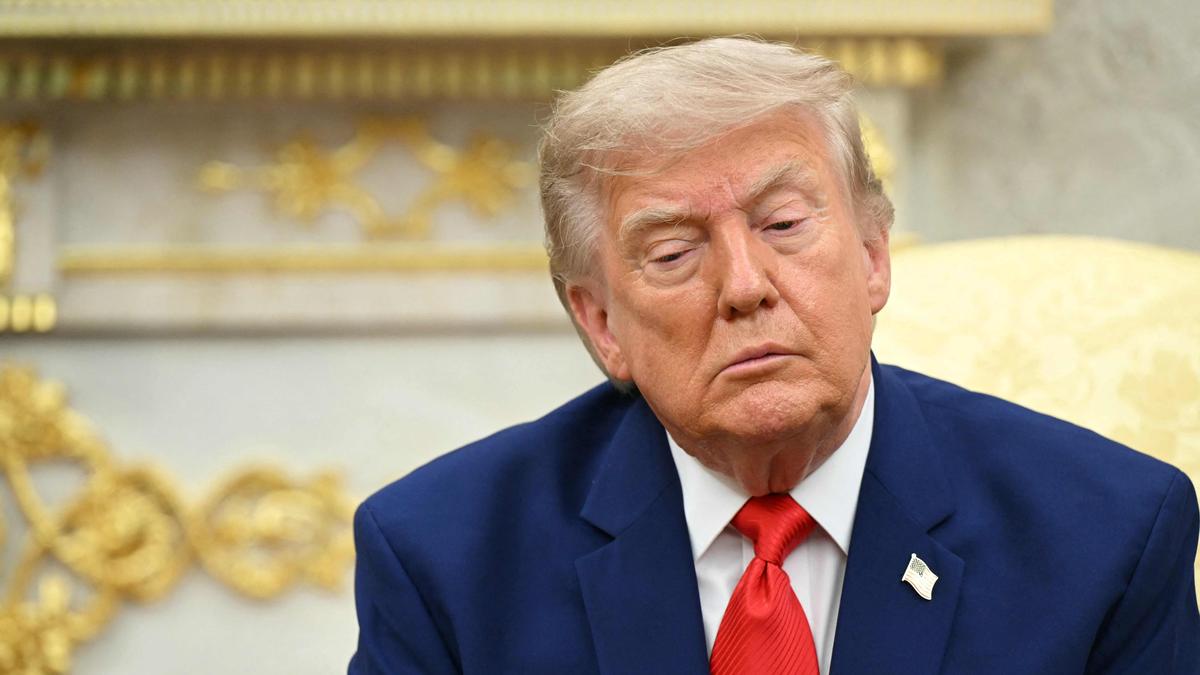

‘Donald Trump has few good options’
| Photo Credit: AFP
“When we are finished, take over your government. It will be yours to take. This will be probably your only chance for generations,” United States President Donald Trump told Iranians on February 28, 2026, after the U.S. and Israel assassinated Iran’s Supreme Leader Ayatollah Ali Khamenei, and launched a war against the country. More than five months later, the war that Mr. Trump believed would be over in weeks, if not days, is far from over. The Islamic Republic has not only survived but has also consolidated its position, at home and in the region. Mr. Trump has alternated between strikes, ceasefires, talks, threats, ultimatums, renewed strikes, and U-turns in an attempt to shape the course and outcome of the conflict and the behaviour of the Iranian state, while seeking a face-saving exit. But with the war unresolved and his objectives unmet, Mr. Trump, confronting a resolute yet risk-tolerant Tehran, has found himself in a strategic cul-de-sac.
The U.S. and Israel launched the war with four principal objectives: destroy Iran’s nuclear programme; dismantle its missile capabilities and military industrial base; end Tehran’s support for its non-state quartet (Hamas, Houthis, Hezbollah and Hashad) and bring about a regime change. The first three objectives, however, were inseparable from the fourth. Without toppling the Islamic Republic, achieving any of the other goals appeared impossible even before the war began. This makes regime change or regime collapse the central strategic aim of the war on which all the others depended.
Published – August 07, 2026 12:16 am IST
Leave a Reply