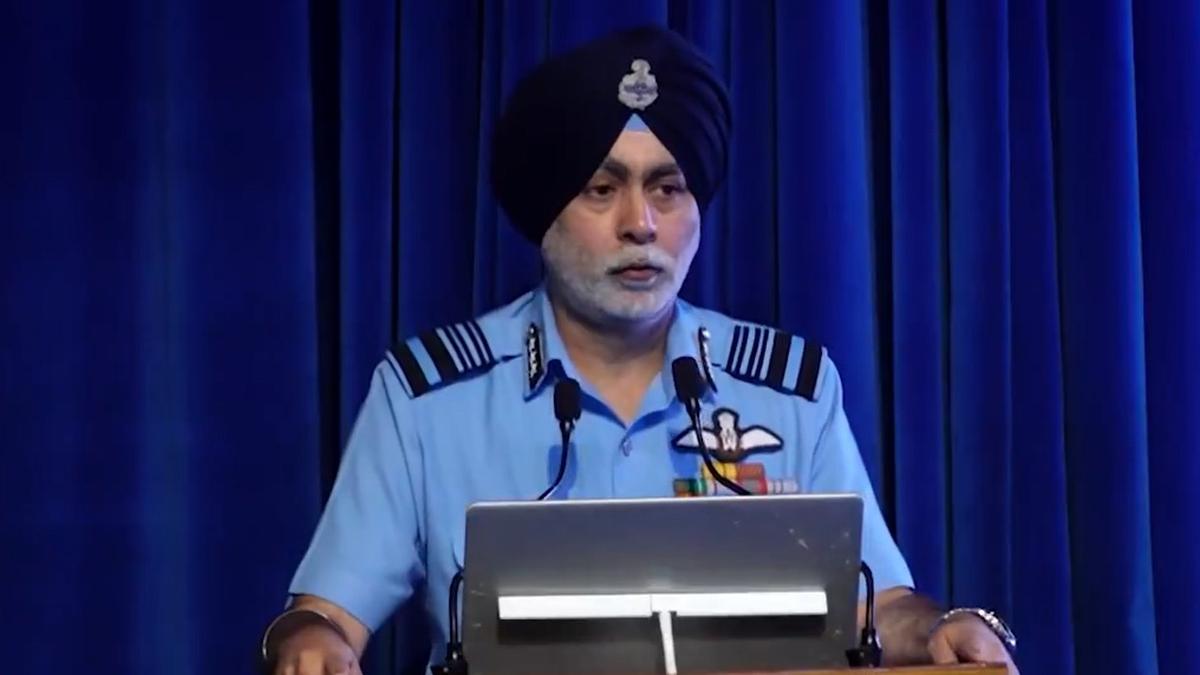
Deputy Chief of the Air Staff Air Marshal Tejpal Singh on Tuesday (August 18, 2026) said that while the importance of weapons and platforms will never go away, today’s battlefields and battle airspace are defined by “information superiority”, network-centric operations, and most importantly, split-second decision making.
In his address at a seminar hosted in New Delhi, he also said success in multi-domain operations can come only if “we can reduce and shorten our OODA (observe, orient, decide and act) loop”.
The event hosted by think-tank Centre for Aerospace Power & Strategic Studies (CAPSS) and Indian Military Review (IMR) at the Subroto Park is themed on use and integration of surveillance systems, C4I2 (Command, Control, Communications, Computers, Intelligence, and Information), and electro-optics.
Air Marshal Singh, who on August 1 took charge as the new Deputy Chief of the Air Staff (DCAS), said the objective today in the battlefield is to “sense better, understand faster, decide with confidence, engage precisely and assess continuously”.
He said this is where the experience gained from designing and operating the IACCS (Integrated Air Command and Control System) is very critical, because it is a system where the sensors, communication and the shooter are all integrated.
The DCAS emphasised that the importance of platforms and weapons will “never go away”, but today’s battlefields and battle airspace are defined by “information superiority, network-centric operations, and most importantly, split-second decision making”, and therefore, success in multi-domain operations can come only if “we can reduce and shorten our OODA loop, that is observe, orient, decide and act”.
While the ‘act’ part comes from the platform and the weapons it carries, the first three aspects of observe, orient and decide will come from the topics that are being discussed today in this seminar, which is surveillance, C4I2 and electro-optics, he added.
“The intention is to make our OODA loop shorter than that of the adversary so that we can decide and act before he can. But to achieve true operational superiority, we can no longer treat these three aspects, that is surveillance, C4I2 and electro-optics in their own silos. They need to be integrated into a system of systems,” the Air Marshal said.
He underlined that surveillance obviously will act as the persistent eyes and ears in all domains — land, sea, air, space, cyber, — and electro-optics will give that precision, delivering high-definition thermal imaging, multi-spectral targeting and optimal identification in various environments that are possible.
He said C4I2 will act as their “central nervous system” which will integrate all these, fusing disparate sensors into real-time and actionable intelligence and situational awareness for the commander in the field.
He emphasised that integration of these, is not merely an engineering tool or a goal, but it is a “combat multiplier”.
Interoperability, cyber security and resilience were also discussed at the seminar.
The DCAS said as network-centric operations will accelerate, these network themselves may become a target, for the adversary, and “we must confront these critical operational bottlenecks”.
To achieve seamless jointness, it is very important that there are “standardised protocols”.
“We need to be self-reliant in modern communication systems. All our communications, ground sensors, the platforms, the aerial ISR assets, they all need to operate on the same network, on the same standardised protocols and speak a common digital language, which is very, very important. And therefore, interoperability must be a design principle and not an afterthought,” he asserted.
The Air Marshal said modern networks will always face electronic threats, whether in the cyber domain, in the EW (electronic warfare) domain or spoofing. “Therefore, our C4I2 backbone must be self-healing and be resilient enough to operate in the most densest of EW environments”.
The way forward for this is for that “holy trifecta or the triple helix” partnership of the military, the user, the industry and the academia to work together. The armed forces obviously cannot solve these complex problems on their own, and these can only be done in a synergistic manner, he added.
Air Marshal Singh urged the R&D organisations and the industry partners to give the armed forces systems which are “ready to deploy, which have been tested in the extreme of conditions required”.
He underlined the need for the industry partners, start-ups and MSMEs to “collaborate rather than compete” in this area.
The DPSUs, the big players who have deep pockets, need to collaborate with the startups and MSMEs who are more nimble and more agile, and support them and take them under the wings, rather than compete with them, he said.
Also, as military leaders, “we need to be ready to integrate modern technologies into our battle plans, our operational plans. We should not be asking what is the system, but what is the operational problem that I’m trying to address,” Singh said.
Future of warfare will certainly continue to revolve around the platforms and weapons, but increasingly it will be one through information, integration, and faster decision making, he asserted.
Vice-Chief of Air Staff Air Marshal Ashutosh Dixit and Deputy Chief of Army Staff (Capability Development & Sustenance), Lt. Gen. Rahul R. Singh also attended the event.
Leave a Reply