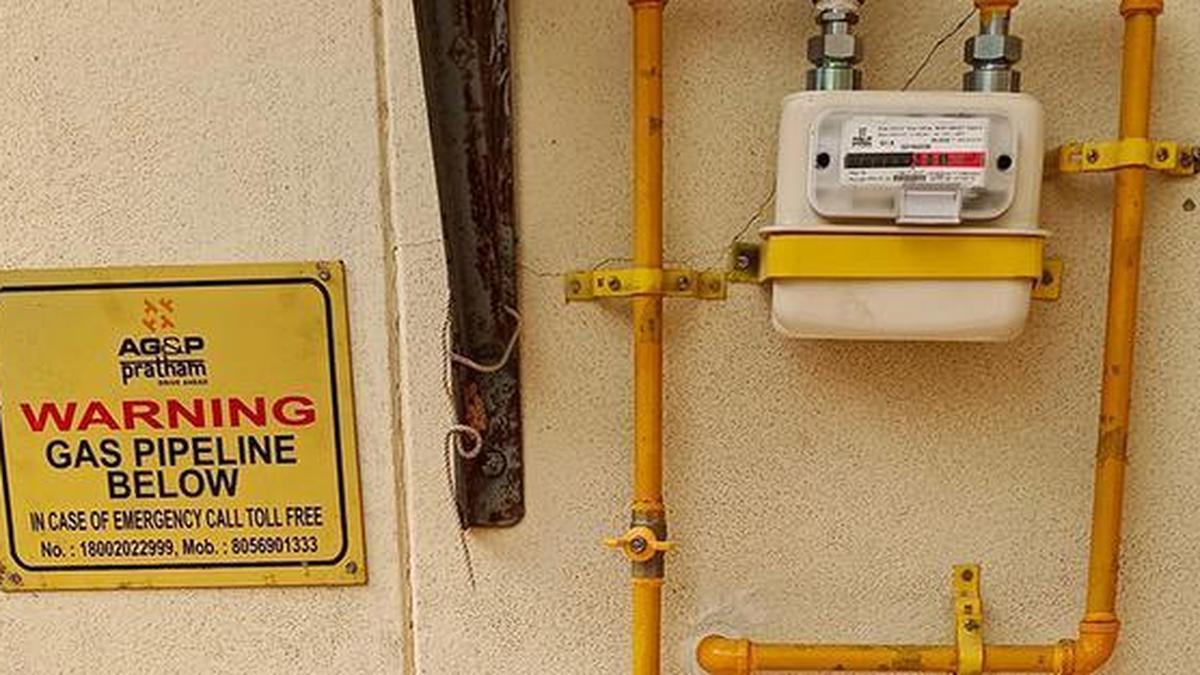
The story so far: The Petroleum and Natural Gas Regulatory Board (PNGRB), along with city-gas distributors and oil-marketing companies, on Thursday (October 1, 2026) launched the National PNG Drive 3.0 with the target of enrolling 50 lakh domestic-piped natural gas (D-PNG) connections by the end of the fiscal year 2027. The broader objective is to accelerate the adoption of piped natural gas, facilitate transition from liquefied petroleum gas (LPG) to PNG and further ensure the existing infrastructure for PNG is effectively utilised to attain these objectives.
What is the push for piped natural gas all about?
The government’s objective for promoting piped natural gas across consumer segments primarily rested on spurring access to cleaner fuels and increasing the role of natural gas in the national energy basket.
This directly aligns with India’s broader net-zero commitments and sustainable development goals, as well as ensuring access to cleaner, reliable and sustainable energy, it had stated.
The PNG Drives therefore were conceived as a structured intervention that sought to bridge the gap between network creation and consumer adoption, two imperative pillars that were to expand the adoption of piped gas ecosystem.
Transitioning to piped natural gas received a further impetus during the West Asia crisis with varied government orders that sought to expedite potential transition.
This was primarily aimed at easing off pressure on LPG, supplies of which were bothered because of the conflict spanning across the energy route, Strait of Hormuz.
What is Drive 3.0 all about?
The National PNG Drive 3.0 is not only targeting to add 50 lakh new domestic-PNG connections but also to convert 40 lakh connections into active users and register another 50 lakh users.
As on June 30, India has 1.74 crore PNG consumers of which 1.15 crore are billed consumers.
Among other things, the 3.0 drive seeks to accelerate adoption in newly connected, semi-urban and rural areas.
It also rests focus on converting connected-but-unbilled consumers into active consumers.
Albeit in a broader context, the closure report for PNG Drive 2.0 (published July 7, 2026) had also apprehended about the time taken for converting consumer interest into active usage.
“The pre-campaign baseline itself indicated a significant gap between connected domestic PNG users and billed users,” it had observed.
Thus, the 3.0 drive underlines this among the imperatives.
Additionally, the drive would also endow focus on maximising utilisation and gasification of existing infrastructure of city-gas distributors.
According to the regulator’s estimates, the country at present has about 6.9 lakh inch-kms of laid pipeline (inclusive of approximately 2.5 lakh inch-kms of steel pipeline and more than 4.41 lakh inch-kms of MDPE pipeline), which can cater to an additional 1.3 crore connections.
Robust business planning and supply chain readiness were also underlined as an imperative to complement consumer awareness and the adoption momentum that these drives sought to acquire.
“Scaling PNG penetration will require collaborative material planning across CGD entities such as gas meters, regulators, appliance valves, isolation valves, GI pipes and MDPE pipes,” the report read.
It is essential to also note that, on August 18, 2026, to encourage city-gas distributors to spur the expansion of D-PNG, the Petroleum Ministry had announced they would be allocated an additional 200 standard cubic metres (SCM) of the lower-priced Administered Price Mechanism natural gas for every incremental billed domestic-PNG connection they scale beyond the threshold determined for their area of operation.
Finally, the drive would also look to expand infrastructure in residential complexes and government colonies on a priority basis.
What are the broad observations from Drive 2.0?
Other than the mentioned, the closure report highlighted addressing consumer awareness in emerging geographical areas (for operability of PNG), improved technology for installation and affordability-related notions as imperatives to spur uptake.
The closure report noted consumer awareness remained uneven across geographical areas (GAs).
That is, the populace in mature markets of city-gas distributors were more familiar with the benefits of piped natural gas than those in emerging GAs who often required greater clarity about the process of obtaining a connection, safety aspects, comparative advantages to LPG and billing mechanism, among other things.
A related concern was about affordability and addressing upfront costs, especially in the emerging GAs.
To address these concerns city-gas distributors introduced varied schemes such as security deposit waivers and conversion incentives, among other things.
This was especially at the peak of the West Asia crisis amid the government push for a transition to piped gas.
The report also called for a differentiated strategy for mature and emerging geographical areas of CGD operations.
“Mature CGD markets require deeper consumer activation, billing conversion and service-level engagement, while emerging GAs require stronger awareness, trust-building, affordability communication and local handholding,” it observed.
Finally, the report also observed that relying on “slower methods” for installations could limit the number of household connections that could be completed during a campaign period.
It called for “making faster and standardised installation technologies” as an imperative for accelerating adoption.
Published – October 02, 2026 03:34 pm IST
Leave a Reply