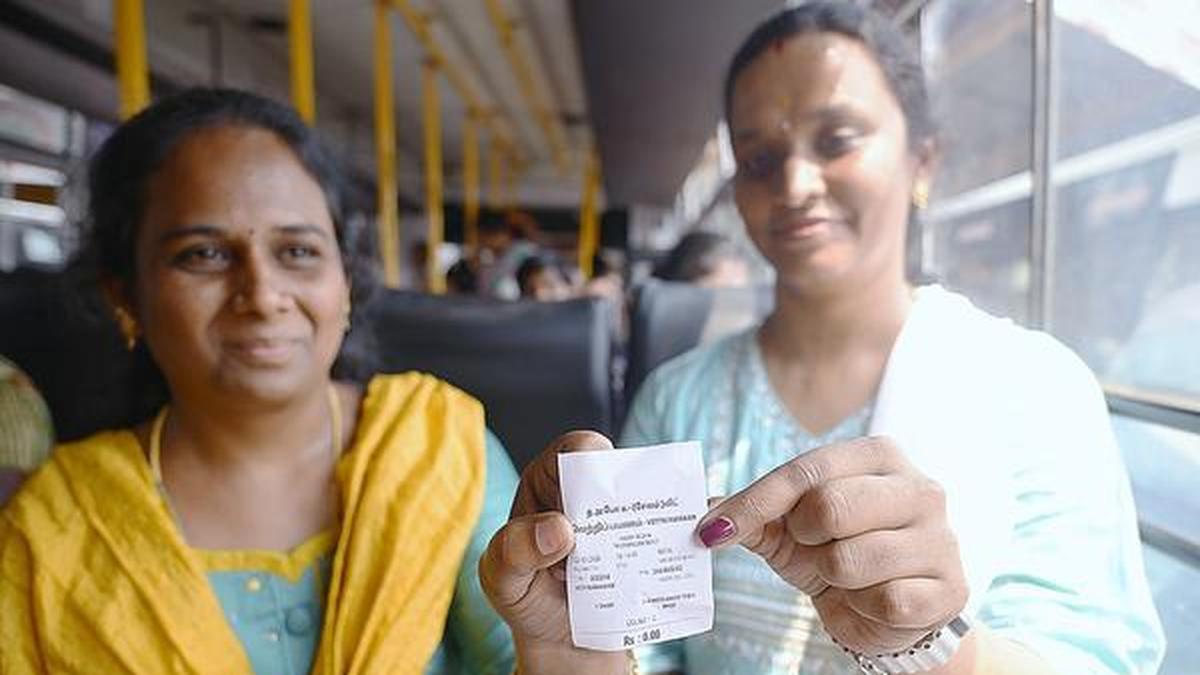
Vettri Payanam, which alone is expected to cost an additional ₹1,600 crore a year and a total of ₹6,000 crore for free travel, has brought to focus social return on investment (SROI) versus fiscal cost.
Actor-turned-Chief Minister C. Joseph Vijay seems to have mastered the art of welfare politics by accommodating the gratis within an about ₹4 lakh crore revenue-spending framework. However, the real test is whether the government can convert 84 lakh daily journeys into measurable gains in female employment, productivity, household income and mobility.

Going by Tamil Nadu’s Gross State Domestic Product (GSDP), estimated at ₹40.67 lakh crore for 2026-27, it is large enough to afford Vetri payanam in a narrow accounting sense.
Nevertheless, the State’s outstanding liabilities are projected at about 27% of GSDP in 2026-27. Besides, debt servicing is about ₹1.28 lakh crore or 37% of the state’s estimated revenue receipts.
The latest initiative, launched on Gandhi Jayanti Day, is an extension of the existing women’s zero-fare bus scheme, Vidiyal Payanam, covering a much wider range of government buses. The scale is substantial, as 12,692 buses, about 69% of the 18,413 scheduled buses operated by the eight state transport undertakings, have been brought under Vettri Payanam.

Of the 1.95 lakh scheduled single trips, around 1.65 lakh, or 85%, will operate under the scheme. The government expects approximately 84.32 lakh women to benefit every day.
Cost to exchequer
The annual allocation for the free travel scheme, including Vetri Payanam, is reportedly estimated to cost around ₹6,000 crore annually. Before expansion, the annual allocation was about ₹4,400 crore, implying an additional burden of approximately ₹1,600 crore a year.
Tamil Nadu’s 2025-26 Budget allocated up to ₹3,600 crore as a subsidy for Vidiyal Payanam (launched by the previous DMK regime), along with ₹1,782 crore for concessional student fares and ₹1,857 crore for diesel subsidies.

The expanded Vettri Payanam scheme accounts for only 1.7% of revenue receipts and 0.15% of GSDP in isolation, but the State’s budgeted ₹55,775-crore revenue deficit indicates that current revenues are insufficient to meet current expenditure.
Bright spots
Citing studies that found economic rationale in such populist schemes, at ₹6,000 crore a year, the State is effectively betting that cheaper mobility will produce higher female labour participation, higher household disposable income, better access to education and healthcare and stronger use of public transport.
Opportunities
Converting mobility into employment is one of the biggest advantages. If transportation costs are a hindrance to women accepting jobs, particularly in urban and industrial clusters, free travel can expand the geographical radius of the employment market.
It has the potential to become a complementary policy to skilling, industrialisation and women’s employment initiatives. Its economic impact will be much larger and wider if the government connects bus routes with industrial estates, IT parks, textile clusters, markets and educational institutions.
It could also ensure a public transport multiplier as higher occupancy on the existing services translates as low marginal cost of carrying an additional passenger, provided capacity is available.
The environmental benefit, however, depends on whether buses actually replace private-vehicle trips rather than merely generate additional trips.
Rising concerns
The recurring burden on the State budget, which may appear to be small in terms of GSDP, is not targeted, which means part of the subsidy goes to those who may not need financial assistance.
The higher the ridership, the larger the reimbursement needs will be. In order to ensure sustainability, the State should have a clear formula linking reimbursement to actual passenger journeys and route costs.
Otherwise, it may put pressure on transport funding if reimbursement does not fully compensate TN State Transport Undertakings (STUs), which already have weak finances and incur daily average losses of ₹19 crore.
On an all-India basis, too, the picture is the same as they cannot run like conventional commercial bus companies because of their public-service mandate.
Apprehensions are that the scheme will create market distortion, crowding out private bus operators, who are already up in arms. A writ petition has been filed in the Madras High Court challenging the constitutional validity of the scheme.
Economics behind
A Tamil Nadu State Planning Commission study found that women in Madurai, Tiruppur and Nagapattinam were able to save an average of ₹888 a month through free bus travel. For those earning less than ₹12,000 a month, these savings represented a meaningful proportion of monthly income; farm and construction workers, street vendors and domestic workers were reported to save 14% of their monthly income.
The State 2025 Assembly documents say the scheme has facilitated more than 571 crore journeys, with female daily ridership rising from about 32 lakh in 2021 to 57 lakh. It also cites the Planning Commission’s findings that the scheme improved women’s workforce participation.
An independent 2024 study by the Citizen Consumer and Civic Action Group (CAG), which surveyed 3,000 women across six Tamil Nadu cities, similarly found monthly savings of ₹601-800. It reported that women frequently redirected the savings towards family health and education.
As per the existing arrangement, the State compensates transport undertakings for zero-fare journeys.
CAG reported that the government reimbursed MTC at ₹16 per zero-value ticket, implying that the revenue loss is effectively shifted from the transport corporation to the State Budget.
Not an outlier
Several States have already adopted or are in the process of allowing free or highly subsidised bus travel for women.
Karnataka’s Shakti scheme, launched in 2023, is a large, universal scheme with the State initially budgeting ₹4,000 crore annually. Research by Azim Premji University covering January 2023-March 2025 found a substantial increase in bus usage following implementation.
Telangana’s Mahalakshmi scheme, which began in December 2023, offers free travel to women, girls and transgender persons on specified TGSRTC services. Women’s share of its bus passengers has risen from 40% to more than 67%, with more than 35 lakh women travelling free every day.
Punjab introduced its free bus travel scheme in 2021. More than 3 lakh women use it daily, and nearly 11 crore women’s journeys were recorded in FY23-24. However, PRTC reported a severe cash crunch, seeking ₹151 crore in pending reimbursements, as the free-travel scheme was costing it around ₹30 crore a month.
Delhi’s women-free-travel scheme has generated enormous usage. DTC data showed 8.25 crore free journeys between April and July 2026 alone.
In August 2025, Andhra Pradesh launched Stree Shakti, providing free travel to women, girls and transgenders in the State on specified APSRTC services.
Kerala and Himachal Pradesh have had women-focused free travel/fare concessions, but their scale and design differ.
Ultimate fare
A yearly ₹6,000-crore commitment is not a one-off theatric; rather, the State government has to transparently quantify the benefits of an unstinted subsidy to show mobility efficiency, labour market efficiency, income generation efficiency, cost-benefit ratio and long-term sustainability (at the end of the current term of TVK). The ultimate fare for its success is measurable SROI, not the electoral mileage.
Leave a Reply