Hailing from the South of the country, I believed my sole encounter with Jammu and Kashmir would be through Hindi films. Actors romancing in the backdrop of snowcapped mountains and gun encounters, lingered in my mind, as I saw my flight slowly land on the runway at Srinagar International Airport.
However, that did not stop me from relishing this paradise on earth, as I traverse through a city, where the past coexists with present, carrying forward remnants of horror, heritage and honour.
Here’s how I spent 36 hours in Srinagar.
Tuesday
5pm | Visit Jamia Masjid

Jamia Masjid in Srinagar
| Photo Credit:
Nainu Oommen
Placed in contrast to the bustling streets of downtown Srinagar, the 600-year-old Jamia Masjid, is an embodiment of serenity in the middle of chaos. Boasting architecture which deviates from the usual Islamic structural tendencies, owing to the absence of domes and minarets, the mosque exhibits Hellenic features, supported by 378 intricately carved deodar pillars that are 14 metres high.
“The roof of the Jamia Masjid is pyramidal in shape, because it allows the snow to slide down during winters and stops the roof from getting damaged,” explains our tour guide, Yunus Bhatt. We walk slowly past pillars, admiring the imprinted floral patterns — a motif across my trip, constantly surfacing on carpets and flatware among others.
The central fountain surrounded by arched colonnades hosts a flock of pigeons. The flutters of their wings echo as Maghrib prayers, resound through the compound. Sunlight bounces off the water at twilight, as we settle down on lawns, overlooked by the snowclad Hari Parbat, also known as the Koh-i-Maran.

7pm | Explore Khanqah-e-Moula (Great Khanqah)
A 15-minute walk through the Zaina Kadal – Khan Kah Road, from the Jamia Masjid, leads you to the Khanqah-e-Moula, one of the oldest Sufi shrines in Kashmir. The sanctum is dedicated to Mir Syed Ali Hamadani, who is also known as the Shah-e-Hamadan.
Another great example of Kashmiri wooden architecture at its best, the structure, has been rebuilt multiple times, after multiple fires. The wooden facade is topped with a pyramidal minaret.
Inside the mosque, ceilings boast embellishments made with papier mache and the prayer hall possesses an aura of tranquility, despite the heavy movement of visitors . The structure is built entirely of deodar wood without using any nails, using the traditional Kashmiri Taq system of interlocking wooden beams.

A view of closed Khanqah-e-Moula shrine
| Photo Credit:
NISSAR AHMAD
8pm | Head downtown
Downtown, locally known as the Shehr-e-Khaas, is Sringar’s throbbing heart which ceases to stop. Considered one of the most culturally and historically significant parts of the city, the area is marked by seven wooden bridges built across the Jhelum River, known as Kadals in Kashmiri and settlements on either side of the river.
Sauntering through the alleys bustling with visitors and vendors, you will encounter buildings with peeling paint and bare brick bodies – a glance into the downtown’s unaltered existence.

A building at Downtown
| Photo Credit:
Nainu Oommen
Each of downtown’s narrow, tiled streets differs in its appearance, odour and tone. On one we are welcomed by the fragrance of a freshly baked batch of bakarkhani, the flour-based Mughlai flatbread. A seller who is piling them on to his wicker basket, to take them to nearby shops, offers me a sample: “It goes really well with kahwa tea. But you can also eat it by its own,” he says.

Bakarkhani
| Photo Credit:
Nainu Oommen
With newly found energy, I walk to SR Gunj Market, where I encounter intricately designed copper vessels such as Samovars (traditional tea kettles), Tash-t-Nari (wash basins), and cookware. A few more alleys and chinar trees further, I see dark rooms, illuminated with embers, where containers are shaped, hammered, and engraved, with a solitary metal smith crafting them.
Wednesday
6am | Shikhara ride through the Dal Lake
A few minutes post sunrise in Srinagar, the shikharas, made of deodar wood, are docked and ready to go at Nehru Gate. The thinly-cushioned rowboat with its unique, pointed end cuts through the waters smoothly as it moves towards the Zabarwan Range.

Shikharas docked before ride
| Photo Credit:
Nainu Oommen
The shikhara ride through the Dal Lake is a soothing experience, if you can wake up early enough: ideally leave by 6am. Flanked by floating shops near the banks, we pause by the kahwa vendors who serve us piping hot cups of the Kashmiri tea, garnished with saffron strands and crushed almonds. Boats serving steaming plates of instant noodles also await customers.
Dal Lake is also home to a floating vegetable and flower market, catering to customers for less than two hours past sunrise. Gleaming fresh produce include leafy greens, water chestnuts, onions, radish, turnips, carrots and the famous lotus stems, locally known as nadru.

A floating kahwa vendor
| Photo Credit:
Nainu Oommen
11am | Visit the Indira Gandhi Memorial Tulip garden
Located 22 kilometres away from the Srinagar International Airport, the tulip garden previously called the Model Floriculture Center, is a must-visit during the spring season. Considered the biggest tulip garden in Asia, it is situated at the foothills of the Zabarwan Mountains.
Boasting over 18 lakh blooming tulips of over 70 varieties and nearly one lakh other bulbous flowers, the garden spreads over an area of 30 hectares. This year, the garden was open from March 16 to April 16, as the tulips typically last for 15 to 20 days.

Tourists visit the Indira Gandhi Memorial Tulip Garden, in Srinagar
| Photo Credit:
IMRAN NISSAR
4pm | Shopping at Lal Chowk
A visit to Srinagar is incomplete without a stopover at Lal Chowk. Named after the Red Square in Moscow, Russia, by Sikh Leftist and intellectual BPL Bedi, it is an important political and commercial spot in the city.
The iconic clock tower, or ghanta ghar, looms over the area, surrounded by lanes that extend on all sides. Security forces, accompanied by bomb-sniffer dogs and explosive detectors, patrol the lanes, flanked by shops with their facades adorned by pherans, a traditional, loose-fitting Kashmiri cloak.
Pick up wool, tweed, or cotton pherans worn by men, women and children from the stores that line the narrow streets of Lal Chowk. Pashmina and Cashmere shawls and stoles can also be found there.
We also find bakeries such as Crème by Ahdoos, boasting a selection of pastries ranging from a flaky walnut tart to eclairs and savoury puffs.

Lal Chowk square
| Photo Credit:
Nainu Oommen
7.30pm | Wazwan dinner at Firdaus at Radisson Collection Hotel & Spa, Riverfront Srinagar
The wazwan dinner at Firdaus, set in the sonic backdrop of 2000s Hindi hits, is a gift that keeps on giving. Served on a handcrafted copper plate called a traem, the feast consists of back-to-back courses of meaty goodness served on a bed of aromatic long-grain rice and is an experience to cherish.
Prepared by experienced executive chef Naresh Kharbanda, using traditional techniques and locally sourced ingredients, the dinner showcased the depth and complexity of Kashmiri flavours.
From Tabak Maaz, a lamb rib dish which delicately falls off the bone, to the subtly spiced aab ghosht, aromatic gushtaba, and rista, the sumptuous meat-forward supper effortlessly lulls me into a food coma until I taste the phirni. The fragrant rice-based sweet is a necessary delicate touch to the heavy dinner, which wraps up with a cup of kahwa.

Wazwan dinner from Firdaus at Radisson Collection Hotel & Spa, Riverfront Srinagar
| Photo Credit:
SPECIAL ARRANGEMENT
Check into Radisson Collection Hotel & Spa, Riverfront Srinagar
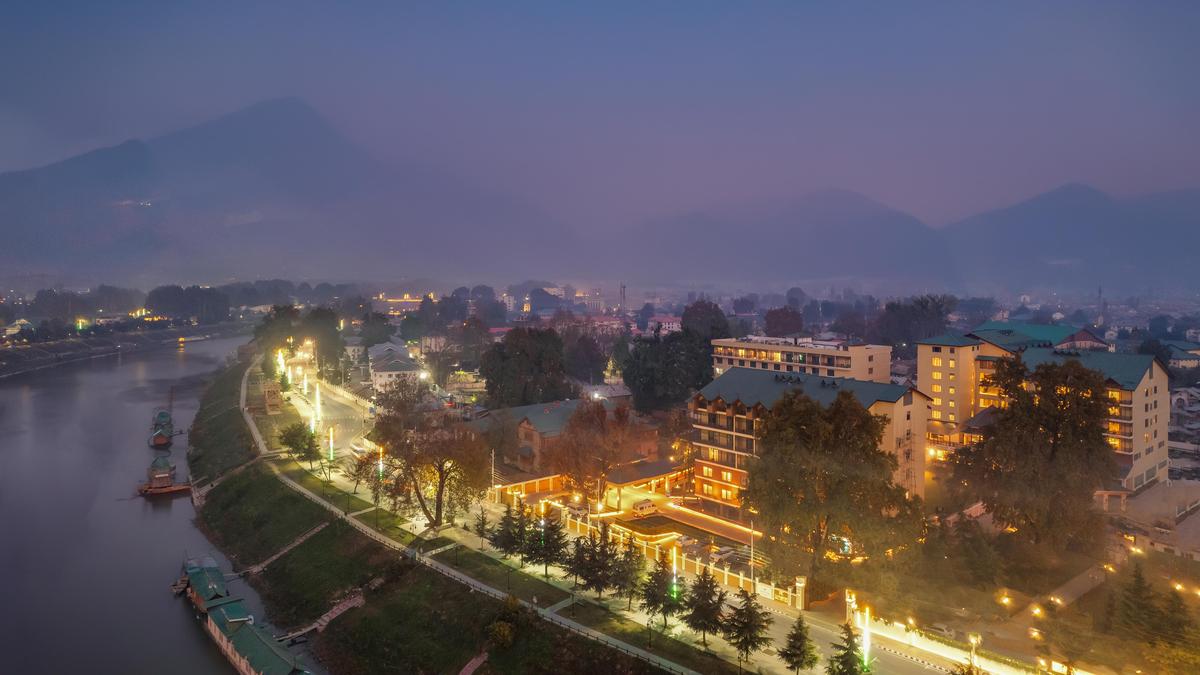
Located along the banks of the Jhelum River, with a view of the Zabarwan Mountains, the hotel is situated 10 kilometres from Srinagar International Airport and connected to Srinagar’s major tourist attractions.
The hotel’s architecture combines the grandeur of a European alpine estate with traditional Kashmiri design features, including sloping roofs and warm wood detailing.
Guests are welcomed with intricate woodwork, woven carpets with inspired patterns and locally influenced motifs as a tribute to the Kashmir valley’s rich cultural heritage.
The hotel marked Radisson Collection’s debut project in India in 2024. “Srinagar has a distinctive cultural identity, remarkable heritage, and stories worth experiencing. Few destinations embody these qualities as authentically as this city,” says Shubhankar Jyoti, general manager, Radisson Collection Hotel & Spa, Riverfront Srinagar.
“The property was envisioned as more than just a luxury hotel. It was designed to immerse guests in the spirit of Kashmir through thoughtful design, curated local experiences and genuine hospitality, allowing travellers to discover the destination in an authentic and meaningful way,” adds Shubhankar.
Thursday
8am | Savour walnut fudge from the iconic Moonlight The Walnut Fudge Shop
Founded in 1896 by Ghulam Mohammed, the flagship sweet is prepared with a secret recipe containing Kashmir’s own walnut, honey, and dates. Filled with crunchy walnut bits, the fudge has a dense chewy texture with a thin pastry base.
There are two outlets, in Hazratbal and Hyderpora. The latter is located few kilometres from the airport, allowing me to end my Srinagar sojourn on a sweet note.
The writer was in Srinagar on the invitation of Radisson Collection Hotel & Spa, Riverfront Srinagar.
Leave a Reply