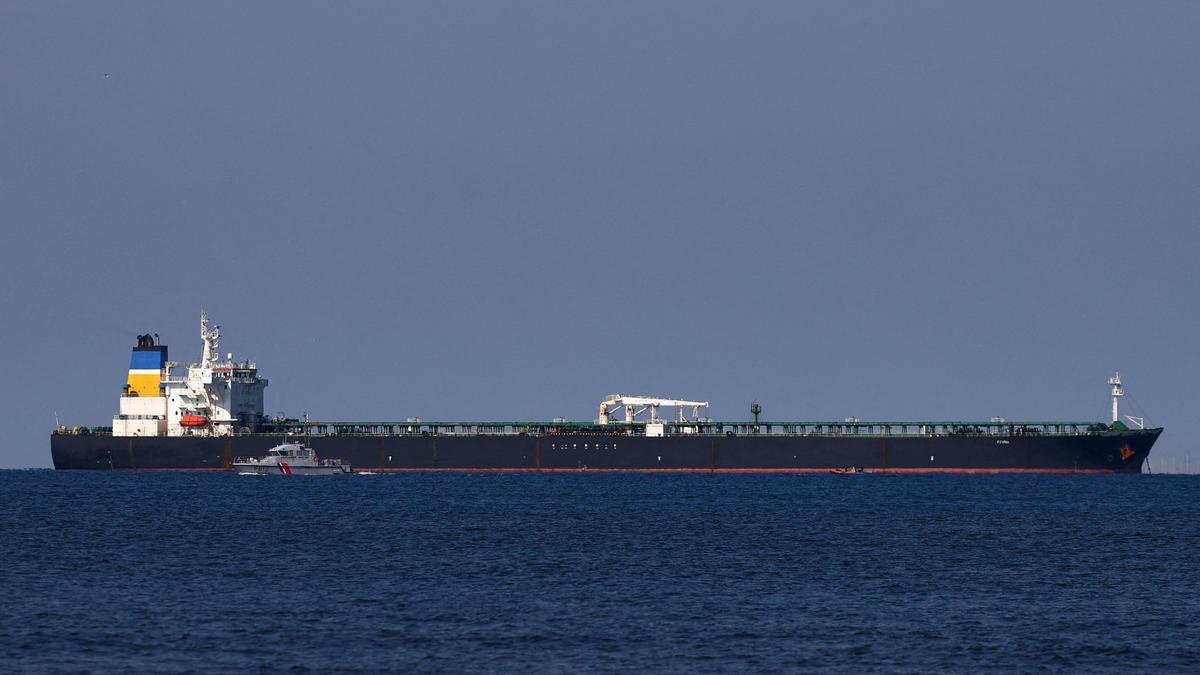

U.S. President Trump suggested the U.S. could allow the re-imposition of the sanctions by ending the waiver. File.
| Photo Credit: Reuters
The U.S. Treasury on Wednesday (June 17, 2026) did not publish an extension of its waiver of sanctions on Russian seaborne oil that ran out at midnight, but U.S. President Donald Trump and administration officials did not say whether that meant the measures would be re-imposed.
During the war on Iran, Mr. Trump’s administration waived U.S. sanctions on Russian oil to help vulnerable economies deal with the energy crisis. That could change after Washington and Tehran reached a memorandum of understanding to end the war that would allow oil from West Asia to reach global markets.

Mr. Trump on Wednesday (June 17, 2026) was non-committal about a U.S. re-imposition of sanctions on Russia. “We are looking at that. We’re seeing how far the price of oil comes down; it’s, it’s really tumbling,” he told reporters during the G7 summit in France.
On Tuesday (June 16, 2026), Mr. Trump suggested the U.S. could allow the re-imposition of the sanctions by ending the waiver. “Soon we’ll be able to do that, because the oil is now flowing out of the Middle East,” he said.
The Trump administration last year slapped sanctions on Russian oil majors Rosneft and Lukoil to pressure Russia to end its war in Ukraine by depriving Moscow of oil revenue. Russia is one of the world’s top oil exporters, along with the United States and Saudi Arabia.
The U.S. has allowed the waiver to expire in recent months only to extend it days later. The White House and Treasury Department’s Office of Foreign Assets Control did not immediately respond to requests for comment.
Tehran can immediately sell oil after a ceremony expected later this week for the signing of the deal, a senior U.S. official said on Tuesday (June 16 , 2026). But it could take months to bring oil and gas flows to normal levels. International Energy Agency head Fatih Birol has said the Iran war has led to the biggest disruption to global energy markets in history.
Russian President Vladimir Putin’s special envoy Kirill Dmitriev, who was involved in talks with the U.S. on previous extensions, said on June 4 that U.S. officials understood the waivers’ role in stabilising markets.
U.S. envoys Steve Witkoff and Jared Kushner, who have led U.S.-brokered negotiations aimed at ending the war in Ukraine, will visit Russia soon, the Kremlin said on Sunday (June 14, 2026).
Published – June 18, 2026 07:54 am IST
Leave a Reply