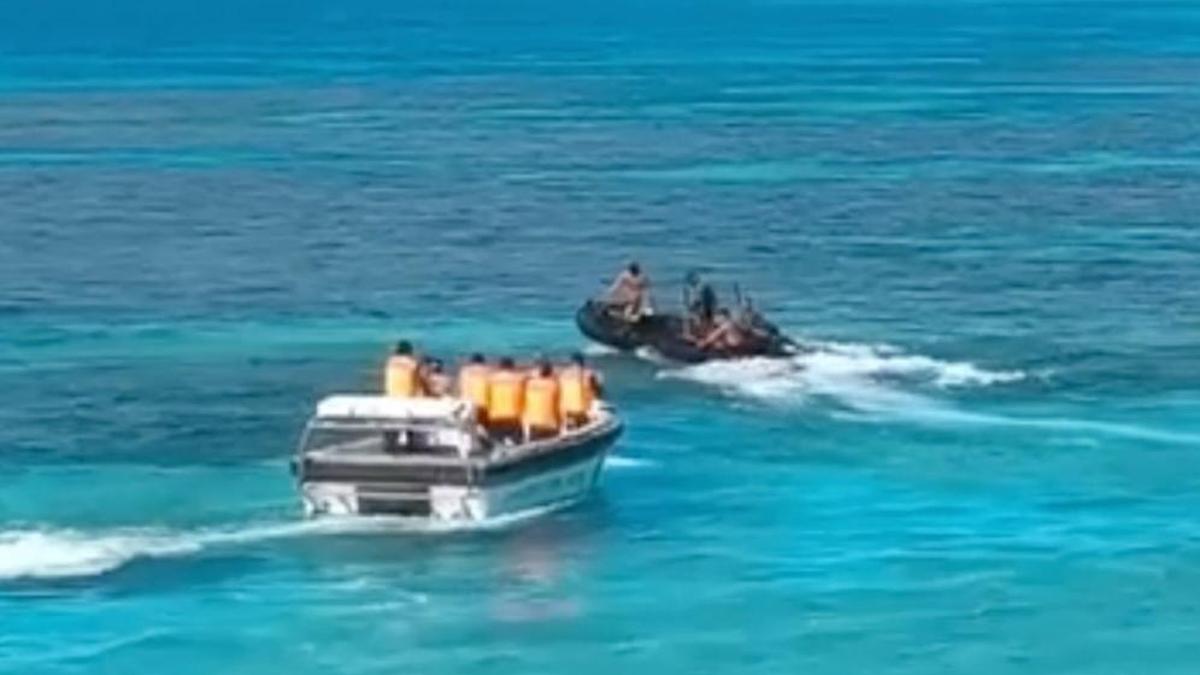

In this photo, taken from video by the Armed Forces of the Philippines, China Coast Guard personnel, left, on rigid hull inflatable boat chases Philippine Navy personnel aboard a rubber boat at the Second Thomas Shoal, locally known as Ayungin Shoal, at the disputed South China Sea on July 20, 2026. Photo: Armed Forces of the Philippines via AP
The Philippine military on Monday (July 20, 2026) accused China’s coast guard of allegedly injuring a Filipino sailor during an incident in a disputed shoal in the South China Sea.
The military said Chinese coast guard personnel aboard a motorboat repeatedly struck the sailor on the head with a wooden baton, injuring him and damaging his smaller vessel.
The assault was captured on video by other Filipino sailors in the hotly disputed Second Thomas Shoal and set off angry condemnations by Philippine officials. They praised the Filipino navy personnel, saying they did not do anything that could have caused an escalation.
China’s coast guard responded by claiming that two rubber boats belonging to an “illegally” stationed Filipino vessel had rammed the Chinese patrol boat “in a dangerous manner.”
“During the incident, Philippine personnel maliciously attacked Chinese law enforcement personnel using oars and long sticks,” the Chinese coast guard said in a statement on social media.
The row was just the latest altercation between Chinese and Philippines personnel in disputed waters in the South China Sea, which Beijing claims virtually in its entirety. China has demanded that Manila pull away a long-marooned and now rusting navy ship, the BRP Sierra Madre, which is manned by Filipino navy personnel and serves as a fragile territorial outpost.
The Philippine military said a Chinese coast guard inflatable boat carrying eight personnel was deployed from a ship and approached the BRP Sierra Madre within close range and maneuvered around while its occupants took pictures and video.
Filipino sailors aboard two rubber boats asked the Chinese to back away in a non-confrontational manner. “The Chinese coast guard vessel personnel reacted violently and aggressively by striking a Philippine Navy personnel on the head with a wooden baton, causing injury and damaging the navy rubber boat,” the Philippine military said.
The extent of the Filipino sailor’s injury was being assessed to determine if he needed to be medically evacuated, it said.
“No act of coercion or aggression will deter us from carrying out our constitutional mandate or exercising the Philippines’ lawful rights in the West Philippine Sea,” the military said, using the Philippine name for the South China Sea.
“The latest act of violence and harassment committed by the China coast guard against Philippine navy personnel … adds to a clear pattern of provocative and hostile behavior and further contributes to the People’s Republic of China’s deficit of trust and credibility,” the Department of National Defense said in a statement.
The Chinese coast guard accused the Philippines of distorting facts by falsely accusing China, “which is a complete reversal of right and wrong,” according to its statement.
The Philippines deliberately beached the Sierra Madre in the shallows of the Second Thomas Shoal in 1999 to serve as a territorial outpost. China, which also claims the shoal, later surrounded the atoll with its ships in a tense territorial standoff that has dragged on for years.
The long-simmering territorial disputes, which also involve, Brunei, Malaysia, Vietnam and Taiwan, is high in the agenda of annual talks in Manila this week between foreign ministers of the Association of Southeast Asian Nations and their Chinese counterpart, Wang Yi.
Both sides have been negotiating a nonaggression pact that aims to prevent a major armed conflict that could draw in the United States, which has vowed to help deter growing Chinese aggression and defend freedom of navigation in the busy waterway.
Published – July 20, 2026 10:59 pm IST
Leave a Reply