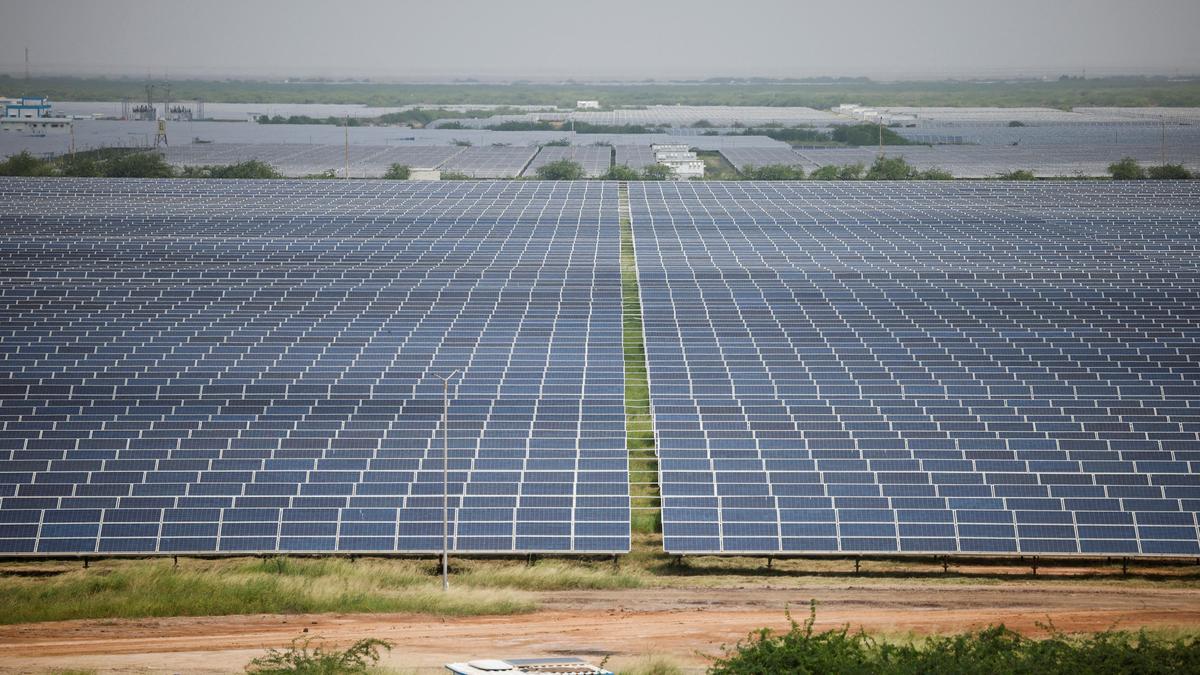

Solar panels at Gujarat Solar Park, also known as Charanka Solar Park, in Patan district. File
Gujarat recorded its biggest annual reduction in carbon emissions during the 2025-26 financial year, preventing an estimated 49.79 million tonnes of carbon dioxide equivalent (MtCO₂e) from being released into the atmosphere, according to the State government.
The reduction coincided with a record 67,655 million units of electricity generated from renewable energy sources, driven by the rapid expansion of solar, wind and other clean energy projects.

The government said the State has prevented a cumulative 179 million tonnes of carbon emissions over the last five years through renewable energy expansion, environment-friendly policies and other green initiatives. Officials said the achievement is significant, considering Gujarat’s annual greenhouse gas emissions, which are estimated at around 442 million tonnes.
It attributed the achievement to policy measures, including the Integrated RE Policy 2026, the Green Hydrogen Policy and the Gujarat Pump Storage Policy, which have accelerated the State’s transition towards clean energy.
According to the government, agencies such as the Gujarat Urja Vikas Nigam Limited (GUVNL), the Gujarat Energy Development Agency (GEDA) and the Gujarat Power Corporation Limited (GPCL), under the supervision of the Energy Department, have played a key role in increasing the share of renewable energy in the State’s power generation mix.

It said greater reliance on renewable energy has reduced dependence on coal and other fossil fuels, helping lower carbon emissions while improving air quality. It added that reduced emissions also contribute to mitigating the effects of climate change, including extreme heat, erratic rainfall, floods and droughts.
The State has set a target of achieving 100 GW of installed renewable energy capacity by 2030, in line with Prime Minister Narendra Modi’s vision of making India a net-zero economy by 2070. The government said Gujarat’s progress would contribute to India’s climate commitments under the Paris Agreement while strengthening its position as a leading renewable energy hub.
Published – July 21, 2026 04:45 pm IST
Leave a Reply