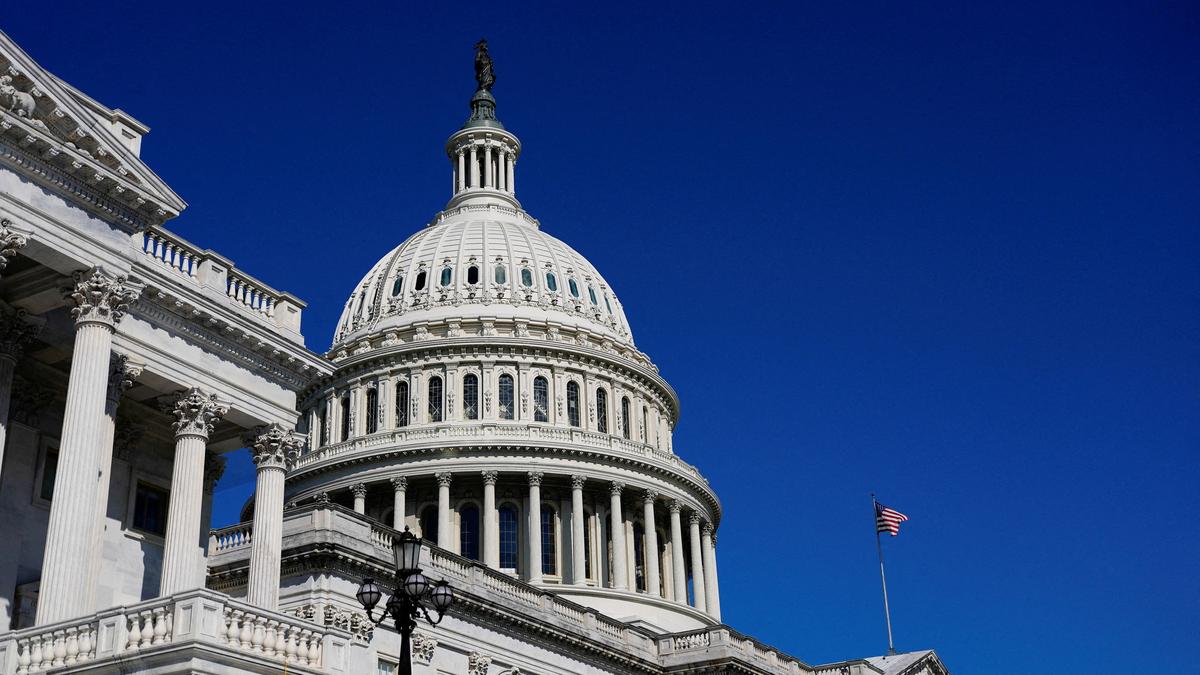

The U.S. Senate voted 86-12 to invoke the cloture motion to advance the Lindsey O. Graham Sanctioning Russia and Iran Act of 2026. File.
| Photo Credit: Reuters
The U.S. Senate has voted to fast-track the passage of the Lindsey O. Graham Sanctioning Russia and Iran Act of 2026, which could see a tariff of 100% being imposed on India for its import of Russian oil. A previous version of the Bill had set the tariff amount at 500%, but it was subsequently revised downwards.
The Senate exhibited a rare display of bipartisan agreement by voting 86-12 on Tuesday (July 28, 2026) to invoke a cloture motion to advance the Act.

A cloture is basically a Senate procedure that sets a time limit for the debate and related actions on an issue before it is put to a vote. That is, it is a procedure meant to hasten the vote on a particular issue.
Aiming at depriving Russia
According to Senate documents, the bipartisan Act “is designed to deprive Vladimir Putin of the revenue financing Russia’s war against Ukraine” by imposing sanctions on Russia’s political leadership, financial institutions, energy sector, and sanctions-evasion networks.

These sanctions are to be implemented through the use of “targeted tariffs to pressure the world’s largest purchasers of Russian energy to reduce their dependence on Moscow”.
The original version of the Act, introduced in 2025, proposed a blanket 500% tariff on those importing Russian oil. However, the Act was revised in early July 2026.
Impact on India
Under the latest version of the Act, a tariff of “up to 100%” would be levied on the top five purchasers of Russian crude oil and natural gas. Currently, China accounts for about 47-50% of Russian crude oil exports, while India accounts for another 36-38%.

As per the latest Indian government data, Russian oil made up a little more than 40% of Indian oil imports in May 2026, and the Ministry of Petroleum and Natural Gas has told The Hindu that this rose to “more than half” in June.
“The stakes for India are substantial,” Ajay Srivastava, founder of the think tank Global Trade Research Initiative said. “Access to discounted Russian crude has significantly lowered India’s import bill, supported energy security, and helped contain inflation.”
U.S. strategic moves
“Washington is steadily expanding its use of trade and economic measures to pursue strategic objectives,” he added. “Reciprocal tariffs, Section 301 investigations, forced-labour measures, sector-specific duties, and now Russia-related sanctions reflect an increasingly broad toolkit of economic pressure.”

The new version of the Act also creates a carve-out by exempting countries that are currently importing less than 15% of Russia’s natural gas exports and are taking significant steps to reduce those imports.
This carve-out would benefit several European countries that currently import natural gas from Russia through pipelines or in liquefied form.
The new version of the Act also empowers the U.S. to impose tariffs of up to 100% on the top five countries facilitating Russian oil sanctions evasion.
Published – July 29, 2026 12:36 pm IST
Leave a Reply