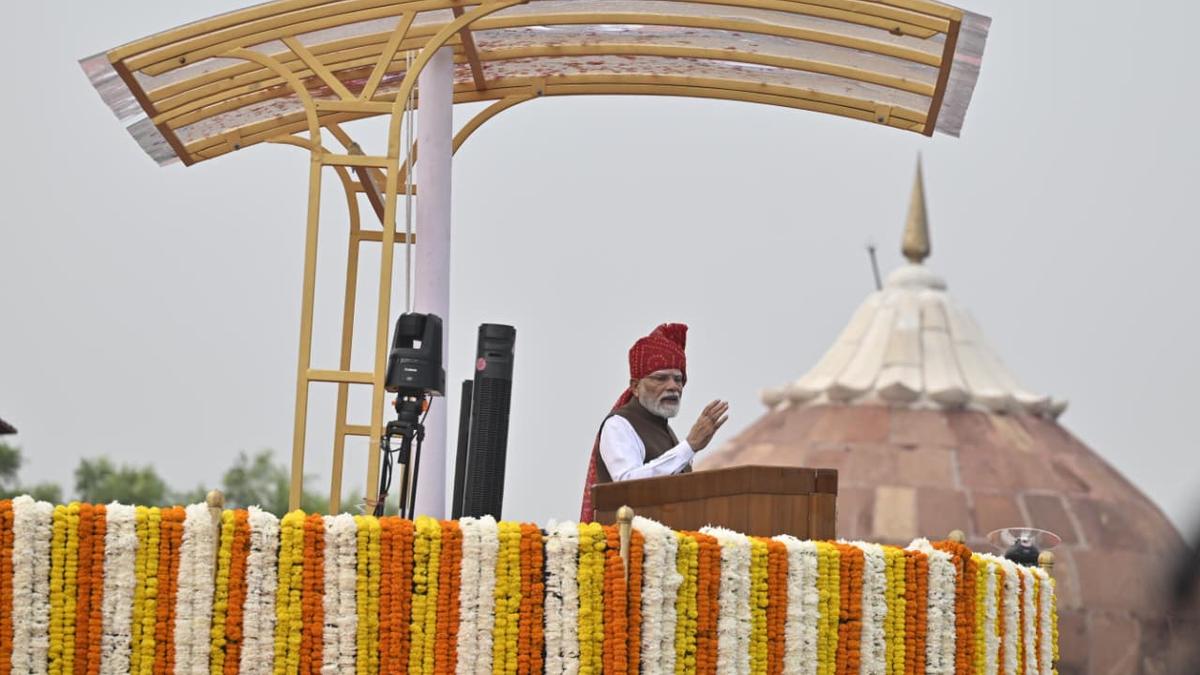
Prime Minister Narendra Modi on Saturday (August 15, 2026) laid out a seven-point reform framework, ‘Sapta Dhara’, aimed at accelerating India’s journey towards becoming a developed nation by 2047, with a focus on manufacturing, agro-food production and food processing, technology and innovation, logistics, defence, green and blue economy, and soft power.
Addressing the nation from the ramparts of the Red Fort on the 80th Independence Day, Mr. Modi recalled the era when India’s might was known through the “Sapta Sindhu” and said the country now needs new streams of strength to build a developed India.
“Now, to build a developed India, we need a new stream,” he said.

“Today, from the ramparts of the Red Fort, I invoke the seven streams of power before the nation,” Mr. Modi said.
“In the coming 5-7 years, with the strength and power of these seven streams, we will give the country new heights, new momentum, and the capacity to achieve new goals,” he said, adding that the full potential of the nation’s youth power will be utilised in nation-building.
Freedom’s Progress Through the Years
The first strength of the ‘Sapta Dhara’ is manufacturing power, Mr. Modi said, stressing the need to take the manufacturing sector forward and produce both small components and large products.
“We must build a complete value chain. From design to manufacturing, India must establish itself as a trusted global supply chain partner for the world,” he said.
“We must rise to global standards of cost, quality and scale,” Mr. Modi said.

He said Indian manufacturers must meet global benchmarks on cost, quality and scale, while factories should be competitive, products user-friendly and packaging attractive.
“For every manufacturer, every entrepreneur, every MSME, I want to say that in the global market, our identity should be based on trust and quality,” Mr. Modi said, stressing that there should be “no compromise” on quality.
The second stream is agriculture and food processing, with Mr. Modi calling for Indian farmers to access global markets.
Modi on trade deals
“The world’s markets are now open for our farmers. Due to FTAs, we are gaining access to a very large market. We must reach there,” Mr. Modi said, stressing the need to go “from the farm to the export market”.
The Prime Minister said traditional cuisine, millets, spices, fruits and flowers and chemical-free agricultural produce could become global brands, provided they meet international parameters.

“The third stream, he said, is technology and innovation. India must become an innovation hub as emerging technologies such as artificial intelligence, quantum technology, space, robotics and data centres create new opportunities,” Mr. Modi said.
Modi on digital public technologies
“We have made our mark in UPI and digital public infrastructure,” Mr. Modi said, calling for India’s digital public technologies to be taken to every corner of the world.
“India must lead in next-generation communication technology. Made in India 6G should reach every corner; this should be our goal,” Mr. Modi said.
The fourth strength of the ‘Sapta Dhara’ is Gati Shakti, with Mr. Modi stressing the need for seamless and high-speed connectivity. “Our cities must be connected through high speed rail,” he said.
Modi on port-led development and defence
Mr. Modi also called for a focus on port-led development, saying ports should not remain merely places for loading and unloading goods but should become engines of growth.
The PM highlighted defence power as the fifth strength, stressing the need for self-reliance in the defence sector and for India to emerge as a global supplier of next-generation defence technologies.
“When the world is thinking about itself, India cannot remain merely a market for the world,” he said.
“We have to become global suppliers. We have to take leadership in hypersonic defence technologies,” Mr. Modi said.
He also called for developing drones, counter-drone systems and hypersonic defence technologies, while underlining the growing importance of cyber security. “India has to become self-reliant in the defence sector.” Mr. Modi said the sixth stream is the green and blue economy, which will also create green jobs.
He called for India to operate at a global scale in green hydrogen, renewable energy, energy storage, green mobility and green manufacturing, while continuing to provide solutions to global challenges.
The Prime Minister also highlighted opportunities in the blue economy, including fisheries, coastal tourism and ocean technology, given India’s long coastline.
The seventh stream is India’s soft power, with Modi highlighting the global reach of yoga and India’s strengths in faith and spiritual centres, Ayurveda and holistic healthcare.
“Yoga is becoming an energy for the world and a major source of confidence for India,” Mr. Modi said.
He said the ‘Heal in India’ movement, handicrafts, culture, films, VFX, animation, gaming and digital content are among the areas where India can build global strength.
The Prime Minster also called for greater efforts to attract foreign tourists, noting that India has vast forest resources and more than 100 national parks but has not fully tapped its potential to attract international visitors.
Mr. Modi stressed that the seven streams should not be viewed as separate sectoral initiatives.
“The seven powers of ‘Sapta Dhara’ are not meant to make progress in just one sector,” he said, adding that India needs to adopt a “holistic approach” to achieve its development ambitions and cross the scale of the targets it has set for itself.
Mr. Modi said the combined strength of the seven streams will help India achieve new heights and accelerate its progress towards the goal of becoming a developed nation.
Leave a Reply