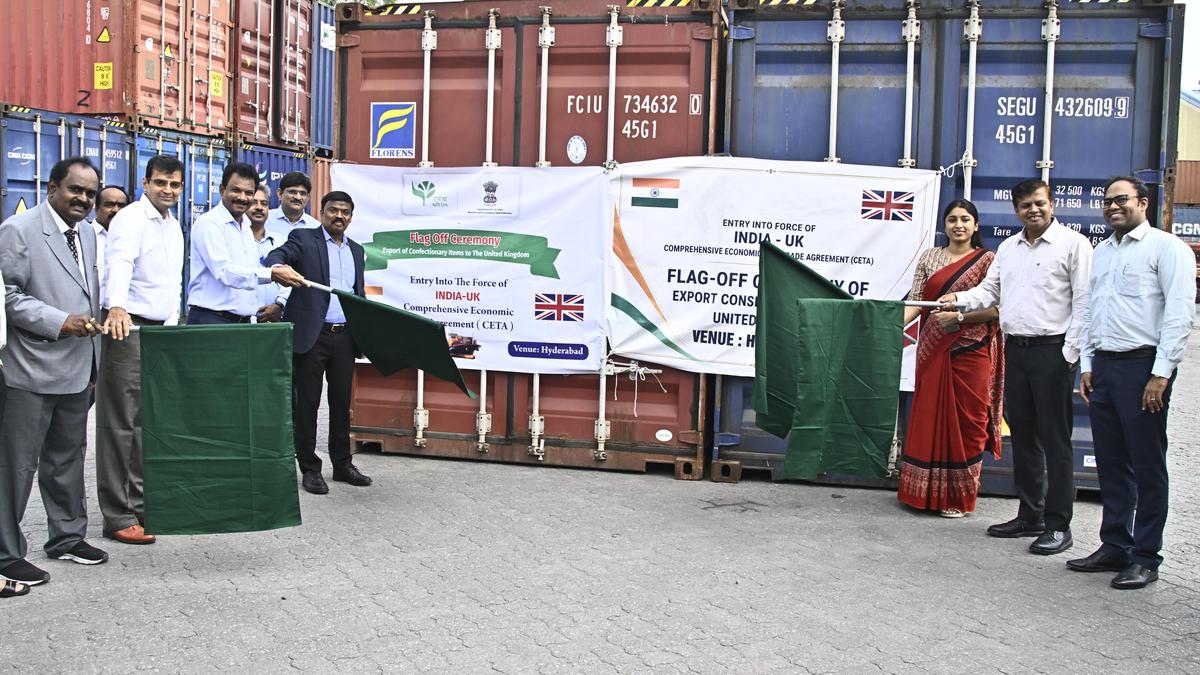

‘The gains promised today will become real only if India’s exporters are ready, its procedures are clean, and its enterprises are informed and educated of the opportunities that trade agreements create’
| Photo Credit: The Hindu
A trade agreement is usually sold on its potential for export facilitation. Its deeper worth often lies in what it obliges the country to import. The Comprehensive Economic and Trade Agreement between India and the United Kingdom, which came into force earlier this month, is a good agreement on the first count. It may prove an even better one on the second.
The first fruits lie here
Start with exports, because that is where the immediate gains lie and where they matter most. Effective July 15, nearly all of India’s exports — about 99% by value — will enter the U.K. free of duty. The tariffs that fall to zero are not on the goods that fill headlines but on the goods that matter to India’s workers: textiles and garments, leather and footwear, marine products, processed food, engineering items, and auto components. These are labour-intensive sectors. They employ precisely the workers India most needs to draw into productive, formal jobs. A garment unit in Tiruppur, Tamil Nadu, or a footwear cluster in Agra, Uttar Pradesh, competes on thin margins; a duty of 12% or 16% at the British border is often the difference between winning an order and losing it.
Hitherto, India has carried a handicap in this aspect. Bangladesh, Pakistan and Cambodia already shipped their garments into Britain duty-free while India’s exports paid the tax. That gap is now closed. This is the part of the agreement that deserves to be recognised, because it bears directly on employment. Trade policy is, in the end, about jobs.
A gain of a different character deserves mention. India is the world’s largest supplier of generic medicines, and Britain buys close to $30 billion of pharmaceuticals a year. Removing the duty lets Indian generics compete on price. This is not a labour story but a scale one — a mature Indian industry meeting one of its largest markets on equal terms.
Another aspect of the agreement too deserves special mention. It settles an old unfairness. An Indian professional posted to Britain for a few years has had to pay into the British social security system money he would almost never see again, while still contributing at home. The Double Contribution Convention that takes effect alongside the trade pact now exempts such workers, and their employers, from that double payment for up to five years. More than 75,000 workers and some 900 companies stand to save on the order of $600 million a year. It is money returned to Indians who go abroad to work, and the removal of a real grievance that had long irritated an otherwise warm relationship.
Opening markets, raising standards
Now to the imports — and to the part of the agreement that will make some people uncomfortable. India has agreed to bring its duty on cars built in Britain down from about 110% towards 10%, and to lower the tax on Scotch whisky from 150% towards 40% over a decade. The cuts are phased across years, capped by quotas, and drafted so that India’s own passenger vehicle industry has the time to enhance its competitiveness. They are, in short, cautious. But they point in the right direction, and the direction is the point.
This is a good place to record what protection does when it is never-ending. It does not build strong industries; it preserves weak ones. An industry that is never made to face a better product never has to make one. India’s own record proves this in both directions. Where its carmakers have had to compete — in small and mid-sized vehicles, at home and abroad — they have become genuinely good. Where they have sheltered behind very high walls, they have had little reason to improve. Letting a limited number of British cars in at a lower duty will not overwhelm anyone. It will do something more useful. It will remind India’s producers that the customer, not the tariff schedule, is the person they must satisfy. Exposure to competition is not a concession to a trading partner. It is a favour we Indians do ourselves. A domestic industry pushed to raise its game confers significant economic benefits over time.
Use the open door
In the end, trade agreements are living arrangements, not monuments. Signing an agreement and making it work are two different tasks, and the second is the harder and longer one. The gains promised today will become real only if India’s exporters are ready, its procedures are clean, and its enterprises are informed and educated of the opportunities that trade agreements create. There is considerable scope for improvement in the utilisation rate of free trade agreements in India. The government and premier industry bodies must actively and continuously engage with small industry and enterprise associations.
India and Britain now intend to double their trade, from about $56 billion, by the end of the decade. Whether they get there will depend less on the text signed last year than on the confidence with which India uses it. That, in the end, is what an agreement like this asks of a nation: to compete. Thiruvalluvar said it more economically than any government could. Those who strive without slackening, he wrote, will see even destiny retreat before them. An open door puts that conviction to the test. India should be glad of the test.
V. Anantha Nageswaran is the 18th Chief Economic Adviser to the Government of India. The views expressed are personal
Published – July 18, 2026 12:08 am IST
Leave a Reply