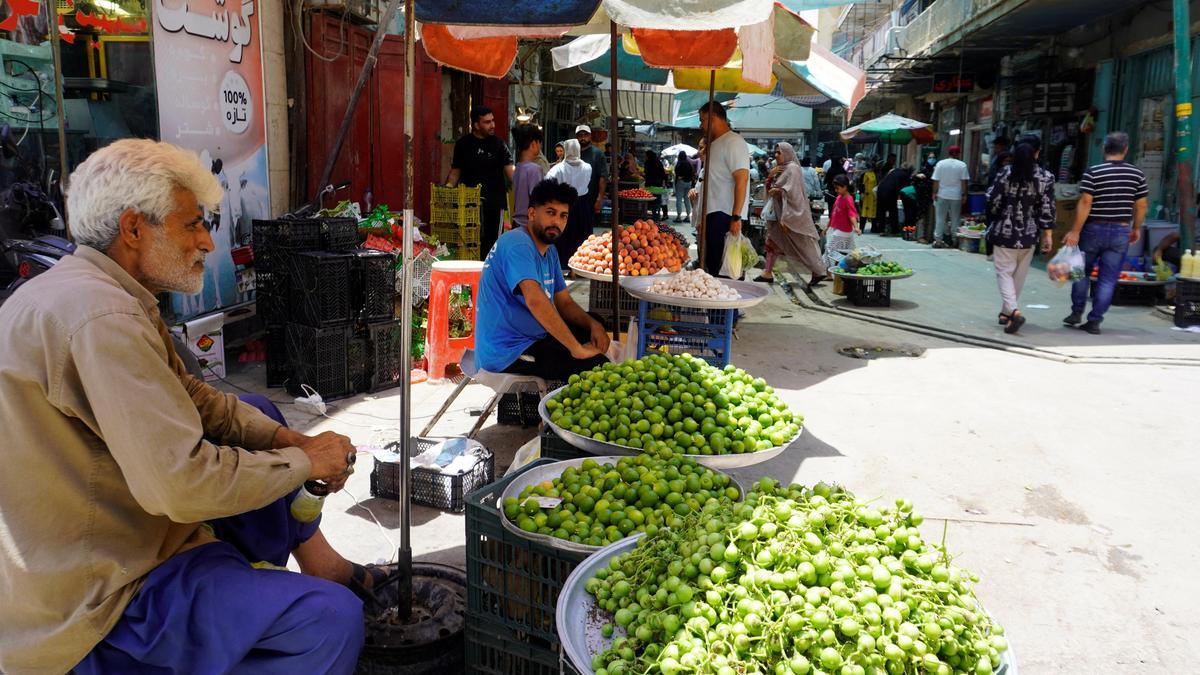

A local market in Bandar Abbas
| Photo Credit: Reuters
The simmering tension between U.S.-Iran has hit a new low after President Donald Trump claimed the ceasefire deal is ‘over’ on Wednesday (July 8, 2026). Following Mr. Trump’s remark, the United States launched a barrage of fresh strikes on Iran, alleging the latter had attacked three ships in Strait of Hormuz.

Amidst the turmoil, the port city of ‘Bandar Abbas’ is caught in the hostile flashpoint between Iran and U.S. military strikes. US Central Command (Centcom) on Wednesday said the strikes were carried out to “further degrade Iran’s ability to attack commercial shipping and innocent civilian mariners” in the vital waterway. It said it hit Iranian targets including air defence systems, radars and more than 60 small boats used by Iran’s Paramilitary Revolutionary Guard.
Why is Bandar Abbas important for ‘Iran’
The city, located on Iran’s southern coast along the Persian Gulf, is situated on the northern part of the Strait of Hormuz, the narrow waterway which controls one-fifth of the world’s seaborne oil trade passes. Any disruption here has immediate consequences for global energy markets, shipping costs and maritime security.

According to the 2016 census, the city has a population of 5.26 lakh, with Bandari and Tehrani Persian being the widely spoken language.
The city is home to the Shahid Rajaee Port, Iran’s largest commercial container terminal, as well as Bandar Abbas International Airport and major naval installations belonging to both the Iranian Navy and the Islamic Revolutionary Guard Corps (IRGC). Together, these facilities make the city the backbone of Iran’s maritime logistics and coastal defence.

Significantly in 1977, the bulk of the fleet of the Iranian Navy was shifted from Khorramshahr to its new headquarters, naval base, and naval airbase at Bandar Abbas.
Why has it become U.S. military target?
The U.S. military operations have so far focused on thwarting Iran’s military movement through the Strait of Hormuz. Bandar Abbas represents a concentration of command-and-control facilities, drone infrastructure, naval assets and logistics hubs, making it a high-value target during any escalation, according to the military experts.

Several rounds of strikes have reportedly targeted military infrastructure in and around the city, including areas linked to drone operations, air-defence systems and coastal surveillance. Iranian authorities have responded with missile and drone attacks against U.S. interests in the Gulf, turning the region into one of the most volatile flashpoints of the conflict.
How is Bandar of Abbas important to Iran’s economy
The port handles around 85-90% of Iran’s container traffic and more than half of the country’s maritime trade, making it indispensable for the movement of manufactured goods, machinery, food products, minerals and industrial raw materials. It is also linked to Iran’s national rail and highway networks, allowing cargo to move efficiently between the coast and inland industrial centres.

Bandar Abbas is equally important for Iran’s energy and logistics sectors. The city supports exports of petrochemicals, minerals, agricultural produce and fisheries, while also serving as a transit hub for regional trade corridors such as the International North-South Transport Corridor.
Strait of Hormuz factor
Strait of Hormuz plays a defining role in highlighting the geographical importance of ‘Bandar Abbas’ city.
The narrow maritime corridor acts a gateway from the Persian Gulf to the Gulf of Oman and the Arabian Sea. Massive energy exporters, including Saudi Arabia, Iraq, Kuwait, the UAE and Iran, are squarely depend on it to move crude oil and liquefied natural gas to global markets.

Whenever tensions escalate near Bandar Abbas, shipping companies reassess routes, insurers raise premiums and oil prices react almost immediately. Following renewed strikes and threats to maritime traffic, crude prices climbed as markets priced in the risk of supply disruptions.
Published – July 09, 2026 11:45 am IST
Leave a Reply