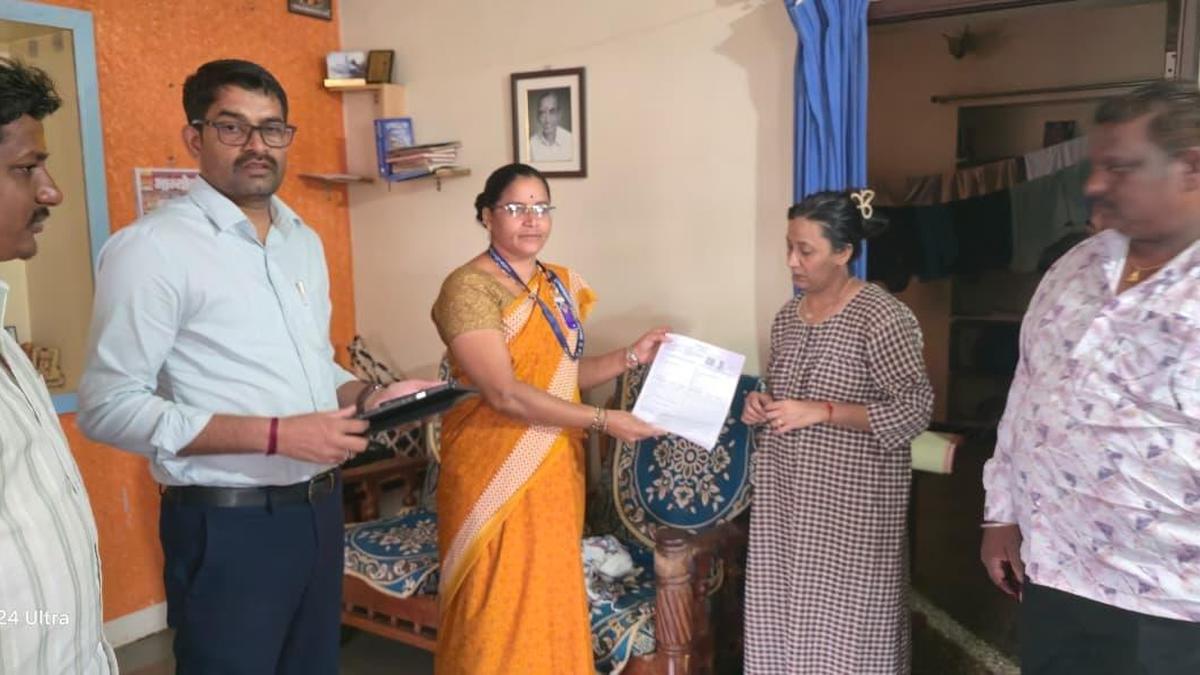

A file photo of Booth Level Officers issuing enumeration forms to voters in Belagavi.
| Photo Credit: File photo
The district administration has directed all officers on Special Intensive Revision (SIR) duty to ensure that members of nomadic tribes, which do not usually reside in one place, are included on electoral rolls.
“We are adopting some measures to ensure inclusion of nomadic communities and migrant labourers. Special instructions have been given to Booth Level Officers (BLOs) to see that eligible voters in these communities are not left out of the SIR exercise,” Belagavi Deputy Commissioner Mohammad Roshan said.
He added that BLOs are contacting nomadic families in various parts of the district and filling enumeration forms. “They are also tracing family members of migrant labourers and handing out forms. Even if one member of a family is traced, they are being asked to fill the forms of all their family members. The same applies to students and workers who are voters in Belagavi but are temporary residents of other places,” Mr. Roshan explained.
“However, if they are not registered voters already, steps will be taken to include them after the draft roll publication on August 17. They will need to fill Form 6 and enrol as new voters. As per SIR norms, they will have to submit one of 11 documents,’’ the Deputy Commissioner said.
The issue of some officers leaving out the names of several members of nomadic communities was raised after the first round of mapping did not reflect names of some long-time residents. Leaders of some nomadic tribes complained that they were facing problems in enumeration of their names in SIR.
“Several families of nomadic communities have been left out of the SIR exercise. Most families do not have a permanent address as they keep moving every season. However, even those who have settled in some villages and towns have been left out,’’ said community leader Maruti Hussein Durugmurugi. While he got a form, his wife Seetavva had not received one. Mr. Roshan said the BLO managed to trace her name in the electoral roll and give her a form.
“For example, several nomadic families have been living Yaragati town for the last 30 to 35 years. But BLOs have not distributed enumeration forms to them. There have been cases where forms have been given to only some members of a family and not others,” alleged one Prakash Duragmuragi. “In my house, the BLO gave me only my form, but my wife did not get it,” he said.
In the Hallur household, which comprises 12 adults, only Khairu has been given the form. Her sons and daughters-in-law have not received them. Their neighbours, the Kalaigars, have not received enumeration forms. Four family members — Allabaksh, Davasab, Dilshad and Sabari — do not have Electors Photo Identity Cards and have never voted in the past.
Nomadic and tribal communities are experiencing this as officers have not issued enumeration forms in several villages, especially those in remote areas and inside forests, said Alla Baksh Siddi, a member of the Siddi community.
Tribal leader Rajshekar Hakki Pikki stated that in a democracy, the right to vote is a fundamental right of every citizen. “The election officials should take special care so that no eligible voter is left out in the SIR process, by providing necessary information and assistance to illiterate people and members of nomadic communities. It is the responsibility of the government and the Election Commission to immediately check the errors committed by officers and address our grievances,” he said, alleging that illiterate people were not getting assistance to fill forms.
Published – July 27, 2026 07:18 pm IST
Leave a Reply