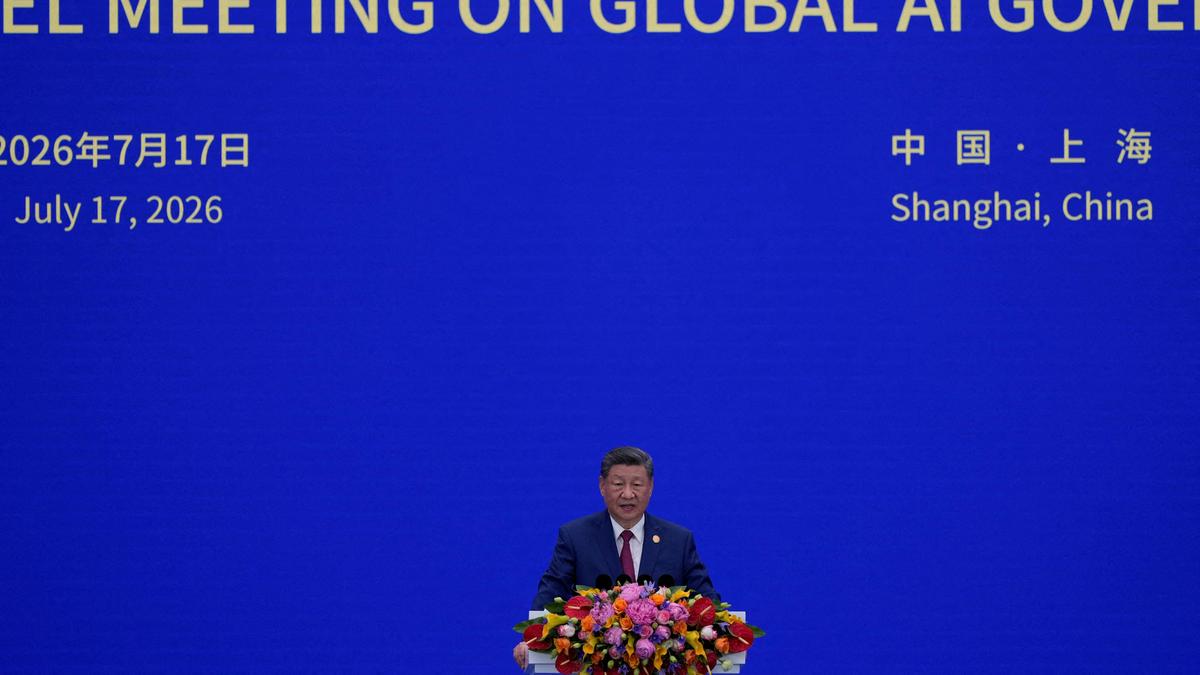

Chinese President Xi Jinping speaks at the opening ceremony for the World AI Conference in Shanghai, China, on July 17, 2026.
| Photo Credit: Reuters
It is the clearest signal yet of China’s global leadership ambitions in Artificial Intelligence (AI).
On Friday (July 17, 2026), Chinese President Xi Jinping unveiled a new initiative on global AI governance, pitched largely at the Global South and developing countries. China, along with 29 other countries mostly from Asia, Africa, and Latin America, has established a World Artificial Intelligence Cooperation Organisation (WAICO) based in Shanghai.
India, present at the Shanghai summit with a Joint Secretary-level delegation, is the only founding BRICS country missing from WAICO.
Also Read | What is Kimi K3, China’s first open AI model to reach 2.8 trillion parameters?
Mr. Xi described the effort as “a major move by China to answer the call of the Global South and unite the international community together to promote vigorously AI development and governance.”
“It will be an important milestone in the history of AI development,” he told a summit on AI governance in Shanghai.
He announced that in the next five years, China would provide developing countries “with 5,000 opportunities in AI training and seminar programmes”, as well as set up joint AI application cooperation centres with ASEAN, the League of Arab States, the African Union, the Community of Latin American and Caribbean States, the Shanghai Cooperation Organisation, and BRICS.
Beijing’s concern over models based in the West
The broader context is China’s push to both develop its alternatives to Western AI models and to offer them to developing countries. Beijing is concerned about the security implications of relying on models based in the West such as OpenAI’s ChatGPT and Anthropic’s Claude.

Mr. Xi hinted at these concerns in his speech, saying countries “should jointly oppose overstretching the national security concept in the field of AI and placing one country’s security over that of others”. He did not name the U.S., but Chinese officials have previously hit out at Washington for what they have described as securitisation of technologies, including AI.
A day before the launch of WAICO, Chinese AI firm Moonshot announced its latest Kimi K3 model that has surprised Western analysts with its capabilities. Chinese companies like Moonshot and DeepSeek are offering open-source models, which Beijing sees as giving them an edge n developing countries seeking technology for AI adoption. Mr. Xi said China would “encourage open source, openness, collaboration and sharing.”
‘Infiltration’ of Western values through AI
If security implications of using Western AI models are one concern, ideology is another. Chinese officials have also spoken of what they see as an “infiltration” of Western values through AI platforms and an erosion of sovereignty. This is a message that, Beijing believes, will find resonance in many developing countries and in the Global South.

“We should tend to the garden of civilisations with great care to ensure that the beauty of each civilisation is appreciated and shared,” Mr. Xi said. “We often say in China, ‘A single string cannot make music, and a single tree does not make a forest.’ AI development should not be a solo performance by a single country, but a symphony of international cooperation.”
Among the nations signed on to WAICO are Brazil, Russia, South Africa, Indonesia, Kazakhstan, Kenya, Malaysia, Pakistan, Uzbekistan and Venezuela. India is alone among the five founding BRICS countries in its absence, and will have to grapple with China’s plans to broaden the initiative in both the BRICS and SCO, organisations where India is a member.
Published – July 17, 2026 11:14 am IST
Leave a Reply