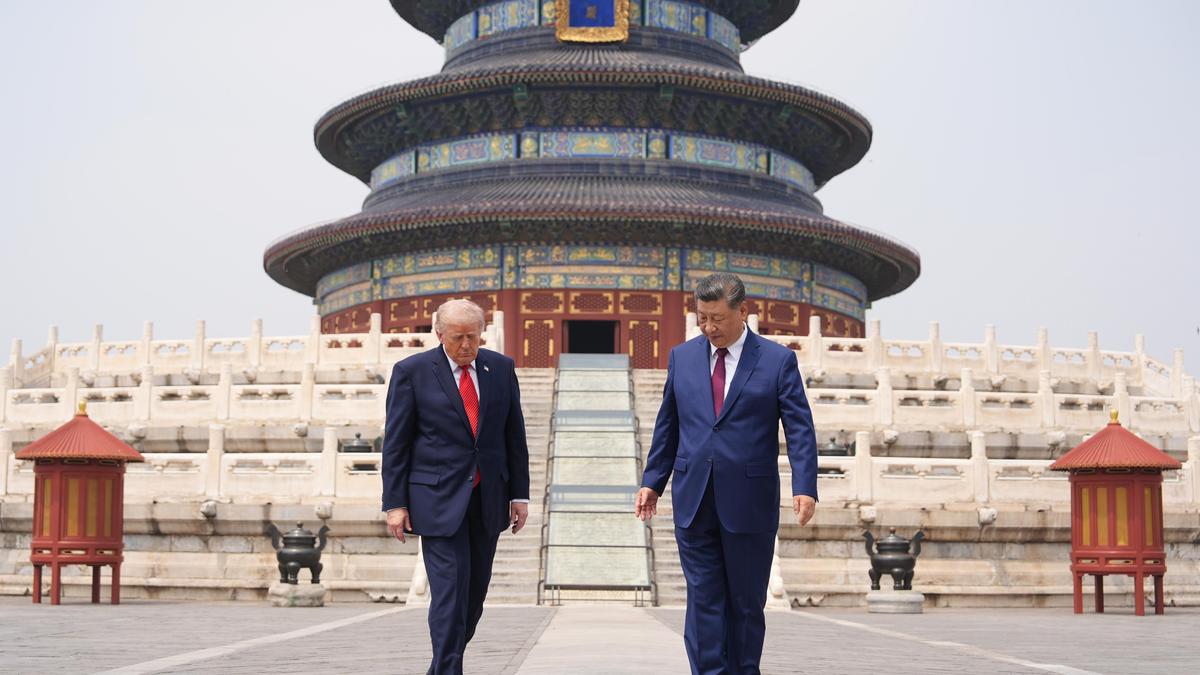

‘U.S. President Donald Trump and Chinese President Xi Jinping have agreed on building a constructive relationship of strategic stability’.
| Photo Credit: AP
In the past six months, specifically from December 2025 to May 2026, the top leaders of all the other permanent members of the United Nations Security Council (UNSC) have visited China.
In December 2025, French President Emmanuel Macron paid a three-day state visit to China, accompanied by over 30 French business leaders. Then from January 28 to 31, 2026, British Prime Minister Keir Starmer visited China, also accompanied by a large group of business leaders. Last month, from May 13-15, U.S. President Donald Trump visited China. He was accompanied by key government officials, and a high-profile delegation of over a dozen American CEOs. Russian President Vladimir Putin also paid a state visit to China from May 19-20. He was accompanied by a 39-member delegation including five deputy prime ministers, eight federal ministers, and the heads of Russia’s Central Bank and major state corporations. Such intensive, high-level diplomatic engagements in a single country have drawn wide attention. As observed by Professor Rajan Kumar from Jawaharlal Nehru University, such incidents are “extremely rare” and “underline China’s emergence as a central hub of global diplomacy”.
Indeed, facing an increasingly fluid, turbulent and challenging international order, these visits are telling examples of China’s unique role in mediating between world leaders. Since the founding of the People’s Republic of China, an independent foreign policy of peace has been established as its diplomatic principle, where China seeks, not bloc confrontations, but global partnership, ensuring decisions are made on their own merits, and that the UN plays an essential role in international relations. China endorses multilateralism, non-aggression, and the resolution of global disputes through dialogue rather than military means, which gives it a special advantage in the efforts to tackle complex issues flaring up across the world, together with the other permanent members of the UNSC. During the meetings, China’s President Xi Jinping emphasised the importance to uphold the UN-centred international system, and increase communication and coordination for the settlement of disputes.
On the U.S., Russia and the UN
President Xi and President Trump have agreed on building a constructive relationship of strategic stability. The framework of ‘constructive strategic stability’ between the two countries means that they will uphold positive stability with cooperation as the mainstay; healthy stability with competition within proper limits; constant stability with manageable differences; and lasting stability with expectable peace.
When it comes to the Taiwan question, the One China principle and China’s reunification should be unequivocally supported. While talking with President Trump, President Xi stressed that the Taiwan question is the most important issue in China-U.S. relations. “Taiwan independence” and cross-Strait peace are as irreconcilable as fire and water. Safeguarding peace across the Taiwan Strait is the biggest common denominator between China and the U.S.
In the meeting with President Putin, President Xi noted that 2026 marks the 30th anniversary of the establishment of the China-Russia strategic partnership of coordination and the 25th anniversary of the signing of the China-Russia Treaty of Good-Neighborliness and Friendly Cooperation. Guided by the core principles of non-alliance, non-confrontation, and not targeting any third party, the two states have kept deepening mutual trust and strategic coordination.
Moreover, designed out of the ashes of a global conflict to prevent future world wars, the UN’s role should never be weakened. All five permanent members of the UNSC shoulder great responsibility to maintain world peace, uphold the post-WWII world order, and work to make the global governance system more just and equitable. This requires joint efforts in fighting militarism and fascism.
Trade as necessary for peace
Economic and trade cooperation was also a priority of the leaders’ visits. While dwelling on deepening economic ties with each of the four countries, President Xi underlined mutual trust as the foundation for steady and sustainable state-to-state relations. In our globalised world, the industrial and supply chains of countries are deeply interconnected, and exchanges and cooperation between China and other economies are mutually beneficial in nature. In order to build an inclusive economic globalisation that benefits everybody, countries should share responsibilities together, coordinate actions, and work together to make global economic governance fairer, more just and equitable. Joint efforts should be made to address the global industrial restructuring. As China kicks off its 15th five-year plan, the country will remain a key contributor to economic growth, open its doors wider and share opportunities with the rest of the world. No matter how developed China becomes, it will never be a threat to other countries.
While a few voices in the media have expressed concerns that such chemistry would squeeze the room for India’s role in the international arena, such worries are ill-grounded. China and India are both large economies with strategic autonomy. Both countries should focus on the goals of national development and revitalisation, and seek common understanding and shelf differences. Efforts should be made to deepen the friendship between our two peoples, and strengthen exchanges in education, culture, tourism, etc.
Qin Jie is Consul General of the People’s Republic of China in Mumbai.
Published – June 10, 2026 12:45 am IST
Leave a Reply