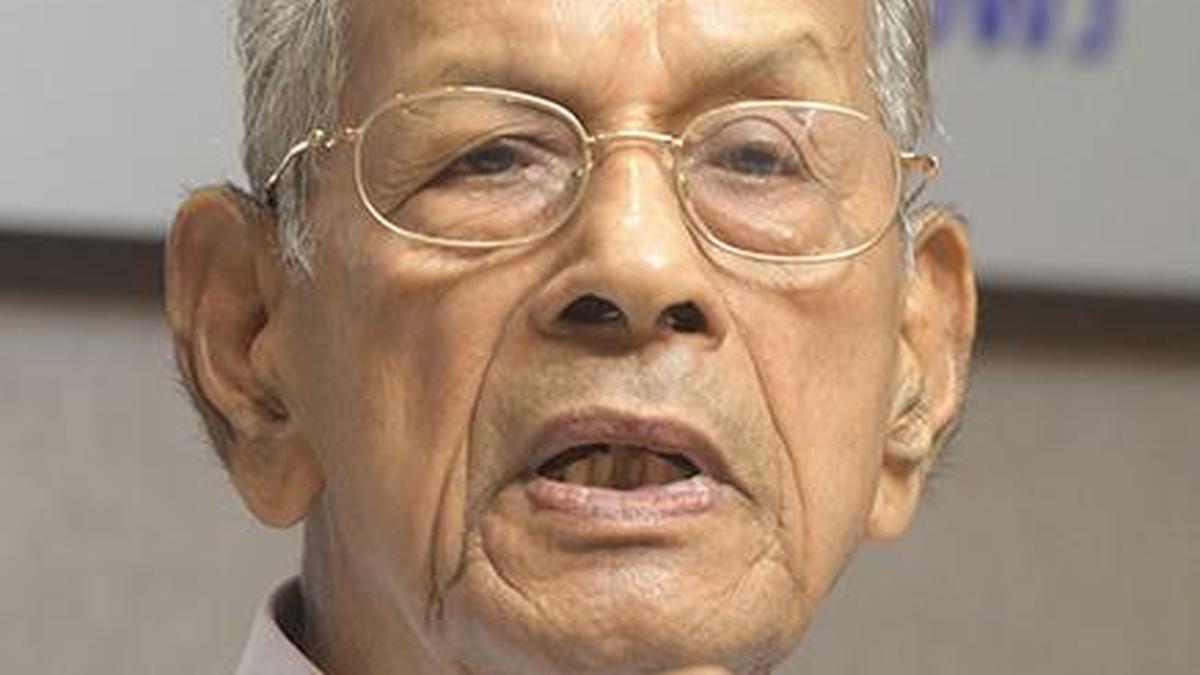

The KHSR proposal has been prepared by veteran technocrat E. Sreedharan as an alternative to the previous Left Democratic Front (LDF) government’s K-Rail project
| Photo Credit: MUSTAFAH KK
The Delhi Metro Rail Corporation (DMRC) has urged the Kerala government to entrust the proposed Kerala High Speed Railway (KHSR) project to it on a turnkey basis, similar to the Kochi Metro, saying it could complete the project within five years without cost overruns.
The proposed high-speed rail corridor, estimated to cost ₹57,000 crore, will connect Thiruvananthapuram and Kannur. According to DMRC, the project will eventually have the capacity to carry 2.28 lakh passengers a day.

DMRC spokesperson P. Narayanan said the predominantly elevated alignment would minimise land acquisition issues. “A major advantage of the project is that it will connect all four airports in Kerala while also providing rail access to areas currently without railway connectivity,” he said. “It will also substantially reduce road accidents.”
Mr. Narayanan said the corridor’s entire energy requirement would be met through captive solar power. “Its operation and maintenance costs will be only two-thirds that of a conventional railway line, enabling affordable fares,” he said.
DMRC also said the technology proposed for the project had already been proven in India.
According to the corporation, the project has a Financial Internal Rate of Return (FIRR) of 8.09% and an Economic Internal Rate of Return (EIRR) of 20.01%, indicating that while the financial returns are modest, the project would generate significantly higher economic benefits through wider gains to society.
DMRC added that the corridor could eventually form part of the National High Speed Rail Corporation Ltd.’s cross-country high-speed rail network.
The KHSR proposal, prepared by veteran technocrat E. Sreedharan as an alternative to the previous Left Democratic Front (LDF) government’s K-Rail project, is currently under review by the State government. A four-member expert committee is examining its technical, financial and environmental feasibility.
The proposed 473.2-km double-line corridor will run from Poojapura in Thiruvananthapuram to Mundayad in Kannur through 23 stations. The alignment will be elevated throughout except for a 6.5-km underground stretch in Thiruvananthapuram city. The journey between the two cities is expected to take three hours and 30 minutes.
The average distance between stations will be 21.5 km. Trains will have a design speed of 200 kmph, an operating speed of 180 kmph and an average commercial speed of 140 kmph.
Services will initially use 12-coach trains with 800 seats, while platforms will be built to accommodate future expansion to 16 coaches. During the initial phase, trains are proposed to run every 20 minutes during peak hours and every 40 minutes during off-peak hours, carrying around 54,400 passengers daily. With increased service frequency, the corridor’s capacity could be expanded to 2.28 lakh passengers a day. All services will operate on a reserved seating basis.
The project is proposed to be financed through equity contributions from the Centre and the State in a 51:49 ratio. The average construction cost is estimated at ₹127 crore per kilometre.
Future plans include extending the corridor to Kasaragod and developing branch lines connecting Kozhikode and Kalpetta, Pattambi and Palakkad, and Thrissur and Palakkad.
Published – July 06, 2026 03:08 pm IST
Leave a Reply