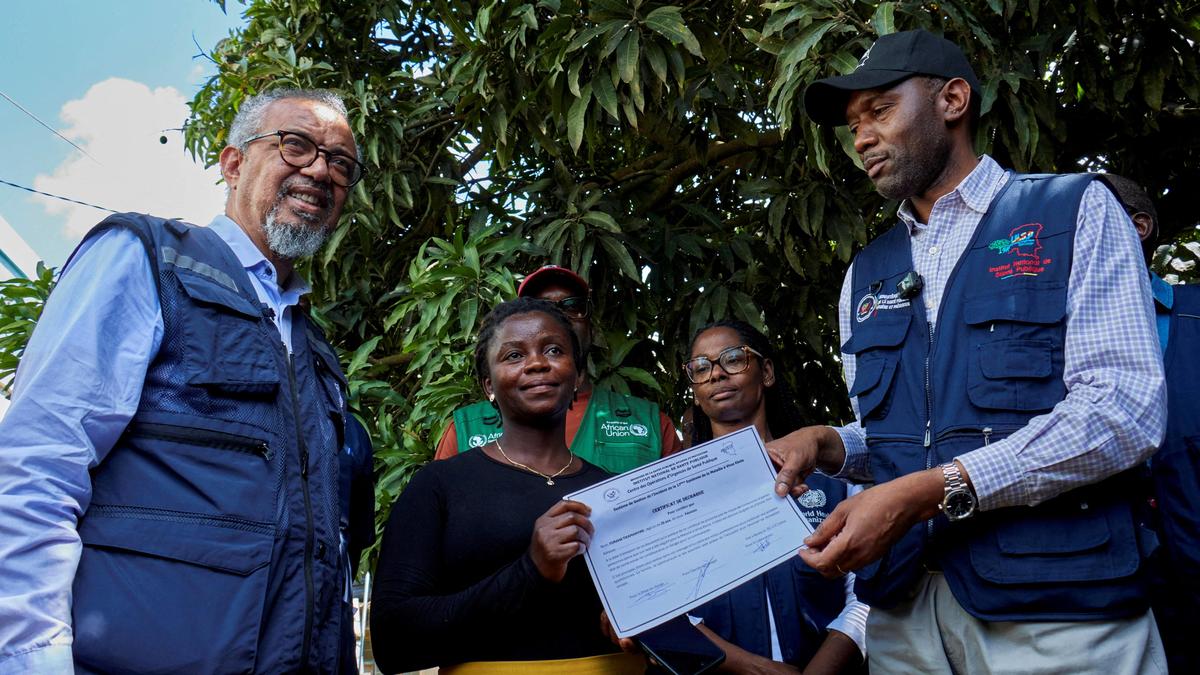
Furaha Tikamanyire, a Congolese health worker who recovered from the Ebola virus receives her certificate of discharge at the Evangelical Medical Center, as she stands with Director-General of the WHO Tedros Adhanom Ghebreyesus, in Bunia, Ituri province, Democratic Republic of Congo, on May 31, 2026.
| Photo Credit: Reuters
The outbreak remains focused in Congo’s eastern Ituri province, where 264 of the cases have been recorded, Congo’s Ministry of Health said. Congo has reported over 1,000 suspected cases with the Bundibugyo virus, the current species of Ebola, which has no approved treatment or vaccine.
According to the Health Ministry, the main challenges in containing the outbreak include early detection and rapid isolation of cases, rigorous contact tracing, safe and dignified burials and strengthening infection prevention and control in health facilities.
The contact tracing coverage rate so far is 45% with 220 suspected cases under investigation, the Ministry said.

Meanwhile, some of the five people who have so far recovered from the disease spoke of their relief in interviews with The Associated Press.
Baraka Bulambulu, a nurse, said he was overjoyed after the last two Ebola tests on him returned negative.
Bulambulu was among those presented certificates of recovery by the World Health Organisation Director-General Tedros Adhanom Ghebreyesus as he opened a new Ebola treatment centre in Bunia, the capital of Ituri province, on Sunday.
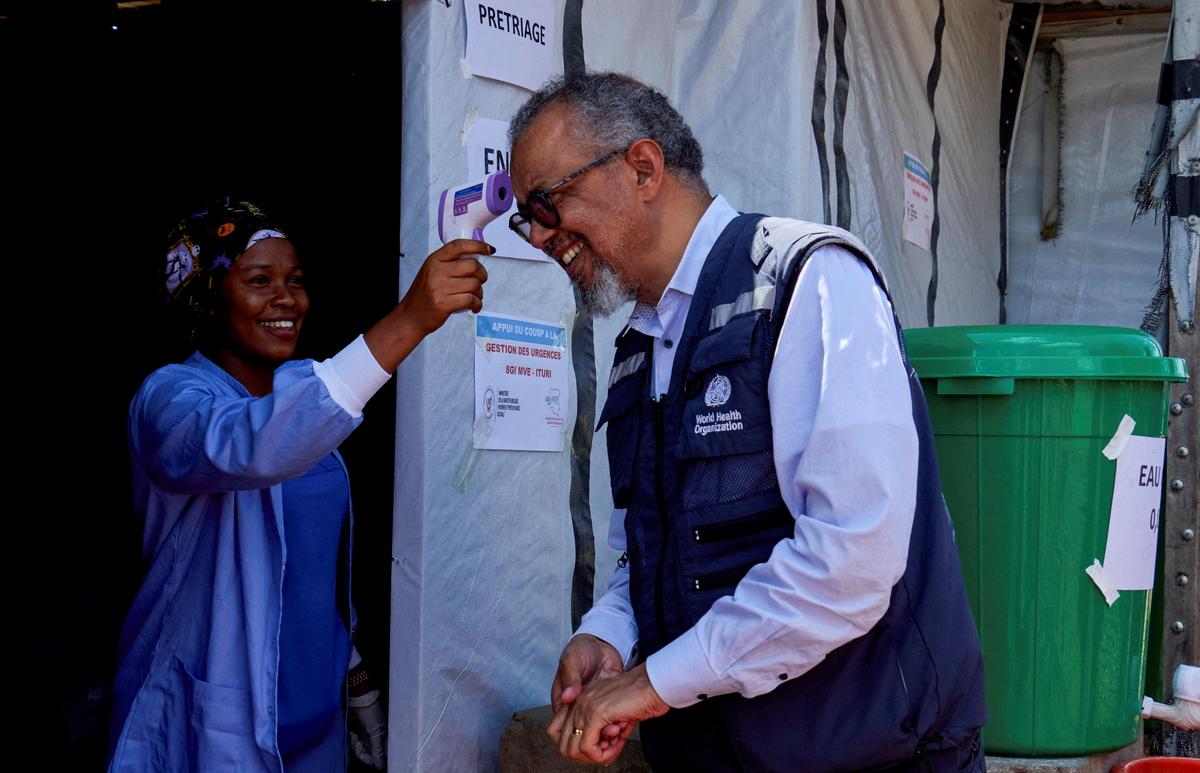
Director-General of the World Health Organisation (WHO) Tedros Adhanom Ghebreyesus during his visit to coordinate the response to the Ebola outbreak in Bunia, Ituri province, Democratic Republic of Congo, on May 31, 2026.
| Photo Credit:
Reuters
WHO Director-General Tedros Adhanom Ghebreyesus, while on a Saturday (May 30, 2026) visit to Bunia — the capital of the eastern Congolese province of Ituri — noted that although there currently is no licensed vaccine or treatment for Ebola caused by the Bundibugyo virus, “it is not without hope,” as it can be survived with good medical care.
“The first one came back positive, but the second and third were negative for me,” Bulambulu said with a wide grin. “Coming out of this illness alive is an indescribable joy.”

Ezo Etienne, another nurse who recovered from the disease, said he first started feeling dizzy during ward rounds at the hospital as he checked on patients.
“That was how it started,” he recalled. “I called the team and told them, ‘Something’s wrong here.’ I checked my blood pressure and saw that I was immediately experiencing hypotension (low blood pressure). I decided to rest for a bit, and a few minutes later I started vomiting.”
The WHO has said all five survivors are health workers — four nurses and a laboratory worker — a group most affected in the outbreak.
Treatments so far have mostly targeted patients’ symptoms, the organisation has said.
“Your courage gives hope and your living story, that this outbreak can be stopped,” Tedros told the health workers on Sunday (May 31, 2026).

Neighbouring Uganda has also reported nine cases of Ebola and closed its border with Congo seeking to limit its spread.
Although more than 20 Ebola outbreaks have taken place in Congo and Uganda, the Bundibugyo virus has been rare. The lack of approved vaccines and treatments, as well as the remote locations and armed violence in hot spots, have made the current response challenging.
Despite the challenges, the recoveries are “a victory worth celebrating,” said Dr. Dieudonne Mwamba Kazadi, the director-general of Congo’s National Institute of Public Health.
“It’s a strong message that it is possible to recover from Ebola when seeking care early in a dedicated health facility,” he added.
Published – June 01, 2026 01:24 pm IST
Leave a Reply