Venkateshwaran, a young Divisional Forest Officer of Chalakudy in Thrissur, and his men have been on their toes since the morning hours at Chiklayi in the Athirappilly forest stretch on a rainy day in the second week of June. An alert call from an elephant watcher on the presence of a herd of wild elephants near the human habitation of Kumbidammudi, a fragmented forest patch in the rainforest of Athirappilly, which forms part of the Western Ghats, spurred the team members to action. Two drone pilots quickly launched their remotely piloted aircraft systems to zero in on the exact location of the animals. Relying on the drones’ inputs, a group of animal trackers moved towards the area where the elephants had appeared.
The team tediously made their way through the forest, as the golden rays of the morning sun filtered through the thick canopy of the rainforest. The verdant forest had grown darker in the monsoon showers. The chirping of the crickets filled the air. Traversing through the wild track was a treacherous task as some segments of the path had turned slushy in the overnight rain. The overgrown wild grass and shrubs obstructed movement. Risk lurked in the form of wild elephants that could position themselves behind the tall and thick patches of vegetation.
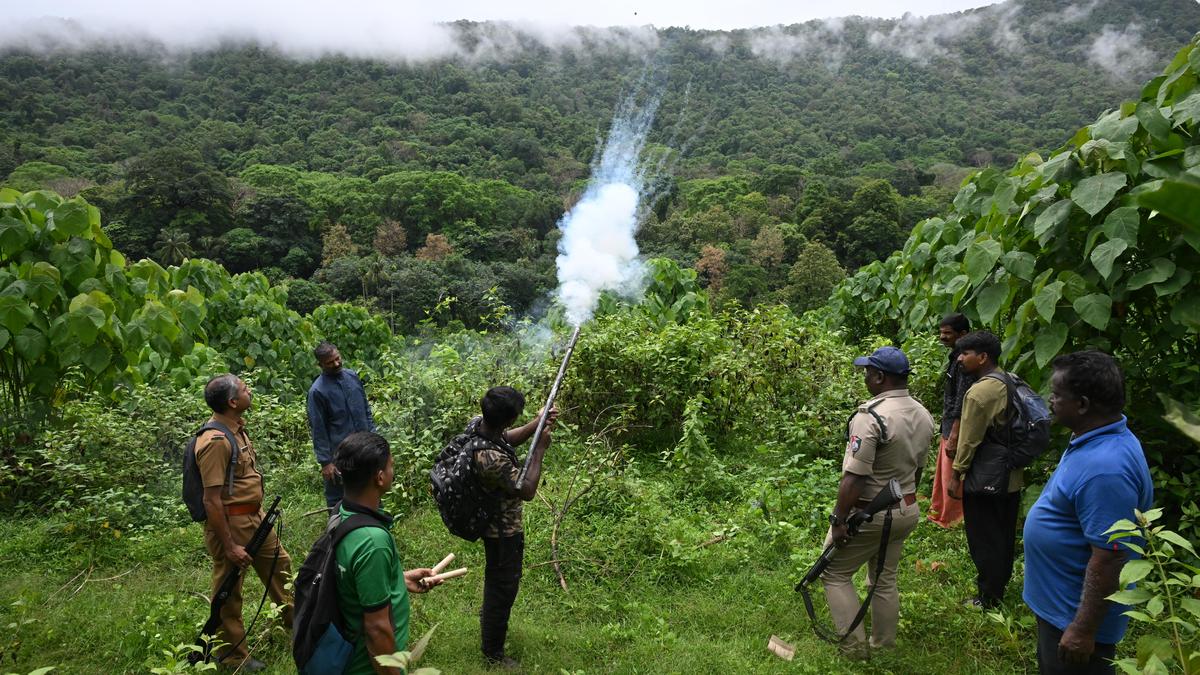
The sound of crushing foliage or the breaking of tree branches made the team instantly wary since one wrong step could turn fatal. Some of the team members held their pump-action guns ready. The pellets shot from the guns can inflict deep pain but would not injure the animal. Pain serves as an effective deterrent while handling wild animals, they say. The trackers carried locally made bazookas, with a long metal pipe and a pistol grip, for bursting firecrackers. Once ignited, the gun will launch the cracker to a distance of 50 metres before it explodes, scaring away wild animals. A team member tightened his grip on the handle of his long machete. “Ideally, animals should be driven out of human habitations during the daytime, when there is sufficient light. The operation becomes more dangerous at night and in forest terrains. Yet, we undertake such assignments,” said Jobin Joseph, a Range Forest Officer, who is currently involved in the operations.
The officials said they put their lives at risk while engaging in such operations. “During a recent operation, one tusker charged at us. The risk multiplies in forest areas at night and during rain, when the terrain becomes slippery. We have to deal with an animal that can move faster than us,” said Jobin. As night fell over the Kumbidammudi hills, the team of officials began “disturbing” the wild elephants in an attempt to drive them safely out of human habitations and into the wild. Someone panned a powerful light across the holding to locate the animal.
The officers stood in a formation, keeping a pathway open for the animal to move out. The animal was pushed out of the human habitation for around 12 km. Suddenly, the jumbo moved in another direction, upsetting the officials’ plans Anticipating trouble, the team leader placed his index finger on the trigger of his 212 rifle as the team members renewed their attempts.

Members of the elephant monitoring team keeping a close watch on the movement of a tusker that came near a human habitation.
| Photo Credit:
THULASI KAKKAT
It was yet another day at work for the elephant chasers of Athirappilly, tiring and perilous. “The team members, who are engaged in the risky business of chasing away wild elephants, have come face to face with death on several occasions. Once, I saw death positioned hardly 10 metres from me in the form of an irate elephant herd and froze for a moment. When the team members shouted on top of their lungs and fired the bazookas, the animals retreated,” recounts Venkateshwaran.
On May 30, 2026, Mohanan, 63, a dairy farmer of Vaissery in Athirappilly, was killed in an encounter with a wild elephant. A lone tusker, which forayed into his holding, trampled him early in the morning as he tried to scare it away with a freshly lit torch. The animal, which remained hidden under the cover of darkness, killed him in a flash. “The elephant had attacked two others a few days ago. It was first spotted foraging in the area a fortnight ago,” said Adarsh, Mohanan’s son.
It was following the death of Mohanan, which shocked the residents of the popular tourist destination, that the Forest department launched its operations on June 2 to secure the human habitations by driving away the marauding elephants. Specially trained teams, which have members of local communities as well as tribespeople who know the terrain, have been patrolling the forest since then to spot the animals.
Signage alerting the passengers about the animal crossing points and possible presence of wild animals could be seen along the Athirappilly-Vazhachal road that leads to Sholayar.
The field operation of driving the elephants begins with data collection.
“The drones track the movements of the elephants while others patrol the forests during the daytime. The animal trackers will be fed with the inputs sent in from the drones. The special teams will start disturbing the animals and drive them out of the holdings using various techniques. The plan is to push back the animals to the Athirappilly forest across the Chalakudy river through select exit points,” said K.K. Sunilkumar, a Deputy Conservator of Forests, who heads the expert team of elephant chasers.
“The animal movements are tracked 24/7. Two watch towers are being set up inside the forest. The action plan for a given day is finalised by around 7 a.m. after analysing the data on animals. A 100-member strong team is involved in the operations,” said Sunilkumar, who appeared sleepy and worn-out after a nearly 13-hour-long operation, which ended at around 4 a.m.
Unique names
The animal trackers, as well as the residents, are familiar with the physical characteristics and behavioural patterns of the elephants that frequent the area. The residents have even assigned each animal a unique name.
Ottakaathan has a big hole in his broad ear flap, probably the remnant of a fight with another one of his tribe. Punyalan (the saint) used to regularly arrive on the church premises at Vettilappara in the evenings. “Ezhattumukham Ganapathy, a cute-looking and gentle tusker, was the first one to appear in the area. Chillikomban has thin, long tusks whereas Manjakomban got the moniker from his yellow tusks. Murivalan derived his name from his short, injured tail,” T.A. Preethikumar, a member of the tracking team, listed the names of the elephants that they regularly encounter during their vigil.
“Some elephants like Pottan Aana (deaf elephant), cannot be easily scared away as they ignore the sound of crackers,” observed Preethikumar. On a given day, the trackers cover around six kilometres on foot, looking for the animals. “I am not scared of the elephants as I encounter them regularly,” said Ratheesh, another animal tracker, while taking a short lunch break after covering around four kilometres.
Another tracker demonstrated the functioning of the bazooka by lighting the wick of the firecracker with his cigarette lighter. The loud boom of the cracker, which echoed across Pillapara, a part of the mountain chain of Western Ghats that runs through the area, was followed by a trail of thick smoke.
“The rampant changes in the land use pattern of the area might have aggravated the incidents of human-wildlife conflicts in the region,” notes I.S. Suresh Babu, Divisional Forest Officer, Vazhachal. “The widespread farming of pineapple and palm oil and the year-round availability of water in the Chalakudy river have been attracting the elephants. Currently, there is a resident population of around 15 elephants in the region,” notes Suresh.
Some of the elephant corridors, which have been used by several generations of wild elephants, were obstructed by the solar fences that were drawn through the region, forcing the animals to seek alternative routes to reach the fodder and water sources. Some of their new navigational paths run through human settlements, thus opening new frontiers of conflicts with humans, observed Suresh.
The wild elephants have to be disturbed to drive them out of human settlements to secure human lives and property. Like the elephants flushed out of the holdings, the elephant chasers too spend their nights all awake and stressed.
Leave a Reply