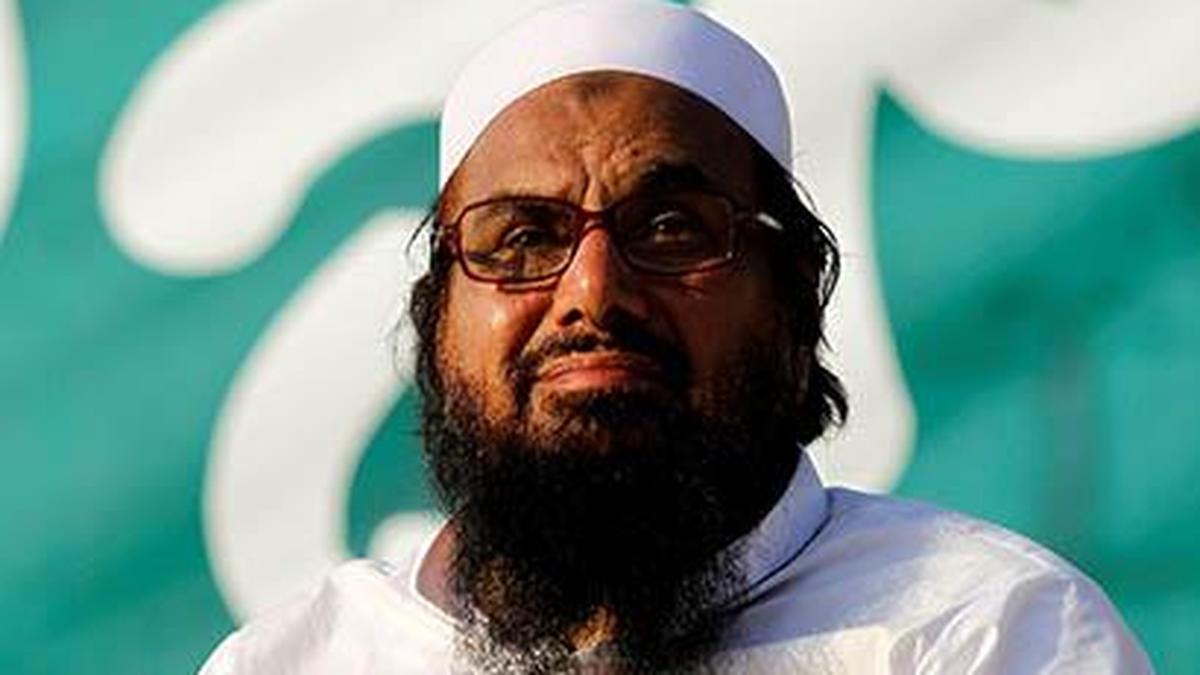

In September 2019, those among the first to be designated as terrorists included Lashkar-e-Taiba’s Hafiz Saeed. File.
| Photo Credit: Reuters
The story so far: On July 4, 2026 the Union Ministry of Home Affairs (MHA) designated 23 individuals as “terrorists” under the Unlawful Activities Prevention Act (UAPA), 1967. A Bengaluru techie is among the six Indians and 17 Pakistanis who were designated “terrorists” and the individuals who are no longer in India are accused of roles ranging from recruitment, training, infiltration and logistics support to financing, arms supply, drone-based weapons delivery and planning or facilitating terror attacks in India. The list of total designated terrorists now stands at 80.
What is the law under which the designations have taken place?
The designations were made under Section 35 of UAPA. The provision empowers the Central Government to add the name of an individual in the Fourth Schedule to the UAPA , if it believes that individual is involved in terrorism.
When was it introduced?
The said provision was inserted in the UAPA through an amendment in 2019. The UAPA, enacted in 1967, was first amended in 2004, 2008 and 2013. The 2004 amendment was to ban organisations for terrorist activities, under which 34 outfits, including the Lashkar-e-Taiba and the Jaish-e-Mohammad were banned. The 2019 amendment on August 2 the same year, gave MHA the power to designate individuals as terrorists.
Why was the law amended in the first place?
Replying to the debate in Rajya Sabha on August 2 ,2019 while the UAPA Amendment Bill was being discussed, Union Home Minister Amit Shah said that terrorist acts are committed not by organisations but by individuals. Merely declaring an organisation as a terrorist organisation will not stop the individuals behind it and not designating them as terrorists, would give them an opportunity to circumvent the law and they would simply gather under a different name and keep up their terror activities, the Minister said. He stated that that terrorism is a global problem and the United Nations along with several other countries, have provisions in their laws to designate individuals as terrorists. The amendment also gave powers to Director General, National Investigation Agency (NIA) to attach properties acquired from proceeds of terrorism. The Minister said that the law does not take away powers of the State police. When NIA takes up a case having international and inter-state ramifications, all the facts pertinent to the case are with the NIA, and not with the State police, he said. The Minister said that at present, the law requires that NIA take prior permission from the respective State DGP to attach the proceeds of terrorism,which delays the process as often such properties are in different States.

Who were the first individuals to be designated terrorists?
In September 2019, those among the first to be designated as terrorists were Jaish-e-Mohammad chief Masood Azhar, Lashkar-e-Taiba’s Hafiz Saeed, his deputy Zaki-ur-Rehman Lakhvi, and underworld don Dawood Ibrahim, who planned and executed the 1993 Mumbai serial blasts. All the individual terrorists are Pakistan-based.
Were there any concerns regarding the misuse of the law?
Opposition had raised concerns in Parliament that the law could be misused against political opponents and civil society activists.
Congress member Kapil Sibal had said in Rajya Sabha, “At what stage will you declare an individual as a terrorist – at the time of arrest, when you file a chargesheet or after trial is completed? It’s not clear. And if he is already being tried for a terrorist offence, you cannot declare him as a terrorist as legally a person is innocent till proven guilty. The Bill will be challenged in court and struck down, its better you send it to Select Committee.”
What was the Ministry’s response?
A Home Ministry official said that the designations were in alignment with laws in European Union (EU) countries, the U.S.A., China, Israel and even Pakistan and Sri Lanka. The official added that Sri Lanka started designating individuals after the April 21 Easter terror attacks in 2019. The official added that the amendment was spurred after India faced embarrassment in diplomatic circles earlier in 2019 while convincing the world to designate Masood Azhar as an international terrorist under UN charter. “We were asked why haven’t we designated Azhar yet? The UAPA bill is to address this anomaly,” the official had said then.
What is the process involved?
The entire process is non-judicial, it will be decided by the officials of the Ministry of Home Affairs (MHA) and the “burden of proof” will be on the government.
The proposal to designate individuals has to come from the intelligence agencies. The information provided by one security agency is corroborated with another. The MHA examines the proposal and once the ministry is convinced after going through all the records, the names are cleared by the Home Minister and then notified in the Gazette of India.
There is an option for individuals designated as a terrorist to file an appeal before the MHA, either in person or through registered post. Once the appeal has been filed, MHA has to decide the case in 45-days. Further to this, the individual will also have an option to appeal before an independent three-member review committee comprising sitting or retired High Court judges. That committee is also to be appointed by MHA. So far, there have been no known cases of individual terrorists approaching MHA to review their case.
What about the outfits and groups designated as terrorist organisations under UAPA?
According to MHA, there are 45 “terrorist organisations” designated as such under Section 35 of UAPA, that are listed in the first schedule of the Act. Other than this, there are 23 outfits declared “unlawful associations” under Section 3 (1) of UAPA.
Published – July 06, 2026 09:51 am IST
Leave a Reply