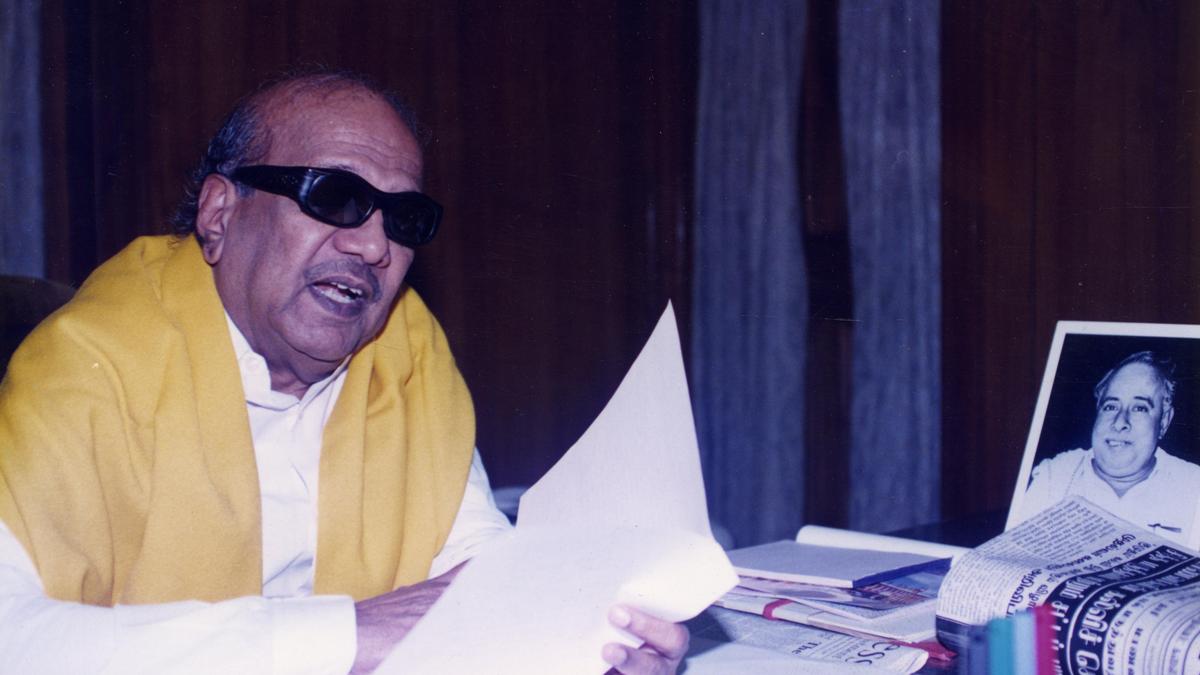
The situation faced by Chief Minister C. Joseph Vijay’s Tamilaga Vettri Kazhagam (TVK) now is no different from what the Dravida Munnetra Kazhagam (DMK), led by late Chief Minister M. Karunanidhi, faced in 2006.
The TVK, which contested the recent Assembly polls on its own, secured 108 seats (with Mr. Vijay winning in two seats).

However, 20 years ago, the DMK, which faced the Assembly elections in alliance with the Indian National Congress, Pattali Makkal Katchi (PMK), and the Communist Party of India (Marxist), won only in 96 seats. However, the DMK formed the government with outside support from its allies, even though the Congress, which won 34 seats repeatedly, exerted pressure on the DMK to accommodate its MLAs in the government.
Karunanidhi remained firm in running it as a DMK government because he enjoyed the support of the PMK and the Left parties, whose combined strength was sufficient to cross the halfway mark. But J. Jayalalithaa, then general secretary of the All India Anna Dravida Munnetra Kazhagam (AIADMK) and Leader of the Opposition, never missed an opportunity to mock it as a “minority DMK government”.
Also read | The last anchor: the legacy of M. Karunanidhi
It was late E. V. K. S. Elangovan, former TNCC president and Union Minister, who was particularly vocal about the need for a coalition government. Long before the 2006 Assembly elections, he had made his views on the issue public.
“Coalitions at the Centre and in many States have become the order of the day, and Tamil Nadu cannot remain an exception for long,” Mr. Elangovan had said when he served as Union Minister of State for Commerce and Industry between 2004 and 2009. His argument was that the Dravidian parties could not come to power without the support of the Congress. His prediction eventually came true in 2006.

The argument advanced by Elangovan and other Congress leaders at the time was that the DMK could not deny the Congress a place in the State government while simultaneously enjoying the benefits of a coalition government at the Centre.
The last time Tamil Nadu witnessed a coalition government was in 1952. However, leaders of the Dravidian parties largely steered clear of the idea thereafter. In 1980, the DMK and the Congress arrived at an understanding to contest 50% of the seats each and form a coalition government if voted to power. But the coalition idea was buried deep after the alliance failed to capture power.
Even before the 2006 elections, Karunanidhi surprised both allies and adversaries by saying his party was prepared for coalition rule after the elections. After the results, he said the DMK alliance had received the mandate to form a coalition government. However, he subsequently changed his mind after the PMK, led by Dr. Ramadoss, with its 18 MLAs, offered a letter of unconditional support.
Karunanidhi, who later travelled to Delhi to meet Congress leader Sonia Gandhi, ruled out a coalition government and said the pre-election arrangement — under which the Congress would support the DMK from outside — would continue.
Also read | Karunanidhi and the shaping of the Dravidian movement
His argument was that the DMK was extending unconditional support to the Congress government in Puducherry, and that the Congress, in a similar manner, would support the DMK government in Tamil Nadu.
A senior Congress leader, who was among the party’s MLAs in 2006, said the DMK leadership had succeeded in convincing Ms. Gandhi about the “difficulties in running a coalition government in a State like Tamil Nadu.”
“Karunanidhi and Arcot N. Veerasami (then Minister) told me and another senior MLA to prepare a list of candidates to be accommodated in the coalition government. Mr. Veeraswami even told me that seven chambers were ready for Congress ministers. But it never happened because of the lack of unity among Congress leaders in Tamil Nadu,” the Congress leader recalled.
Congress MLAs, however, continued to raise their voice in favour of a coalition government. Speaking during the motion of thanks to the Governor’s Address, Congress member C. Gnanasekaran, a well-known face in the party, said the coalition model had proved successful at the Centre.
“The coalition form of governance has been catching up in States such as Maharashtra and Kerala. Mr. Karunanidhi should come forward to implement the coalition strategy in Tamil Nadu as well,” he said.

Karunanidhi somehow survived the pressure, partly because of the support extended
by the PMK and partly because of the lack of unity among Congress leaders in Tamil Nadu, as well as the absence of strong backing from the party high command.
But Mr. Vijay may not be able to avoid a coalition government, as the Congress, which was among the first parties to extend support to him, is keen on joining the government. The Congress legislators are expected to be inducted when the Cabinet is expanded, ushering in a new phase in Tamil Nadu politics.
Published – May 20, 2026 06:00 am IST
Leave a Reply