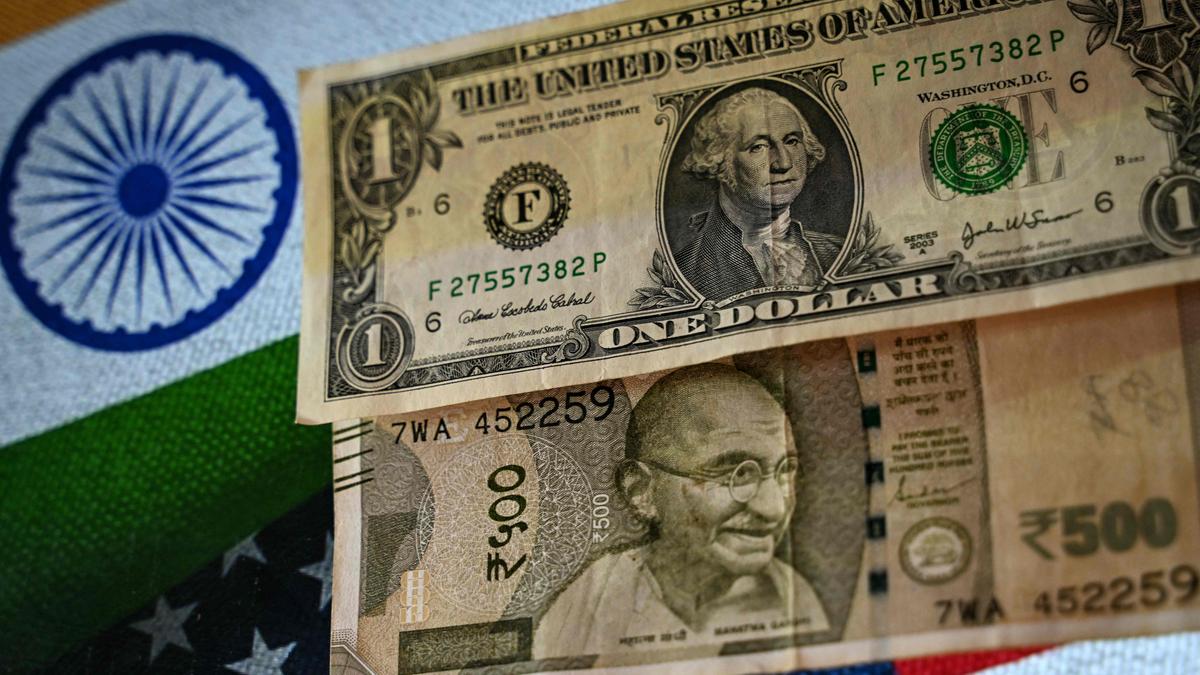

Bond market experts and economists, while certain that the inflows cannot be directly attributed to the tax cut, do not discount the benefits of such a move. Representational image.
| Photo Credit: AFP
The overall inflow of foreign investor money into India’s bond market crossed a record ₹55,518 crore in June 2026. Experts, however, aired concerns over the sustainability of the momentum as the macroeconomic climate had not turned completely conducive.
In early June 2026, the Government of India waived Long-Term Capital Gains (LTCG) tax on foreign investment in bonds. The RBI and the Centre further expanded the Fully Accessible Route (FAR) to include new long-term Government Securities with 15-year, 30-year, and 40-year tenors, as well as Sovereign Green Bonds
The measures came in the backdrop of a net outflow of foreign funds from Indian capital markets and a constantly depreciating rupee.
“The reforms are poised to attract long-term institutional investors such as pension funds, insurance companies, and sovereign wealth funds, leading to more stable and sustained capital inflows. They are also expected to boost foreign exchange inflows and strengthen the resilience of India’s financial markets,” the Ministry of Finance said in its release. The question of whether tax cuts can deliver better inflows is a debated topic among economists and financial analysts.
“Tax tweaks can serve as a catalyst but rarely override core fundamentals like policy consistency and external conditions. India’s progressive liberalisation through the Fully Accessible Route has often mattered more. While taxation was a constraint – especially for debt – it was secondary,” said Lekha Chakraborty, Professor at National Institute of Public Finance and Policy (NIPFP).
The inflows, however, did come, and they were broad-based across the bond market. FPI investment under the general limit in debt securities, which contain both corporate bonds and government securities, came in at ₹55,518 crore in June 2026. Investments under the Fully Accessible Route (FAR) were the highest since September 2024, when it was introduced, and recorded an inflow of ₹21,652 crore in June 2026. Put together, they more than compensated for the significant outflow of ₹49,340 crore from equities.

“Attributing the recent increase in FPI inflows solely to the removal of capital gains tax or withholding tax would be an oversimplification. A combination of factors has contributed to the improved sentiment in India’s debt market,” said Venkatakrishnan Srinivasan, Managing Partner at Rockfort LLP.
“Overall, June has been a positive month for the bond market. The easing of geopolitical concerns surrounding the Strait of Hormuz, expectations of India’s possible inclusion in the Bloomberg Global Aggregate Bond Index and improving market sentiment following the RBI’s recent policy measures have all supported investor confidence and foreign investor interest,” Mr. Srinivasan continued.
The sustainability of the inflows, which the tax cut was aiming at, cannot be definitely guaranteed, as the underlying economic data do not suggest that things have changed completely positively for the debt investors.
All bond market experts and economists, while certain that the inflows cannot be directly attributed to the tax cut, do not discount the benefits of such a move.
Benefits of the tax cut include “diversifying inflows away from equities, deepening debt markets, and supporting external balances,” while fundamentals dominate in determining flows, said Ms. Chakraborty.
However, some others in the policymaking space are more careful in evaluating the utility of cutting taxes to bring in capital market investments. Former Finance Secretary S.C. Garg said that the move did not have much of a deeper policy thought and was “more a desperate attempt at bringing in foreign exchange”.
“If you have to try something to get forex and there is no measure available for FDI or FPI in equity, you end up going for FCNR B and government securities,” he said.
Now that the tax policy constraint on foreign investment in Indian debt securities has been removed, attention will shift to the macroeconomic climate, which will have to be as lucrative for investors to show the same level of interest in the bond market as it did in June 2026.
Published – July 06, 2026 08:37 pm IST
Leave a Reply