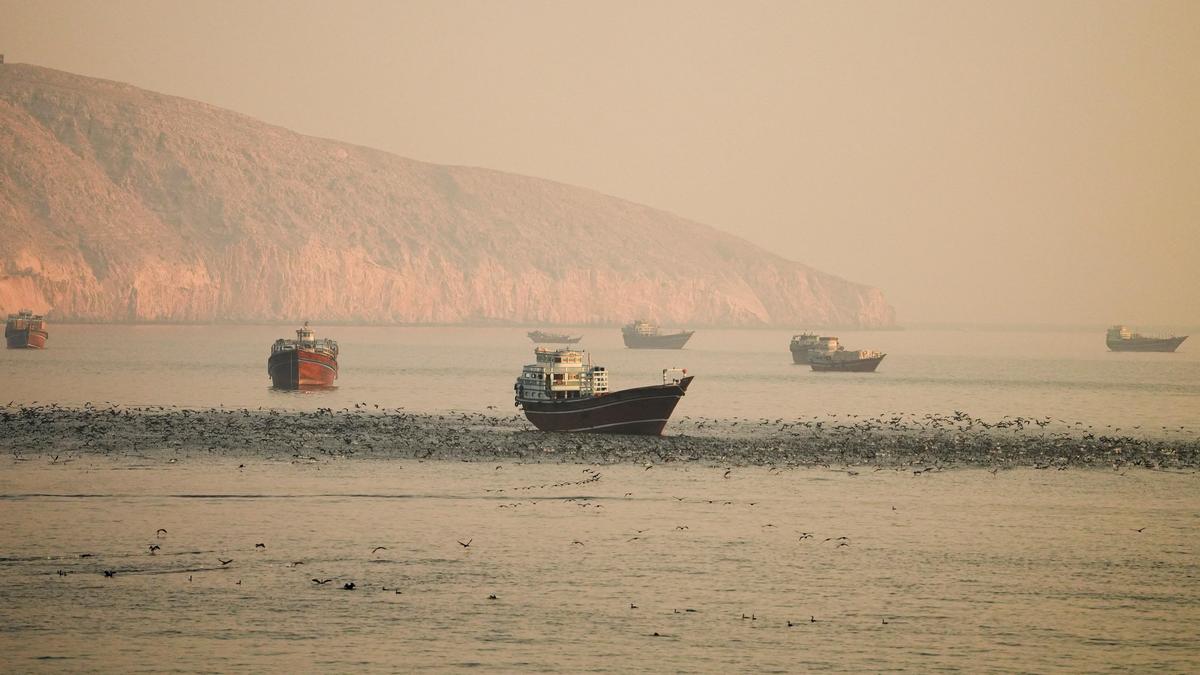

The International Maritime Organisation, a UN agency, referred to a letter written by Oman’s Ministry of Defence Pakistan’s National Hydrographic Office that gives a detailed plan for the evacuation. File
| Photo Credit: Reuters
International Maritime Organisation (IMO) Secretary-General Arsenio Dominguez has announced a plan to evacuate all the ships — and the 11,000 seafarers on them — stranded in the Persian Gulf due to the war in West Asia.
West Asia war: Follow LIVE updates on June 23, 2026
“This large-scale operation will be carried out in close cooperation with Iran, Oman, and all other coastal States in the region, the United States, and the maritime industry,” he said.
Although his statement does not explicitly refer to Iran’s plan, the plan put out by the Sultanate of Oman does mention both routes — one along the Omani coast and the other along the Iranian coast — that ships are currently using to transit the Strait of Hormuz. The plan also asks vessels to contact the respective “coastal state” of their selected route to confirm transit.
Mr. Dominguez added: “We have secured the necessary safety guarantees and have thoroughly verified the conditions for safe navigation to support these operations.”

Phased evacuation
The IMO, a UN agency, referred to a letter written by Oman’s Ministry of Defence Pakistan’s National Hydrographic Office that gives a detailed plan for the evacuation. Pakistan, along with Qatar, has been a mediator in the negotiations between Iran and the U.S.
The letter says that the Sultanate of Oman has worked with the IMO to provide all vessels with the option of a temporary maritime corridor as per listed coordinates. To reduce risks and ensure safe navigation, the IMO has developed a phased approach based on groups of vessels. The letter says that the traditional traffic separation scheme is unsafe in a reference to mines, and two routes, one south and another north of it, shall be used for transit. Vessels will be contacted individually and advised of their allocated transit day by the parties coordinated by the IMO.

Illustration: Pon Vasanth B.A.
These two routes can handle 20-30 ships a day while the traditional route at the centre of the strait used to see some 130 ships transiting every day before the war. Hundreds of ships are still stranded in west of Strait of Hormuz.
There will be a designated waiting area within international waters where ships will go. From there, the vessels will contact “the relevant coastal state”, in a reference to Iran for the northern route. The letter adds: “Each shipowner and master remains responsible for conducting an independent risk assessment prior to voyage.” The Automatic Identification System of the vessel shall stay on, the letter adds.
The letter gives the coordinates of the Omani route that ships should take.
A few days ago, Iran had announced that vessels that submit their passing requests to the Persian Gulf Strait Authority that it set up during the ceasefire “will be cleared for passage promptly.”
Published – June 23, 2026 11:00 pm IST
Leave a Reply