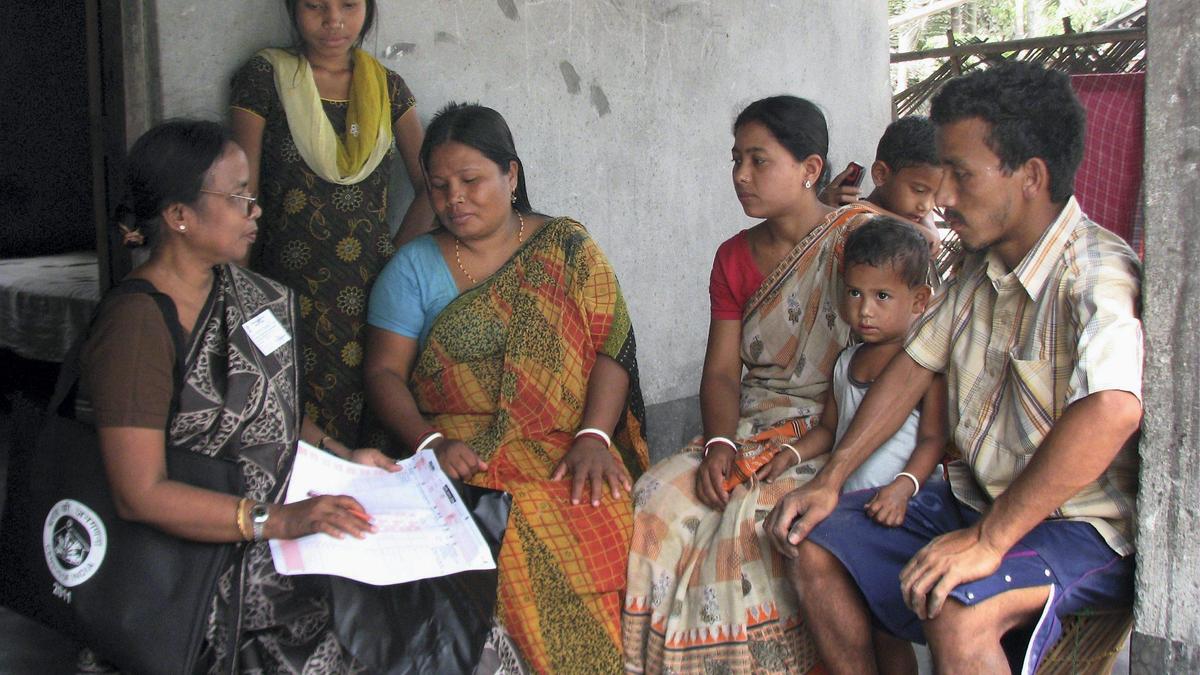
Can India’s official statistics detect large-scale undocumented migration? Undocumented migrants may evade law, but can they evade the Census? If millions of them are living in India, they must appear somewhere in the country’s official statistics. Union Minister of Parliamentary Affairs Kiren Rijiju told Parliament that “As per available inputs, there are around 20 million illegal Bangladeshi migrants staying in India”. Then, they must come across enumerators during the Census. Millions of such people then must be meeting enumerators during the decennial censuses of India. What might an undocumented migrant do in such an encounter?
They can respond in three ways: avoid or duck the Census altogether, contributing to coverage error; be counted but report India rather than Bangladesh as the place of birth, creating measurement error; or report the place of birth truthfully.
Each of these choices leaves a different mark in the data, which can be checked. Together, this provides a simple framework for asking whether India’s official data are consistent with the claimed scale of undocumented migration. But a framework based on birthplace has a built-in limit: the Census records where a person was born, not whether they entered legally. The same “born in Bangladesh” category contains citizens, visa-holders, and the undocumented alike, with nothing to tell them apart. What the data can speak to, then, is scale: whether a population of the claimed size exists at all.
Ducking
Ducking is hiding from the enumerator altogether. But hiding is not the only way to duck. This is what a demographer would call coverage error. A subtler version, for example, is to deflect. For instance, tell the enumerator, “I don’t actually live here. I will be counted at my usual residence elsewhere” and then not to be counted at that other place either. Such an answer, given with no intention of being counted elsewhere, is legally no different from refusing to answer—both are offences under the Census Act—but in practice it is likely to go unnoticed.
The outcome is an omission, which is exactly what the Census is built to detect via the Post Enumeration Survey (PES), an independent re-enumeration of a sample of blocks matched person-by-person against the Census. This has been conducted after every Census since 1951 to estimate coverage error—the people the Census missed—and the measurement error—the reasons for which they were missed.
The 2011 PES found a net omission of 23 persons per 1,000 nationally, or 2.3%, unchanged from 2001 (up from 1.8% in 1991). The Eastern zone, with States bordering Bangladesh and where “infiltration” claim is concentrated, is best covered, as shown in the table below.

The table shows the net omission rates in each of the six zones, as defined by Census
Out of the undercount of approximately 27.7 million, the Central and Northern zones together account for 19 million or about 66%.
Nationally, the people most often missed are infants and young, mobile adults in their twenties—a pattern that has held since at least 1991. However, this pattern is concentrated in the Northern and Central states. In the Eastern and Northeastern States, coverage is not only better overall but is also flatter across age groups, with no comparable spike among young adults, as the chart below shows. The people the Census misses are disproportionately infants, not adult migrants.

As the chart shows, in the Eastern and Northeastern States, coverage is not only better overall but is also flatter across age groups, with no comparable spike among young adults
For the sake of argument, even if every person missed by the Census anywhere in the Eastern and Northeastern zones were assumed to be an undocumented Bangladeshi migrant, that would fall well short of the 20 million the government has cited.
What can be therefore said confidently is that the population missed by enumeration is small, stable across the decades, and smallest along the border. This leaves little room for the unenumerated population of the scale the political claim requires.
Misreporting
The second option—being enumerated but recording one’s birthplace as India rather than abroad—is the one that costs the least and can be neither verified nor refuted at the point of enumeration. But it has an implication: a person who misreports is still a person the Census has counted. This is what would be termed measurement error. They remain in the total population, in the count by religion, and in the age and sex tables, but with incorrect birthplace entries.
If, for example, large numbers of undocumented Muslim migrants were doing this, the effect would not be a hidden population but an inflated one—a Muslim population with a rate of population growth, which a larger than natural increase and differential fertility can account for—and concentrated in the border districts.
That inflation has been examined in an earlier article in The India Forum (https://www.theindiaforum.in/politics/has-demography-border-districts-eastern-india-changed), which found no such signature. If misreporting were hiding a large migrant inflow, it would surface as border-concentrated Muslim growth beyond what fertility explains. Instead, the the counts showed that growth that is moderate, fertility-consistent, and geographically dispersed.
Truthful Responses
The third option is to report their place of birth truthfully with the belief that the Census enumeration is anonymous and does not put them at risk. Migrant stock is a widely used measure to keep track of levels of migration. A person enumerated in India, but born in another country is considered a migrant in this measure.
The composition of the migrant stock in India has seen substantial declines of those born in Bangladesh and Pakistan, with large increases of those born in Nepal, as shown in the chart below. However, despite decline in overall migrant stock, about half of India’s migrant stock has consistently been Bangladesh-born persons.

The chart shows the share of people, whose place of birth was not India, counted in the last three Census
In the last three Censuses, roughly 94% of all India’s Bangladesh-born residents lived in the five border States (West Bengal, Assam, Tripura, Meghalaya, and Mizoram); a share that barely moved even as the national Bangladesh-born population itself fell by nearly one-third from about 4.0 million to 2.7 million.

The table shows data from districts in the Eastern States bordering Bangladesh.
Both by share and by absolute numbers across these districts, migrants who are overwhelmingly from Bangladesh are ageing and likely dying out. The younger age-groups show meagre numbers. This pattern is consistent with a specific history: much of this population arrived during Partition in 1947 or the Bangladesh Liberation War in 1971. That generation is now elderly, and its numbers are falling chiefly because its members are dying.
Was there a surge?
Thus, the evidence using official data, in all its forms, suggest that there is no surge of undocumented migrants from Bangladesh, at least between 1991 and 2011. The argument is not that there are no undocumented migrants from Bangladesh in India, but the question here is about the scale of the migration.
The Census cannot tell us there are no undocumented migrants from Bangladesh. What it does tell, from the three different possibilities discussed in this article, is that there are not 20 million of them.
The author is a faculty member in the Economics Group in School of Humanities and Social Sciences, Azim Premji University. The content and opinions expressed are the author’s and are not necessarily endorsed by or reflect the views of the university
Leave a Reply