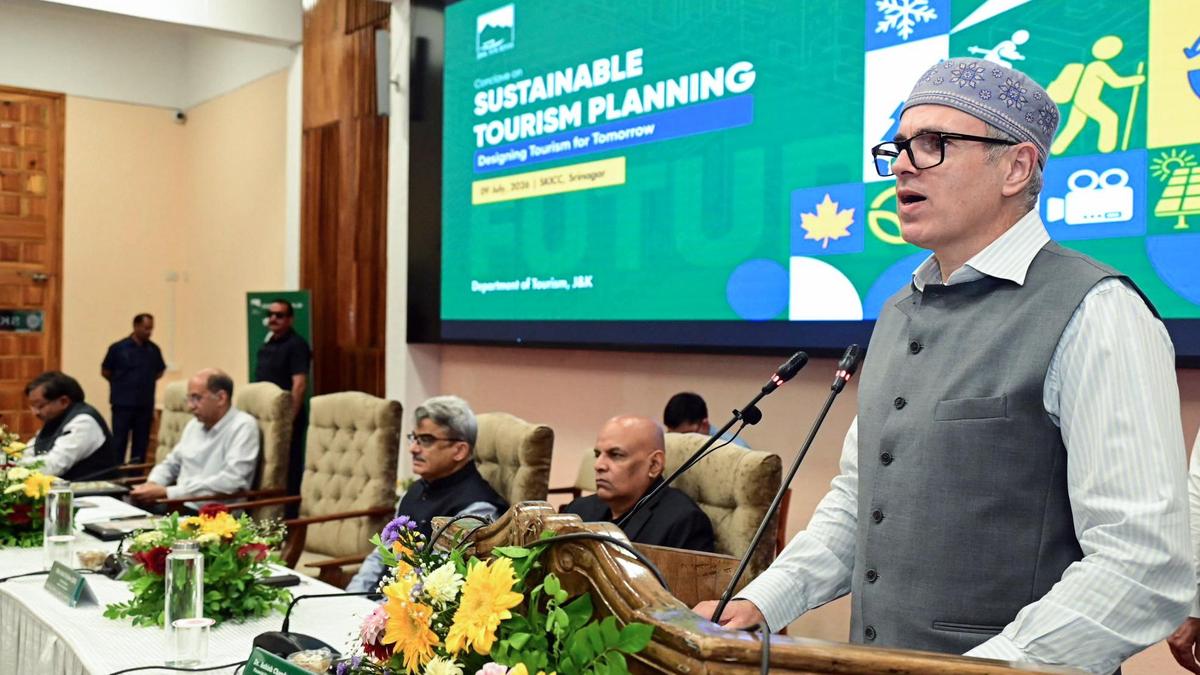

Jammu and Kashmir Chief Minister Omar Abdullah addresses the Conclave on “Sustainable Tourism Planning: Designing Tourism for Tomorrow” at SKICC in Srinagar on July 9, 2026. Photo: X/@CM_JnK via ANI
As Kashmir sees an upswing in tourist footfall over the years, the Jammu and Kashmir (J&K) government is looking at new strategies to strike a balance between tourism and ecology in a region that is ecologically very fragile.
“We are not selling Disneyland, Universal Studios or Las Vegas. What attracts people here is our rivers, lakes, mountains, glaciers and landscapes. Protecting these natural assets must remain the central objective of every tourism master plan. Sustainable tourism is no longer a choice but an imperative for preserving Jammu and Kashmir’s environment and securing the future of one of its most vital economic sectors,” said J&K Chief Minister Omar Abdullah.

He was speaking at the inaugural session of the conclave on ‘Sustainable Tourism Planning-Designing Tourism for Tomorrow’’ in Srinagar. The conclave is attended by policymakers, industry stakeholders and local communities.
Mr. Abdullah made a strong case to “move beyond volume-driven tourism towards a value-based and sustainable tourism model”. “It should safeguard the region’s fragile ecology while ensuring long-term economic prosperity,” said Mr. Abdullah.
Kashmir would host not more than 10-13 lakh tourists annually. The numbers jumped to around 26 lakh in 2024 and dipped due to the Pahalgam attack in 2025. The growing numbers have stressed the small hill stations like Pahalgam, Gulmarg and Sonamarg. The J&K government is in the process of introducing 75 off-beat destinations and establishing tourism infrastructure. However, the government fails to come up with a policy to ensure that numbers are controlled and that infrastructure follows eco-friendly norms.

Mr. Abdullah said tourism devoid of sustainability inevitably could lead to long-term decline. “Tourism without sustainability is an unqualified disaster. It may survive for a few years, but it cannot endure in the long run unless sustainability is built into its very foundation,” the J&K Chief Minister said.
Mr. Abdullah said sustainability cannot be based on knee-jerk reactions. “Every intervention must be well-planned, thoroughly discussed with stakeholders and capable of delivering long-term solutions,” he said.
Stating that Kashmir was witnessing ever-growing visitor numbers, Mr. Abdullah said, “We have to decide whether we wish to earn by charging one hundred tourists one rupee each or by creating an experience where one tourist is willing to pay one hundred rupees. The answer to that question must shape all our future tourism master plans,” the Chief Minister remarked.
He said he welcomed a surge in the number of tourists visiting J&K, but in the future, the tourist flow may need to be regulated so that not only the tourist resorts are protected, but the tourists also enjoy a serene environment rather than having to go through a harrowing experience of traffic jams, poor facilities and over-crowding at these tourist spots.

He said that before the Pahalgam incident, Kashmir was dealing with traffic congestion caused by a huge tourist inflow. “Soon afterwards, we were worried because hotels and destinations had become empty. This reminds us how fragile tourism can be in J&K, where a single incident can affect the whole season,” said Mr. Abdullah.
Meanwhile, Mr. Abdullah also stressed on tourism planning that comprehensively addresses critical issues including traffic regulation, parking infrastructure, waste management, water conservation, building regulations, carrying capacity and community participation. He also laid strong emphasis on scientific solid waste management, saying environmental degradation cannot simply be attributed to tourists.
“Government has a responsibility to manage waste, but citizens too have an equal responsibility. Unless we begin treating Gulmarg, Pahalgam, Sonamarg and Dal Lake as we treat our own homes, sustainability will remain elusive,” he said.
On the master plan, Mr. Abdullah fagged the issue of its implementation. “Selective enforcement breeds resentment and weakens public confidence. Tourism planning cannot be confined to offices; it must be prepared in consultation with local communities who have lived in these destinations for generations,” Mr. Abdullah said.
Advocating premium tourism experiences, the Chief Minister said value-based tourism enables destinations to earn more while reducing environmental stress and improving visitor experiences.
Published – July 10, 2026 11:27 am IST
Leave a Reply