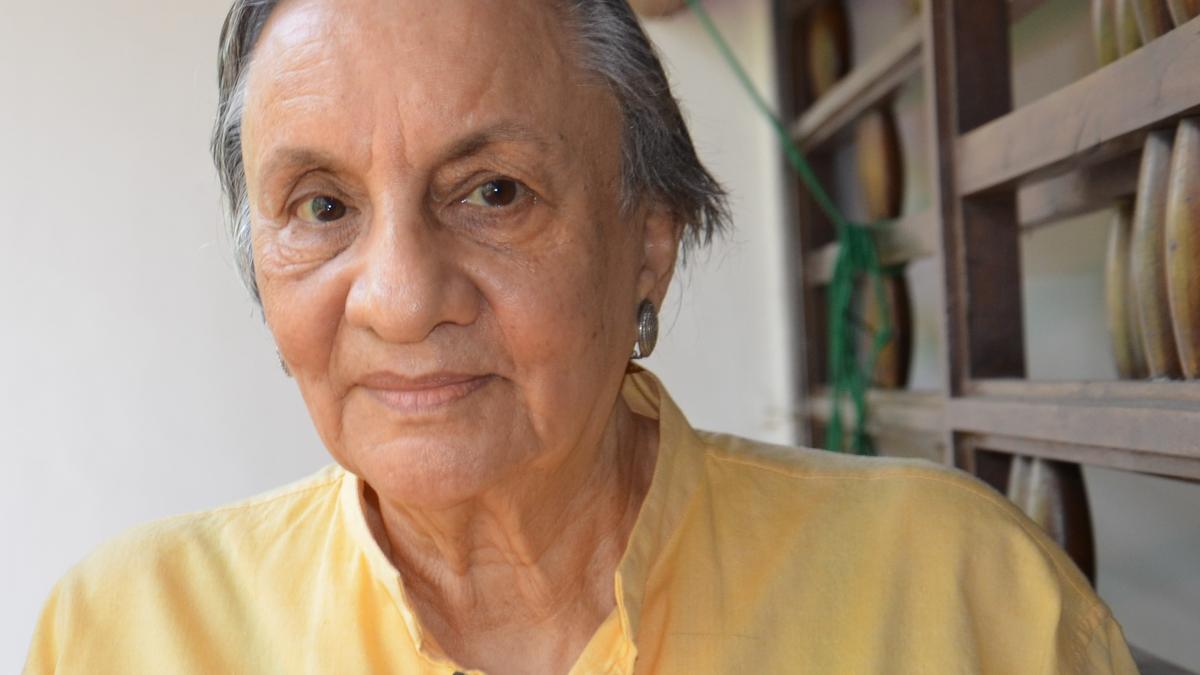
Sri Lanka’s Social Scientists’ Association (SSA) on Tuesday (June 16, 2026) launched the Kumari Jayawardena Feminist Archive, marking the 95th birthday of one of South Asia’s foremost feminist scholars, whose contributions to the study of labour, ethnicity and nationalism, women’s history and movements, are internationally acclaimed.
The archive aims to collate and showcase Dr. Jayawardena’s published work — spanning the realms of scholarship and activism — through her writings, and ephemera by and about her. Best known for the iconic 1986 publication ‘Feminism and Nationalism in the Third World’, an essential text in women’s studies worldwide, Dr. Jayawardena played a key role in generating feminist scholarship and spurring women’s activism not just in Sri Lanka, but across South Asia.
Speaking at an intimate birthday gathering organised in Colombo earlier this week, writer-publisher Ritu Menon, who co-founded India’s first feminist press Kali for Women in 1984, described Dr. Jayawardena as a “beacon across South Asia”. Recalling Dr. Jayawardena’s 1989 essay with Govind Kelkar for the Economic and Political Weekly, offering a sharp critique of leftists who described feminism as “western” to ridicule autonomous women’s organising, Ms. Menon said: “It was an indication to us of what was possible — that we could collaborate across borders, as feminists. Kumari was the initiator and backer affirming these initiatives.”

(From left) Sri Lankan scholar-activist Kumari Jayawardena, publisher and author Ritu Menon, and Sri Lankan political scientist Jayadeva Uyangoda at the 95th birthday celebration of Dr. Jayawardena held in Colombo on June 16, 2026. Photo credit: Meera Srinivasan
The archive is a “work in progress”, said Crystal Baines of the Social Scientists’ Association, a research institute co-founded by Dr. Jayawardena and other academics in 1977. Work on the archive began late last year with individual contributions, and it is now backed by the Rosa Luxemburg Foundation. “We have so far curated a little over 250 items, and what we’re sharing with you today is a preview of more wonderful things to come,” she said at the launch. The team behind the curation hopes that wider engagement with the platform will uncover additional writings, including letters, diaries, manuscripts, or handwritten notes, allowing the collection to grow.
“For over five decades, Kumari Jayawardena produced an extraordinary body of work, including monographs and journal articles, but also magazine and newspaper articles, policy manifestos, pamphlets, and collectively authored pieces that remain relevant to this day,” said Chulani Kodikara, a member of the steering committee of the Kumari Jayawardena Feminist Archive.
“She deployed intersectionality long before the term was coined,” Dr. Kodikara said, adding that Dr. Jayawardena’s focus on the subaltern, the unrepresented and under-represented, and the historically marginalised working class, women, ethnic and religious minorities, was rare at the time. The archive overlaps considerably with the history of Sri Lanka’s women’s movement and that of the vibrant feminist solidarity across South Asia, “because she was one of the foremothers of the feminist movement in South Asia”, she said.
The launch of the portal (www.feministarc.org), held at Dr. Jayawardena’s Colombo residence, was attended by Prime Minister Harini Amarasuriya, former President Chandrika Bandaranaike Kumaratunga, and eminent political scientist Jayadeva Uyangoda, among others. Dr. Jayawardena’s home is fondly remembered as a space of refuge to activists and dissidents through Sri Lanka’s tumultuous history. Dr. Jayawardena sheltered Tamils fleeing the violence of the July 1983 pogrom that would set off a brutal, 26-year-long civil war on the island.
In a special birthday message, recorded in New Delhi and played at the gathering, renowned historian Romila Thapar fondly recalled her first meeting with Dr. Jayawardena in London in the mid-1950s. Prof. Thapar was at the School of Oriental and African Studies while Dr. Jayawardena was at the London School of Economics. “We were together in the hostel [Canterbury Hall],” she said, speaking of Sunday meals and watching films together. “She was doing economics and her economics was heavily polluted, as we all teased her, with politics because that was a time when politics and economics were very closely knitted,” Prof. Thapar said.
In the 1990s, Dr. Jayawardena wrote two acclaimed pieces for Frontline magazine — ‘The Widow’s Might’ and ‘Annie Besant’s Many Lives’. In a conversation with The Hindu in 2017, in the context of London-based radical publisher Verso Books republishing her classic ‘Feminism and Nationalism in the Third World’, three decades after it was first published by Zed Books [London] and Kali for Women [New Delhi], Dr. Jayawardena said: “To discuss the knowledge and status of women today, it is important to know what they have gained and how,” and that “the women’s question is always with us.”
Published – June 18, 2026 02:27 pm IST
Leave a Reply