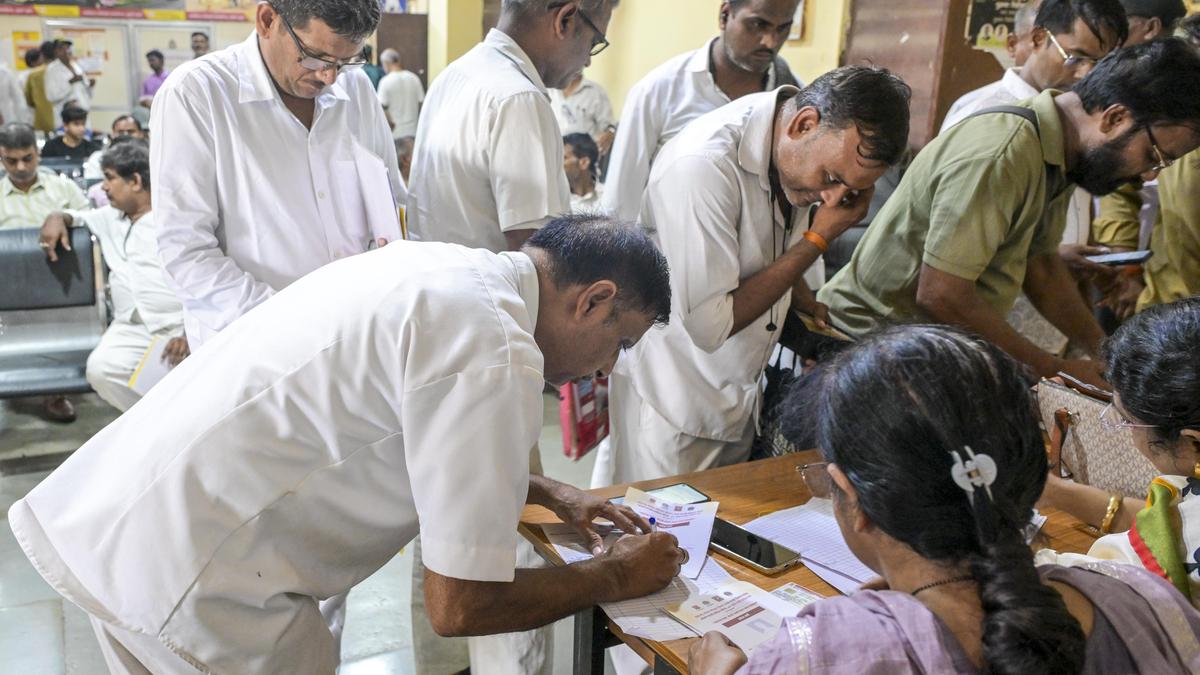
Inside Mumbai’s Andheri Regional Transport Office (RTO), rows of plastic chairs that once held people waiting for their token numbers to take driving tests, now seat a different kind of crowd: auto drivers, with notebooks open, mouthing Marathi sentences for the first time in their working lives. The four-day Marathi course, introduced from June 1, has become an unlikely part at five of 25 RTOs, each in a different zone in Mumbai. Every day, 50 to 80 drivers turn up at each centre, racing to clear a language test before their permits are flagged.
The urgency stems from an announcement made in April by Pratap Baburao Sarnaik, Maharashtra’s Minister of Transport and chairperson of the Maharashtra State Road Transport Corporation (MSRTC). Sarnaik held a press conference to announce that taxi and auto drivers in Mumbai would need to know how to read, write, and speak Marathi, or risk losing their licences. Transport officials who issue licences without proper checks may also face action. The drive was to start from May 1.

His statement sparked a political storm within days, drawing backlash from the Shiv Sena’s Sanjay Nirupam and Samajwadi Party leader Abu Azmi, who objected to the timeline. Sarnaik, who is also from the Shiv Sena, part of the ruling alliance, then pushed the deadline to August 15, giving drivers a longer window to learn to read, write, and speak in Marathi. Mumbai has 88,923 registered taxis and 4,22,990 autos, many of which are driven by people who have migrated to the State in search of work.
For some, the classroom is an unfamiliar and uncomfortable space, one that surfaces old anxieties about literacy, age, and what their children might think. Drivers, who have spent years memorising routes, fares, and the unwritten etiquette of Mumbai’s roads, now find themselves holding a pencil again, sounding out words under the gaze of an instructor.
For some, the four days pass quickly, and without much fuss; for others, each session is a small, quiet reckoning with a part of their past they had hoped never to revisit.
Contrasting views
In Kurla, Moolachand Yadav, 53, who has been driving an auto in Mumbai since 1991, says he has no quarrel with the new requirement. “Itne saal se yahi sheher mein gaadi chala rahe hain, ab Marathi seekh lenge toh sawari bhi badhegi (I have been in this city for so many years now. Maybe learning Marathi will help me find more customers),” he says, confident of finishing the course. Yadav has watched the city change around him for over three decades: new flyovers, new fares, new passengers.
For him, Marathi is simply the next thing to adapt to, no different from learning a new route or a new app. Some drivers at his stand grumble about the classes cutting into their peak earning hours, but he chooses to see it differently. A few mornings spent learning the language, he reasons, could mean better conversations with Marathi-speaking passengers, and possibly more regular customers in the long run. For Yadav, the classes are less an imposition and more an opportunity, a way to earn the trust of more passengers, and with it, more money.
Not everyone shares his enthusiasm. In Govandi, in Mumbai’s eastern suburbs, Rakesh Mandal bristles at the idea of sitting in a classroom. “Mera age 42 hai. Mere bachche school jaate hain. Agar main bhi school jaane lagunga, toh woh sochenge ki unka baap padha-likha nahi hai (I am 42. My children go to school. If I also start going to school, my children will think I cannot read and write),” he says, even though he admits quietly that he can’t.
Mandal has driven a taxi in Govandi for 20 years, ferrying his own children to school before starting his shifts. The thought of his children seeing him study daily fills him with dread. The discomfort runs deeper than the test itself. For Mandal, going back to school risks exposing a gap he has spent decades concealing, and no certificate, he feels, is worth that cost.
Sarnaik feels that learning the language of the region where a person works is a responsibility. The Transport Department had received complaints, particularly from the Mumbai Metropolitan Region, Chhatrapati Sambhajinagar, and Nagpur, that many drivers were unable or unwilling to speak Marathi with passengers, he added, at the press conference.
RTOs turn schools

Vidya Prabhu, a retired teacher, conducting a four-day speaking, reading, and writing Marathi course.
| Photo Credit:
Emmanual Yogini
At the Andheri RTO, the person overseeing the programme is Deputy Regional Transport Officer Sudhir Jaybhaye. “On the first day (June 8) there were 52 students, the second day the numbers went up to 74. Now, we have 85-plus students in every batch,” he says. Classes are between 12.30 p.m. and 1.30 p.m., which he says is between the hectic morning and evening office commute.
Jaybhaye explains that the office uses its routine paperwork as leverage to get drivers enrolled in the programme. When drivers come in to get new licences or renew old ones, or to register a vehicle, the RTO staff tells them to enrol in the free-of-cost Marathi course. “Drivers are told to finish the course first, after which their pending applications are taken up.”
Anjali Deshpande, 73, one of the teachers at the Andheri centre, says attendance is recorded meticulously. She produces a sheet where each driver’s licence number, vehicle registration number, and badge number is logged. Attending all four lectures and signing the attendance register is compulsory to receive a certificate, jointly issued by the Mumbai Marathi Sahitya Sangh and the Kokan Marathi Sahitya Parishad, well-known institutions for their work in the Marathi language, which are under the Department of Cultural Affairs, Maharashtra.

Deshpande is a retired clerk from the Centre’s defence department who took voluntary retirement and turned to tutoring in Marathi and Hindi. She speaks warmly of her days teaching in the RTO classes. “More than 200 auto drivers now call me ‘Marathi madam’. I now get a different, more pleasant kind of treatment from auto drivers when I step out to run errands,” she says, laughing. Unlike in many parts of India, Mumbai’s autos run by the meter, though fares can involve negotiation.
At the Wadala RTO, lectures held are between 1 p.m. and 2 p.m., during what is typically the RTO’s lunch break. One of the course coordinators there explains the philosophy behind the teaching method: a combination of visuals and text. Most of the instructors, she says, are retired professors and language teachers who have spent years in academics.
“The key difference between teaching children and adults, is that children ask far more questions and are starting from scratch, while adult learners tend to work through their difficulties on their own, with less hand-holding,” she says, adding that the focus is on conversational Marathi. Students are taught 14 sentences. On the final day, students are tested on these, to qualify for the certificate. Officials say the test will assess whether a driver can read a signboard or document in Marathi, write a basic sentence, and hold a simple conversation in the language.
Commuters weigh in
The reactions to the drive are not confined to the drivers. Jyothi Ganta, a corporate professional who commutes nearly 9 kilometres daily from the Shimla House area to Fort, about 5 kilometres apart, in south Mumbai, offers a passenger’s perspective. “It’s not always necessary for drivers to speak Marathi. Sometimes commuters and drivers are both so busy on our phones that we just exchange OTPs, that’s it,” she says.
Ganta’s mother tongue is Telugu, but she speaks Marathi fluently because she was born and raised in Mumbai. “When we change location geographically, only two things change: one is food, and the other is language. So, we should speak the language of the soil.” Chetan Tokde, 28, an auto driver from Ambernath, in Thane district, takes a combative position. “Why should we change our language, our culture, our pride?” he says, adding that drivers unwilling to adjust “should go back to their hometowns”. Maharashtra’s Marathi-speaking drivers, he feels, are capable of running the city’s transport on their own.
Vedant Jather, 34, a call-centre employee who commutes daily to Kanjurmarg station, strikes a more measured note. He says he has no problem with migrants, but he finds it telling that some drivers who had lived, worked, and earned in the city for more than 40 years had still not picked up the local language. “Is it possible that this would happen in Karnataka or Tamil Nadu?” he says, arguing that learning the local language is a responsibility drivers should have taken on themselves, rather than waiting for a government deadline to force the issue.
The political crossfire
Maharashtra Navnirman Sena’s Mumbai vice-president Arvind Gawde is critical of the government’s approach, framing the entire exercise as an attempt to woo migrant voters from Uttar Pradesh and Bihar. “Why is this government running a ‘learn Marathi’ project for people coming from U.P. and Bihar?” he says, alleging that the ruling alliance wants to help migrants settle permanently in Mumbai and convert them into a vote bank.
He calls the exercise a “political theatre”, questioning why taxpayer money is being spent on language instruction at all, pointing out that no other State runs comparable programmes. “Have you ever heard of Tamil Nadu’s government spending money and manpower to teach its language to outsiders?” He also feels it is a poor use of the RTOs’s limited resources. The RTOs should be focussing on illegal drivers, road safety, and the broader problems plaguing public transport, than on what he dismissively calls “schooling these bhaiyyas”.
The four-day Marathi course has, in a matter of weeks, become a small but telling window into the larger anxieties of language, identity, and belonging that continue to define life in Mumbai. As the August 15 deadline approaches, RTO offices across the city swell even as the debate over who truly belongs to the city, and on what terms, remains far from settled.
chinmay.r@thehindu.co.in
Edited by Sunalini Mathew and Amarjot Kaur
Leave a Reply