By the time Abdullah bin Saud succeeded his father as Emir of Diriyah (the first Saudi state) in 1814, Ottoman forces, under the command of Muhammad Ali Pasha, had already launched their military campaign against the al-Saud reign. The Ottomans sought to destroy the emirate and bring the Arabian Peninsula back under their control. They entered Hejaz by the sea and then marched into the heart of Nejd. In 1818, Ibrahim Pasha, Muhammad Ali’s son, reached Diriyah, the capital of the Emirate, and laid siege to the city until it surrendered. Abdullah, his three sons and two supporters were captured and taken to Cairo, before being transferred to Constantinople, where Sultan Mahmud II rejected a request for a pardon. In May 1819, the last Emir of the first Saudi state, along with his sons and supporters, was beheaded in a square near Hagia Sophia.
The Ottoman invasion, however, did not prevent the Saudis from rebuilding the state the Pashas had destroyed. They established the second Saudi state later in the 19th century and, after its defeat, founded a third in the early 20th century. The third state, with British support, expanded its authority across much of the Arabian Peninsula, eventually giving rise to modern Saudi Arabia. The Ottoman Empire collapsed after the First World War, with the Republic of Turkey emerging as its successor. After the Second World War, both Turkiye and Saudi Arabia became close allies of the U.S., but relations between the two remained strained. Their historical rivalry and contest for influence in West Asia kept them at odds.
Tensions deepened after Turkiye took an increasingly Islamist turn under Recep Tayyip Erdogan in the 21st century. When Turkiye supported the Arab Spring protests of 2010-2011, Saudi Arabia viewed the uprisings as a threat to political stability. Relations deteriorated further after Jamal Khashoggi, a Saudi dissident, was killed inside the Saudi consulate in Istanbul in 2018. The kingdom and the republic also found themselves on opposing sides in several regional conflicts, most notably in Libya.
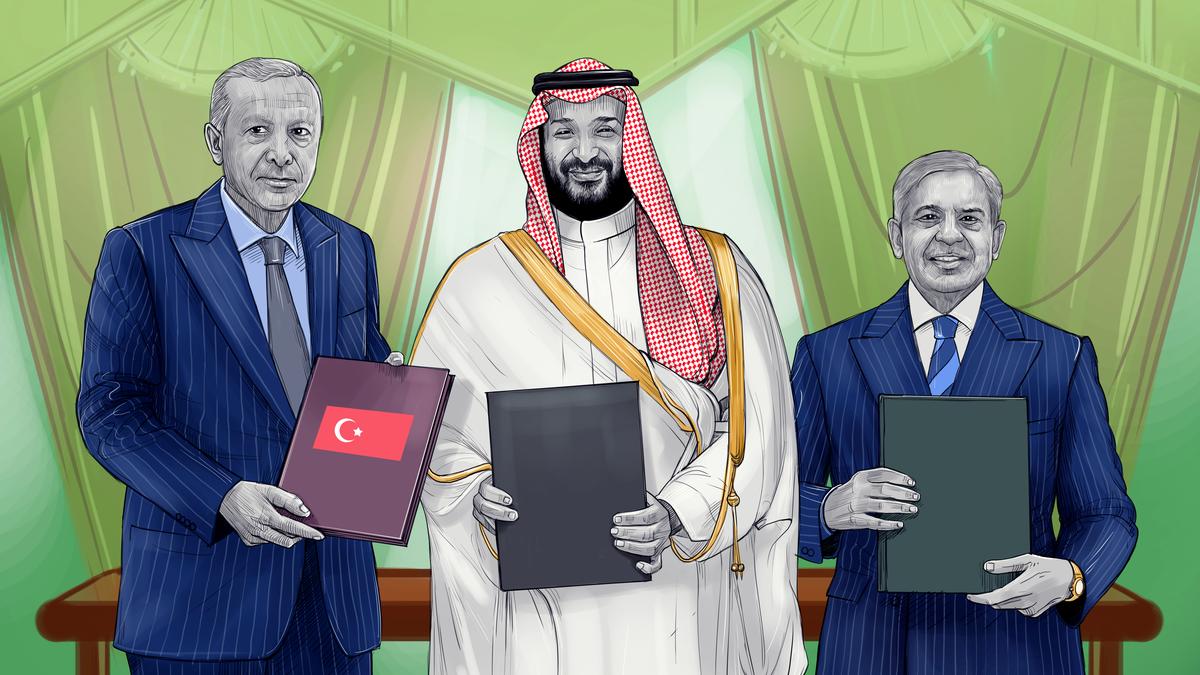
But this rivalry has begun to melt away in recent years, as West Asia has witnessed a series of balance-shifting developments. On August 7, 2026, Saudi Arabia and Turkiye turned a page in their long and often fraught relationship by formally entering into a trilateral defence agreement with Pakistan. Under the Mecca Agreement, signed in the Saudi holy city by Crown Prince Mohammed bin Salman, Turkish President Erdogan and Pakistan Prime Minister Shehbaz Sharif, the three countries pledged to strengthen “collective defence” and “collective deterrence”, and to treat an armed attack against any one of them as an attack against all three.
In search of strategic depth
A NATO-style collective security alliance bringing together three major Muslim-majority countries — a nuclear-armed South Asian power, an oil-rich Persian Gulf monarchy and a NATO ally that straddles West Asia and Europe — is something West Asia has not seen before. According to a joint statement issued by the Pakistani Foreign Ministry, all three countries had been involved in negotiations for a year. In September 2025, Pakistan and Saudi Arabia signed a Strategic Mutual Defence Agreement committing themselves to treat any act of aggression against one as an act against both.
The Saudi-Pakistan agreement showed both Saudi Arabia’s deepening strategic vulnerability and Pakistan’s increasing appetite to play a larger security role in an increasingly volatile region. Now, with the addition of Turkiye, the alliance is seeking strategic depth and military muscle.
Each member of the alliance brings its own strengths and vulnerabilities. Pakistan is the Muslim world’s only nuclear power, but its economy is struggling to stay afloat. Saudi Arabia, one of the world’s largest oil exporters, has deep pockets but faces daunting security challenges, particularly from Iran and the Houthis. Turkiye has a rapidly expanding military industrial base, including advanced drone-production capabilities, but is worried about Israel’s growing militarism in its neighbourhood.
Saudi Arabia, a close American ally since the late 1940s, relied on the U.S. for security, while, in return, promising an uninterrupted flow of oil. The foundations of this alliance have been shaken in recent years as the U.S., faced with a rising China in East Asia, began to deprioritise West Asia. When Saudi oil facilities were attacked in 2019 by Iran-aligned Houthis, the U.S. did little in response. This prompted the kingdom to explore options beyond America’s security umbrella. In 2023, Saudi Arabia reached a normalisation agreement with Iran, brokered by China. It also agreed to a ceasefire with the Houthis (Ansar Allah).
But Saudi Arabia’s security anxieties only deepened when Israel started fighting a mini-regional war after the October 7, 2023 Hamas attack. The Saudis, like several other countries in the region, concluded that U.S. security guarantees were ineffectual when it comes to threats from Israel. The Saudi-Pakistan defence pact was announced in September 2025 weeks after Israel bombed Qatar. After the U.S. and Israel launched the war on Iran on February 28, 2026, Tehran repeatedly attacked all Gulf states, including Saudi Arabia. This war seems to have convinced Riyadh that the U.S. security guarantees to Arab states were not as solid as they used to be.
Turkiye, on the other hand, has long sought to play a larger security role in West Asia — the old fiefdom of Constantinople. It has cultivated strong ties with Qatar and maintains a troop presence there. An alliance with Saudi Arabia would provide Ankara with greater strategic space in the region. Turkiye also has its own security worries. As an increasingly militaristic Israel expands its territory through air strikes and incursions, Ankara believes it should prepare for potential conflicts in the future. Israeli leaders have already publicly warned Turkiye, accusing it of supporting Hamas and other Islamist forces. Although Turkiye is a member of NATO, Ankara has doubts about whether the NATO collective security guarantees would hold in the event of a conflict with Israel, America’s closest ally in the region. It also believes NATO itself is facing serious internal challenges, as the U.S., under President Donald Trump, appears less committed to the alliance than it once was.
Pakistan, the third actor, brings to the alliance its hostility with India. In May 2025, it fought a brief aerial war with India after the Pahalgam terror attack. As India says it would hold Pakistan responsible for terror attacks on its soil, Islamabad is also trying to strengthen its deterrence through counter-alliances.
Shifting sands
The trilateral alliance and its collective security clause do not necessarily mean that Pakistan would go to war with Iran or the Houthis, or that Turkiye would join a future India-Pakistan conflict. After the Saudi-Pakistan agreement was signed in September 2025, Pakistan clashed several times with Taliban-ruled Afghanistan, while Saudi Arabia came under repeated attacks from Iran and the Houthis. But neither country intervened militarily on behalf of the other. So there will always be questions about the practical scope of the alliance’s collective defence commitment.
Yet, the agreement remains significant because it brings together three major powers in a common security framework. Defence partnership and military interoperability among them could expand at a time when an overstretched U.S. is confronting the limits of its power in the region. The alliance also provides greater strategic space for Turkiye and Pakistan in West Asia. Other smaller states in the region could be tempted to join, while powers that have uneasy relations with the alliance’s members, including India, the UAE, Israel and Iran, could seek their own counterbalancing arrangements.
West Asia’s security architecture could therefore undergo profound changes, accelerating the region’s post-American transition.
Published – August 09, 2026 04:48 am IST
Leave a Reply