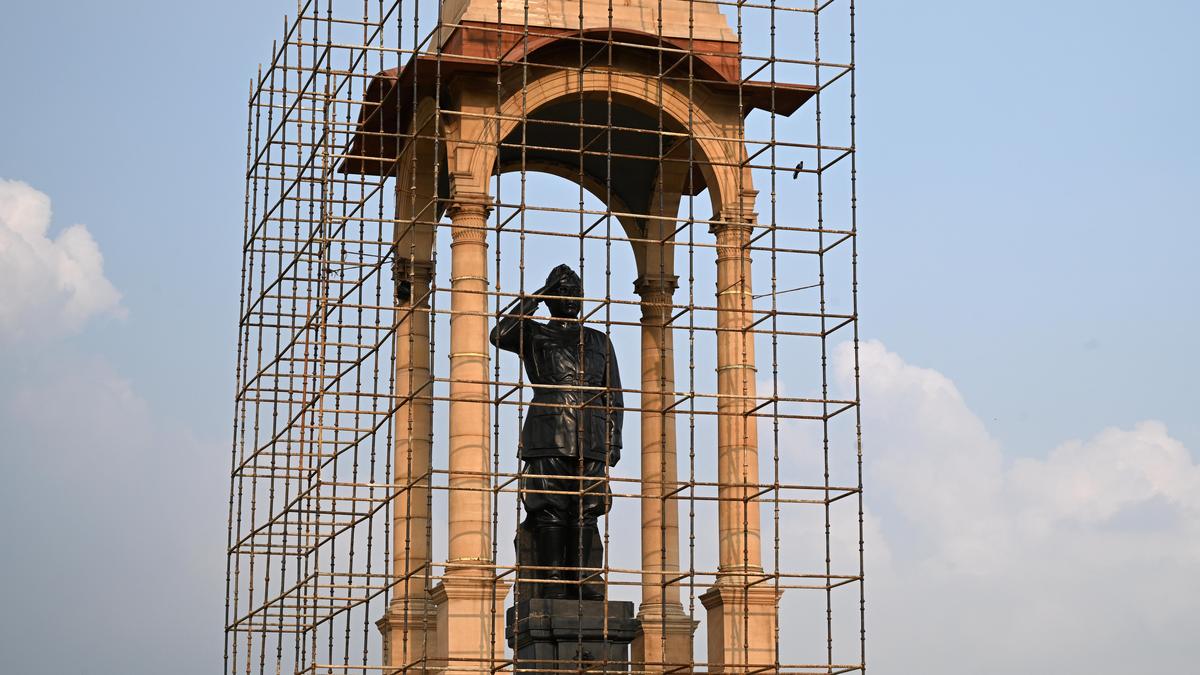

Subhash Chandra Bose Statue near India Gate in New Delhi. File
| Photo Credit: R.V. Moorthy
: The Supreme Court of India on Tuesday (August 11, 2026) sought responses from the Union Ministries of External Affairs and Home on a petition by Anita Bose Pfaff, daughter of Netaji Subhash Chandra Bose, seeking the repatriation of the mortal remains of the freedom fighter and the founder of the Indian National Army from Renkō-Ji Temple in Tokyo.
A Bench headed by Chief Justice of India Surya Kant issued notice to the Union government and the Central Ministries nearly four months after it had previously refused to entertain an identical petition filed by Netaji’s grandnephew Ashish Ray.

The court had, at the time, insisted that Ms. Pfaff, who was present online, should herself approach the court as her father’s rightful and legal heir.
Mr. Ray, in a statement, had conveyed his respect for the court’s inclination to have Ms. Pfaff, represented by senior advocate A.M. Singhvi, directly apply to it for relief.

His petition had highlighted the Union government’s “prolonged failure to take a final, reasoned, and time-bound decision to repatriate [or at least facilitate repatriation] to India of the mortal remains preserved at Renkō-Ji Temple in Tokyo so that Netaji’s daughter may perform final rites in India with dignity and finality”.
Netaji is believed to have died in an air crash at Taihoku (Taipei) while travelling onward from Singapore after the Japanese surrendered to the Allied Powers in 1945. His mortal remains were transported to Tokyo in early September 1945.

His remains had been at the Renkō-Ji Temple for over 80 years – preserved and honoured by successive head priests – forming a continuing state of affairs of “posthumous exile” and non-closure for Netaji’s family.
Published – August 11, 2026 01:02 pm IST
Leave a Reply