On July 19, a cloudburst upstream sent a sudden wall of water through Upper Assam. Sivasagar, Charaideo, Jorhat and Golaghat districts are experiencing their worst flooding in decades, with the Dikhow River breaching its extreme flood level. Bihubor, Nepali Khuti, Bihari Basti, and Railwayghat are among the worst-affected areas in Sivasagar district.
Assam has a history of major floods up to five times a year, killing scores of people and animals and damaging crops and assets worth more than ₹1,000 crore annually. The floods this year have killed 98 people so far, most of them in three eastern districts — Sivasagar, Charaideo, and Jorhat.
Experts believe the catastrophe may not have been caused by extreme rainfall alone. Satellite imagery has revealed extensive excavation, deforestation and other human interventions along the river’s upper reaches, particularly in Nagaland, raising concerns that decades of environmental degradation may have intensified the disaster. Coal mining, stone quarrying and shifting (jhum) cultivation have stripped large stretches of hill slopes of vegetation, making them increasingly unstable and vulnerable to erosion and landslides. Assam Chief Minister Himanta Biswa Sarma said finding a “national solution” to the State’s annual flooding was more important than declaring it a national problem.
For decades, the All Assam Students’ Union and other organisations have been asking the Centre to declare the State’s flood and erosion crisis as a “national problem”.
“Declaring floods a national problem is not going to work. We need a national solution with scientific interventions. We need concrete schemes on how Assam can protect itself if water comes downhill from Nagaland,” the Chief Minister said on Friday.
The Chief Minister said that Assam has long relied on embankments and geo-bags for flood management, but lacks a scientific mechanism to tackle the issue.

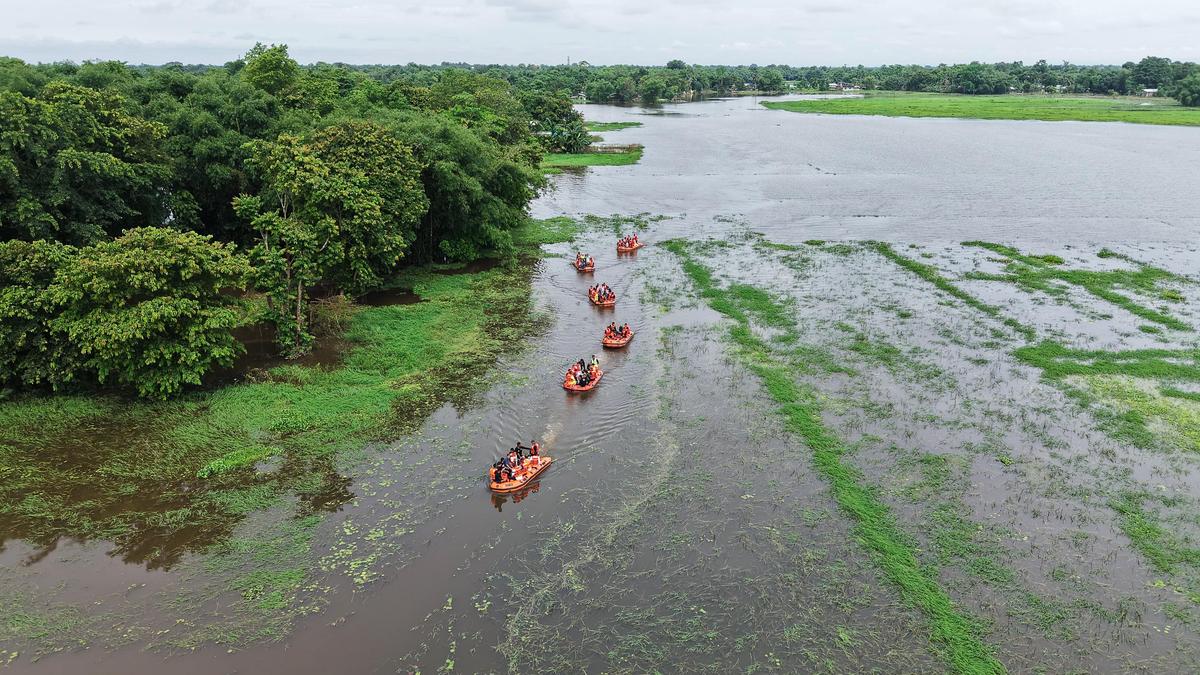
Race to rescue: An aerial view of a rescue operation using rubber boats in flood-hit areas of Sivasagar on August 4, as teams reached people stranded by rising waters. Photo: @himantabiswa X/ANI Photo

Photo:
Ritu Raj Konwar
Disrupted lives: A view of Nepali Khuti village, one of the worst-affected areas along the Dikhow River in Sivasagar district.

Photo:
Ritu Raj Konwar
What remains: Moromi Bora Bordoloi searches for her children’s books among the belongings left behind after floodwaters destroyed their home in Majgaon village.

Photo:
Ritu Raj Konwar
Safe passage: NDRF personnel evacuate villagers from Panbesa village in Sivasagar district as floodwaters continue to isolate homes and communities.

Photo:
Ritu Raj Konwar
Temporary refuge: Women and children take shelter at a relief camp on the outskirts of Sivasagar town. Altogether, 133 relief camps and relief distribution centres were operational across six districts.

Photo:
Ritu Raj Konwar
Picking up the pieces: Flood-displaced villagers take shelter in makeshift camps along a railway line in Betbari village, Sivasagar district.

Photo:
Ritu Raj Konwar
Precious pages: Books salvaged from floodwaters are laid out along a roadside to dry in the Najira area of Sivasagar district.

Photo:
Ritu Raj Konwar
Lessons continue: Children attend classes at a relief camp in Sivasagar town; with thousands displaced and staying in relief camps, temporary arrangements have been made to keep essential services going.

Photo:
Ritu Raj Konwar
After the deluge: A car remains stuck in thick layers of mud and silt deposited by receding floodwaters in Nepali Khuti village.

Photo:
Ritu Raj Konwar
Long wait: Villagers wait for relief supplies in Nemaijan village in Sivasagar district. Normalcy is likely to take a long time to come.
Published – August 09, 2026 08:43 am IST
Leave a Reply