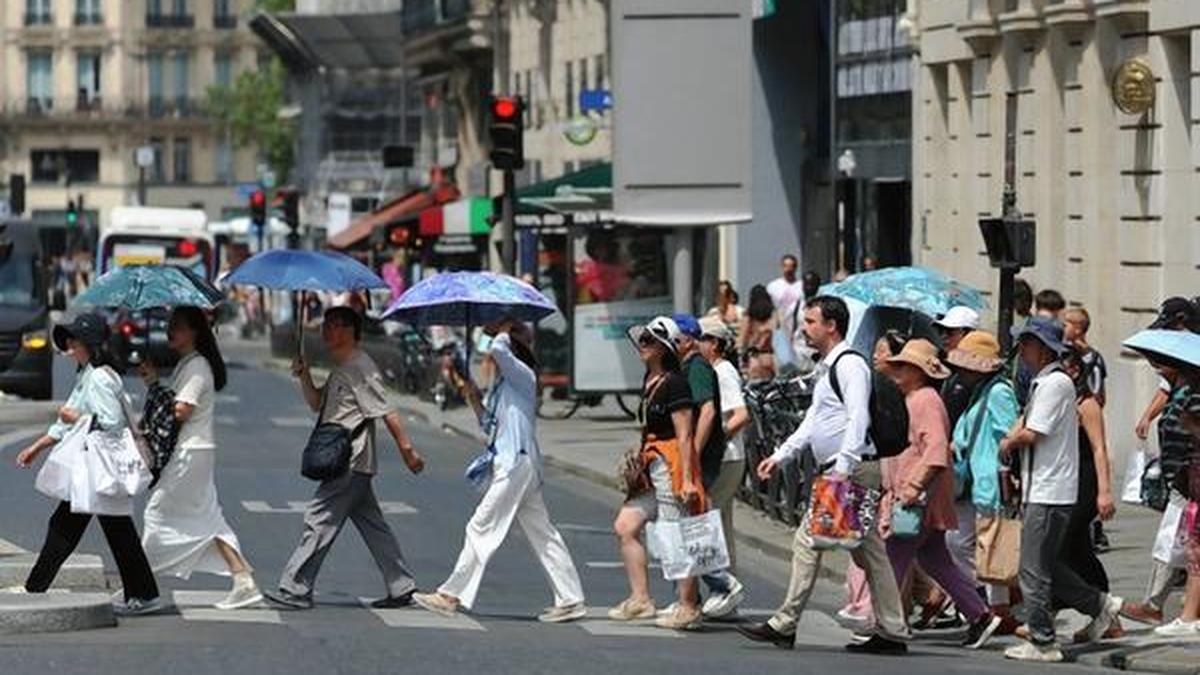
Europe is reeling under an intense heatwave, with health alerts issued across western and central regions as temperatures surge to record levels.
With the continent warming at more than twice the global average, the World Meteorological Organization has cautioned that Europe faces a rising risk of prolonged spells of extreme heat.
Among the drivers of such extremes are atmospheric and circulation patterns that trap hot air over a region for days, causing temperatures to rise steadily.

The ongoing heatwave in western Europe, which has claimed more than 40 lives in France alone, is being sustained by a weather pattern known as an omega block.
Omega block
The heatwave in Europe is being driven by an omega block, pushing temperatures to unusually high levels, according to the Reuters Climate Monitor. The pattern resembles the Greek letter omega, with a bulging ridge of high pressure trapping heat over a region, while cooler conditions persist along its edges.
An omega block is a stalled, Ω-shaped wind pattern that confines air within it, preventing ventilation. This leads to a build-up of heat, resulting in oppressive conditions.
The trapped heat prevents cooling even at night. Unlike a typical moving heatwave, stagnant air within such a system can also trap pollutants, leading to poor air quality. Climate variability, including phenomena such as La Nina and El Nino, may intensify these effects.

In the coming days, the hot conditions are expected to extend to parts of eastern Europe as well. It remains uncertain how long the present heatwave, driven by an omega block that allows temperatures to build up over successive days, will persist.
Phenomenon behind omega block
An omega block takes the shape of the Greek letter Ω, with a bulge of warm, settled high pressure held between two cooler low-pressure systems.
The term “blocking” refers to the way the high-pressure system becomes stationary. Under normal conditions, the jet stream carries weather systems from west to east.
During an omega block, this flow is disrupted and can meander sharply north and south, isolating pressure systems. Weaker steering winds and reduced temperature contrasts in the atmosphere contribute to these slow-moving patterns.
As a result, hot and still air remains over the same region. Omega blocks typically last between three and 10 days, but can sometimes persist for weeks.

What happens during an omega block
Beneath the high-pressure zone at the centre, conditions turn hot and dry. The system suppresses cloud formation, leading to clear skies and uninterrupted sunshine that pushes temperatures higher. Such conditions have prevailed in France and Spain, where temperatures have crossed 40 degrees Celsius.
Regions under the flanking low-pressure systems, in contrast, are likely to experience cooler and wetter weather.
Britain lies along the boundary between the high-pressure system and cooler air to the northwest, resulting in intense heat in the south and east, and relatively cooler, wetter conditions in the north and west, according to the United Kingdom Met Office.

Heat dome effect
“This extreme heatwave has been caused by a heat dome effect, which occurs when a high-pressure system traps hot air in the upper atmosphere,” said Krishna Raj, Professor at the Institute for Social and Economic Change, Bengaluru.
A heat dome is a persistent zone of high pressure in the upper atmosphere that settles over a region like a lid on a pot.
A ridge of high pressure drawing hot air from North Africa is positioned between two low-pressure systems, one over central Europe and another off the coast of Portugal. The high-pressure zone becomes stationary due to the pressure exerted on either side, Samantha Burgess of the European Centre for Medium-Range Weather Forecasts told AFP.
The heat dome acts like a lid, trapping warmth beneath it. Air descending under the high-pressure system warms further through compression, while heat near the surface is unable to escape.
These conditions suppress cloud formation and result in calm weather with minimal wind. Clear skies allow more solar radiation to heat the surface, creating a feedback loop that intensifies the heat.
Heat dome vs omega block
Experts note that heat domes and omega blocks are distinct phenomena, although they can occur together. Climate change is intensifying both heatwaves and storms.

A heatwave in late May across Europe was linked to a heat dome, while an omega pattern played a key role in a major heat event over France in June 2025.
Such patterns are not confined to Europe and occur across the mid-latitudes in both hemispheres. They have been observed over the Pacific, Europe, and North America, according to Burgess.
Climate change and heatwaves
Scientists have observed an increase in high-pressure systems over Europe in recent decades, though there is ongoing debate over the extent to which this is linked to climate change. However, there is broad scientific agreement that climate change is increasing the frequency and intensity of heatwaves.
Greenhouse gas emissions, largely from the burning of coal, oil and gas, have warmed the planet by about 1.3 degrees Celsius since pre-industrial times.
This higher baseline temperature means that heatwaves now reach more extreme levels. As a result, when patterns such as omega blocks occur, the associated heat can be significantly more intense.
Burgess noted that when heat domes develop, the resulting heatwaves are more severe than they would be in the absence of climate change.
Published – June 26, 2026 03:33 pm IST
Leave a Reply