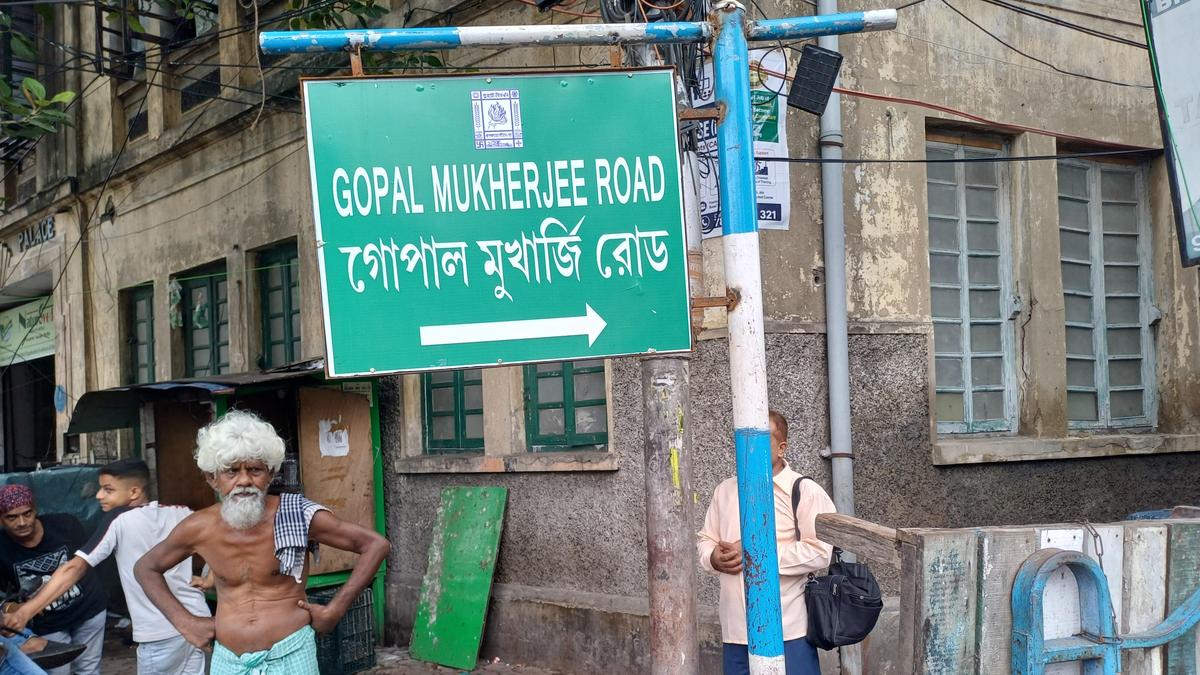
A blue and white metal pole, about 2.5 metres tall, with a freshly painted green coloured signboard stands at the edge of the street leading eastward from Park Circus 7 Point Crossing in Kolkata. Not more than a dozen houses stand on the left side of the street. On the right side is the Park Circus Maidan, which was the epicentre of the anti-Citizenship (Amendment) Act, protests a few years ago.
A lush growth of the green grass now covers the protest site while the hurriedly erected signboard reads ‘Gopal Mukherjee Road’, in Bengali and English. Before June 20, this road was called Suhrawardy Avenue. However, within six weeks of coming to power, the Bharatiya Janata Party (BJP) government in West Bengal named it after Gopal Mukherjee, who ran a goat meat shop in north Kolkata and is considered to have “saved Hindus during the Great Calcutta Killings in 1946”.
This is not the first instance where a government of the day has renamed a street. Then why is renaming of Suhrawardy Avenue a crucial moment in West Bengal politics? That’s because even 78 years after the country’s Independence and the Partition of Bengal, the roles of Huseyn Shaheed Suhrawardy and Gopal Mukherjee, intertwined with each other, continue to dominate the political discourse of the State.
In the years leading to the 2026 West Bengal Assembly poll, the State witnessed a massive campaign mounted by the BJP and its allies glorifying Gopal Mukherjee. At the same time, they also invoked the legacy of Huseyn Shaheed Suhrawardy – a prominent Bengali politician who served as the last Prime Minister of undivided Bengal and later as the Prime Minister of Pakistan – and blamed him for the “massacre of innocent citizens”.
However, the road in question was not named after Huseyn Suhrawardy. Instead, it was named after his uncle Sir Hassan Suhrawardy.
Mistaken identity?
“Kolkata Municipal Corporation has decided that the road known as Suhrawardy Avenue in KMC area will be named and henceforth be known as Gopal Mukherjee Road,” read a single-line notification published by the civic body on June 20.
Calling the decision historic, Chief Minister Suvendu Minister said, “Finally restoration of historical justice will be achieved by honouring a true guardian and saviour.” Adhikari, the first BJP Chief Minister of West Bengal, also added in a social media message that “for decades a major artery of our city bore the name of someone who wilfully misused state power as a weapon, orchestrating the massacre of innocent citizens for sheer political gain”.
The Chief Minister was referring to to Huseyn Suhrawardy whom the BJP and its allies blame for the communal riots of 1946. But then the road wasn’t named after him.
P. T. Nair, known as the ‘Barefoot Historian of Calcutta’, in his book, A History of Calcutta’s Streets, explains how the street got its name. According to the book, “The new road constructed by the Calcutta Improvement Trust from Park Circus Junction of Kasai Para Lane on which stands the house of Sir Hassan Suhrawardy, Vice-Chancellor of the University of Calcutta, will be known as Suhrawardy Avenue.” The name was notified on April 20, 1933.
The real account
Nair gave a detailed account of the accomplishments of Hassan Suhrawardy, describing him as two-time Vice-Chancellor of University of Calcutta, distinguished Muslim medico from the point of academic attainments, a prominent member of the Bengal Legislative Council and its first Muslim to be elected Deputy President.
The historian also gave a description as to how Hassan got his knighthood: “It was during the days of his vice-chancellorship that Sir Stanley Jackson, the Chancellor of the Calcutta University and the Governor of Bengal, was attacked by a girl student during the convocation and it was Dr. Hassan Suhrawardy’s courageous and timely action that saved the Governor’s life. His Knighthood was a reward for this and was granted by a special communique by the King and not during the usual New Year and Birthday Honours’ Lists.”
The student referred to here was freedom fighter Bina Das, who made an assassination attempt at the Bengal Governor on February 6, 1932.
When it became clear in the political circles that the BJP leadership had renamed the street linking it to the wrong Suhrawardy, leaders from the Opposition parties criticised the name change. The Congress’s media and publicity department chairman Pawan Khera cited Prime Minister Narendra Modi’s message in the book, Dr. Syama Prasad Mookerjee: The Great Educationist, to argue that the Hindutva ideologue and Jana Sangh founder had been a supporter of Hassan Suhrawardy, after whom the road was named.
“Typical of the BJP’s abysmal ignorance to remove the name of Dr. Hassan Suhrawardy, first Muslim Vice-chancellor of Calcutta [University] when they targeted his nephew Huseyn Suhrawardy, Premier of Bengal who instigated 1946 Calcutta Riots. Why don’t they read history sometime?” retired bureaucrat and former Rajya Sabha MP Jawhar Sircar said in a post on X.

The house of Hassan Suhrawardy.
| Photo Credit:
Senjuti Sengupta
After the criticism, BJP’s IT Cell in-charge Amit Malviya said West Bengal will have nothing to do with the Suhrawardys. Malviya criticised both the Suhrawardys, calling the uncle closely associated with the British and his nephew as one of the most controversial political figures of the pre-Partition era. “As Premier of Bengal and a leading Muslim League politician, he presided over the province during the horrors of Direct Action Day on August 16, 1946,” the BJP leader wrote on social media.
Almost 11 years ago, the West Bengal government declassified secret Cabinet papers relating to Subhas Chandra Bose, popularly known as Netaji. In the papers that were declassified, the role of Huseyn Suhrawardy also became more pronounced. The papers revealed that Huseyn Suhrawardy claimed it was the withdrawal of the police during the riots that led the situation to acquire such grim proportions. However, he also claimed that there was no delay in calling the military.
The secret files made public in 2016 pointed out that Suhrawardy also claimed during Cabinet meetings that the “military was not in fact called too late as alleged in some quarters. They had actually been used at 2 a.m. on the 17th”. Suhrawardy said he himself had visited the Lalbazar Police Control Room (the police headquarters) on August 16, the day the riots broke out to see how the situation was developing.
The house of Gopal Mukherjee is located less than 5 km away in Kolkata’s Bowbazar area, where his descendants live. The family members said the 2025 film Bengal Files released in 2025 has added to his popularity but they are not very happy that he was shown as a butcher or meat shop owner. Despite the opposition from the then Trinamool Congress government, film director Vivek Ranjan Agnihotri and a few BJP leaders, including current Finance Minister Swapan Dasgupta, held a private screening of the film in Kolkata.
The family members said while the film focussed on the role of Mukherjee, neither the director nor anyone from his team spoke to them. They said they were not invited for the private screening. However, they are now happy that now a road is named after their forefather.
“Despite his contribution to save the Hindu community during the Great Calcutta Killings in 1946, the previous governments were silent about Gopal Mukherjee. We are happy that they took the initiative to name the road after him instead of Hassan Suhrawardy. Our grandfather was a patriot and revolutionist while Suhrawardy exposed Bina Das to the British,” his grandson Shantanu Mukherjee said. The family members said Gopal Mukherjee was also inspired by the revolutionary movement of Netaji.
The family’s ancestral house at 39, Malanga Lane in Bowbazar also has an office room that showcases several photographs of Netaji and other renowned revolutionaries. There is also one in which Mukherjee can be seen sculpting a statue of Netaji.
While re-christening Suhrawardy Avenue as Gopal Mukherjee Road may be the most recent attempt to make the latter an icon of the right wing, there have been many similar attempts.
Recently, a group of local leaders in Kolkata’s Sukeas Lane ( now Phusraj Bachhawat Path), unveiled a statue of Gopal Mukherjee. Two biographies of him have been published in the last five months while three more are also set to be launched next month. One of them, G.O.A.T by Abhijit Majumder and Debajyoti Banerjee, has already been scheduled to be launched during a function on August 16 (on the anniversary of Direct Action Day) in front of his house in Bowbazar where his family members will also be present.
“We are happy with the rising amount of discussion over Gopal Mukherjee in popular culture. People should know about him. We also urge the government to add a chapter on him in the school textbooks. But we don’t want anyone to misuse the name for any political or any other interest,” said granddaughter Neeta Mukherjee.
What the residents feel
While there is much enthusiasm among the family members about the renaming of the road, the people who have lived on the avenue for almost nine decades do not think much of the development. “Will this change of name make our lives any better? I have been living here for over 55 years,” said Sheikh Ismail, who runs a street laundry shop on the avenue.
There are hardly many people staying on the street, which has less than 20 buildings along a 100-metre stretch, including a school and a college. The most prominent house on the street is the house of Hassan Suhrawardy. The two storied colonial house stands out from all the other buildings because of its red colour and ornate green windows and open verandahs overlooking the street.

Tarique Choyon, First Secretary (Press) Bangladesh Deputy High Commission, Kolkata.
| Photo Credit:
Senjuti Sengupta
The house serves as the Library and Information Centre of Bangladesh Deputy High Commission. Above the name of Hassan Suhrawardy, is a plaque by the Kolkata Municipal Corporation describing the building as Grade I heritage property.
Tarique Choyon, First Secretary (Press) of the Deputy High Commission for Bangladesh, who resides in the house located at 3, Suhrawardy Avenue, said he is not sure when the house was named. Keen to show around the library on the ground floor that has about 8,000 books, he is hopeful that soon it will get more books. The Bangladesh government official said nobody has requested him to change the address of the house and rename the address from 3, Suhrawardy Avenue to 3, Gopal Mukherjee Road.
“I have heard that in the 1940s there was a similar demand to change the name of the street,” the Bangladesh official said. Hassan Suhrawardy had two daughters and one of them was among the first women MPs of Pakistan, Choyon said. He added that a granddaughter of the Suhrawardy family is married to the Royal family of Jordan, one of the richest families in the world.
In their defence
Defending the decision to rename the avenue to Gopal Mukherjee Road, CM Adhikari said “in Kolkata the names of Mughal, Pathans and oppressive foreign rulers will not remain”. He said Sister Nivedita, a disciple of Swami Vivekanada, remains the only exception in this regard.
Adhikari on June 23 announced setting up of a committee that, under the leadership of Bharat Sevashram monk Swami Pradiptananda Maharaj, also known as Kartik Maharaj, will evaluate renaming proposals related to roads and streets.
“The committee is yet to be notified. But our objective is to review all the names and their history. No street should bear the names of Mughal or British leaders and should be named after renowned revolutionists or someone who has contributed to shape our State and our culture. As soon as the committee is notified, we will start our work,” he said.
During the previous regime, former Chief Minister Mamata Banerjee also had a penchant for naming streets, government auditoriums and even metro stations. Among her most famous name changes was renaming Bishop Lefroy Road, where Satyajit Ray lived and worked, to Satyajit Ray Dharani. Sarani is usually the Bengali word used for street but when the former Chief Minister wanted the road renamed Dharani, nothing came her way and now the Kolkata Municipal Corporation refers to the street as Satyajit Ray Dharani.

Lady Brabourne College on on the erstwhile Suhrawardy Avenue.
| Photo Credit:
Senjuti Sengupta
Former Vice-Chancellor of North Bengal University Professor Om Prakash Mishra said politics of name or nomenclature change has been practised everywhere and by varieties of political regimes. “With BJP at the centre of power and governance structure in the country and in most of the States, government and public policy is increasingly devoid of evidence-based historical record,” Prof. Mishra said.“Why Bengal under BJP rule should be left behind in re-christening of streets and attempting at re-casting history to suit their ends,” he added.
The re-christening of Suhrawardy Avenue, he added, may just be the beginning of a renaming exercise in Bengal.
senjuti.sengupta@thehindu.co.in,
shivsahay.s@thehindu.co.in
Leave a Reply