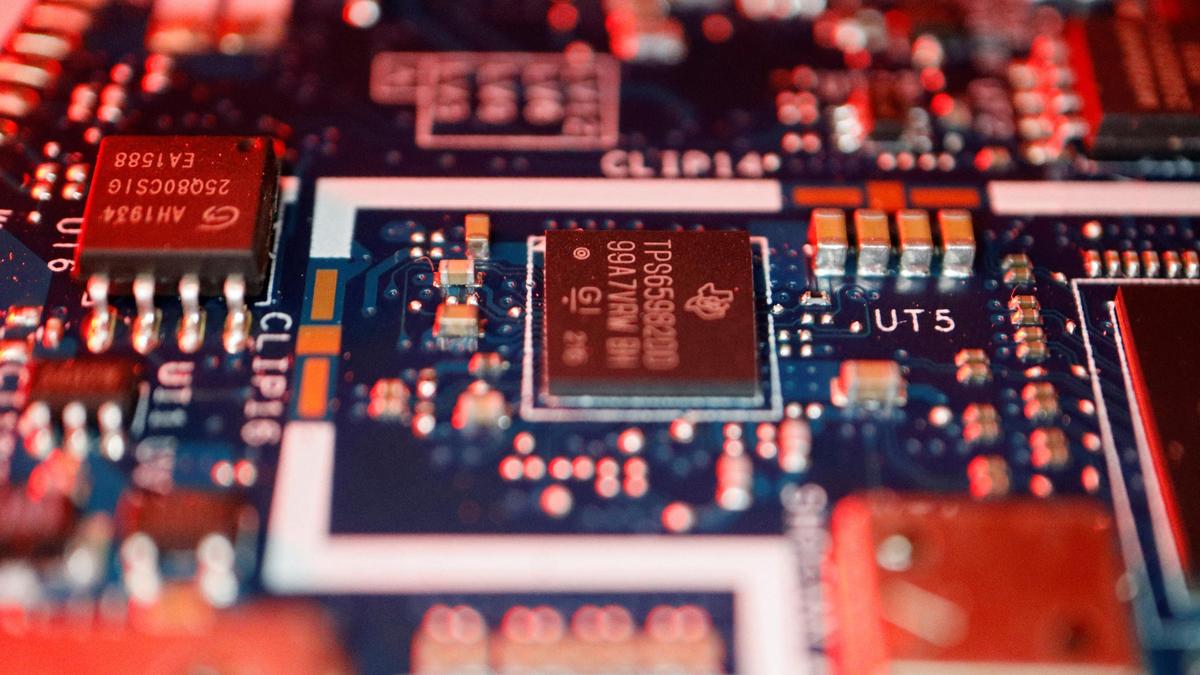
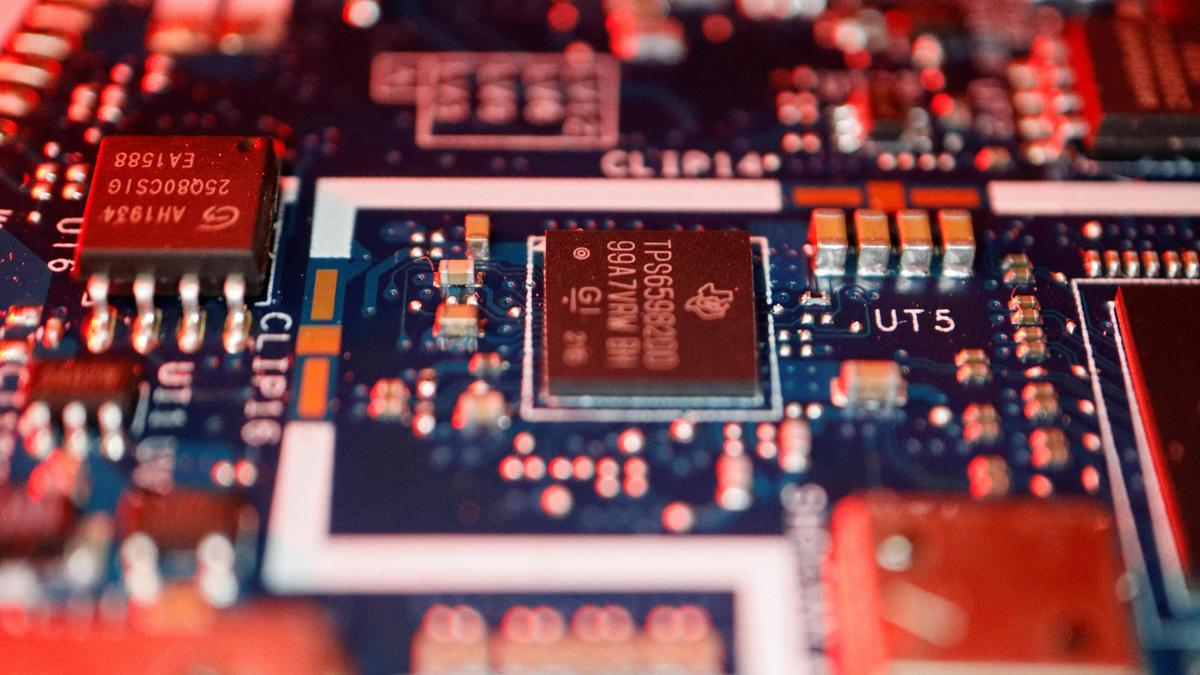
The plan marks President Lee Jae Myung’s boldest push yet to align South Korea’s AI and chip ambitions with his pledge to narrow regional disparities and revive economies beyond the Seoul metropolitan area. Image for representation
| Photo Credit: Reuters
South Korea on Monday (June 29, 2026) laid out a sweeping industrial strategy centred on semiconductors and artificial intelligence, as President Lee Jae Myung unveiled over $576 billion in investment to lock in global dominance and drive more balanced growth.
The plan, anchored by Samsung Electronics and SK Hynix, marks Mr. Lee’s boldest push yet to align South Korea’s AI and chip ambitions with his pledge to narrow regional disparities and revive economies beyond the Seoul metropolitan area.

Flanked by the chiefs of the world’s two biggest memory chipmakers, Mr. Lee cast the initiative as a “great leap forward,” centred on the “triple axis” of semiconductors, physical AI and data centres.
“We must secure the core elements of AI faster than any other country,” the president said in a televised address.
Samsung and SK Hynix will invest 800 trillion won ($518.30 billion) with suppliers to build two new chip fabrication sites each in South Korea’s southwest region, industry minister Kim Jung-kwan said.
Mr. Lee said the country’s southwestern city of Gwangju and South Jeolla province will also invest 5-20 trillion won in the projects. Mr. Kim said a further 81 trillion won is expected for a chip packaging cluster in the Chungcheong area near Seoul.
“To meet the rapidly increasing demand for semiconductors, we need to quickly complete the production hubs that are currently under construction,” he said.
“At the same time, we must secure overwhelming production capacity in advance through large-scale new investments, including in the southwestern region. Existing sites centred around Yongin and Pyeongtaek have already reached their limits.”
Mr. Lee said the southwest will host major chip production clusters, drawing on abundant, underused power.
President defends plan
High-bandwidth memory (HBM) chips produced by Samsung Electronics and SK Hynix have become pivotal in the global race to build advanced AI systems. Both companies already operate major semiconductor facilities in and around the Seoul metropolitan area.
Mr. Kim also said the country will double dynamic random-access memory (DRAM) output within five years by bringing forward construction of fabs in the Seoul metropolitan area to the mid-2030s.
DRAM is a type of memory that is used to power electronics such as laptops and smartphones and HBM is produced by stacking multiple layers of DRAM.
Samsung Electronics Chairman Jay Y. Lee said at the event the company had selected Gwangju as a site for its new chip cluster, while SK Hynix’s Chairman Chey Tae-won said the firm needed more time to finalise a site and secure infrastructure in the southwestern region.
“It took us nine years for us to create a cluster in Yongin. Also, a chip factory requires massive land, power, water and talent,” Mr. Chey said.
Opposition politicians have sharply criticised Mr. Lee’s southwest chip hub, questioning whether the proposal is politically motivated given that 85% of voters in the region backed Lee in last year’s presidential election.
The announcement comes as Mr. Lee’s approval rating has slid for six weeks to 46.5%, according to pollster Realmeter.
The president defended the proposed southwest chip hub in a series of X posts over the weekend, rejecting criticism that it favours a liberal stronghold.
Industry experts say diversifying chip investment beyond Seoul could ease infrastructure bottlenecks, but warn that building cutting-edge fabs requires vast electricity and water, advanced logistics, deep supplier networks and highly skilled labour – elements that may not scale quickly enough in a new region to meet surging AI demand
Published – June 29, 2026 01:31 pm IST
Leave a Reply