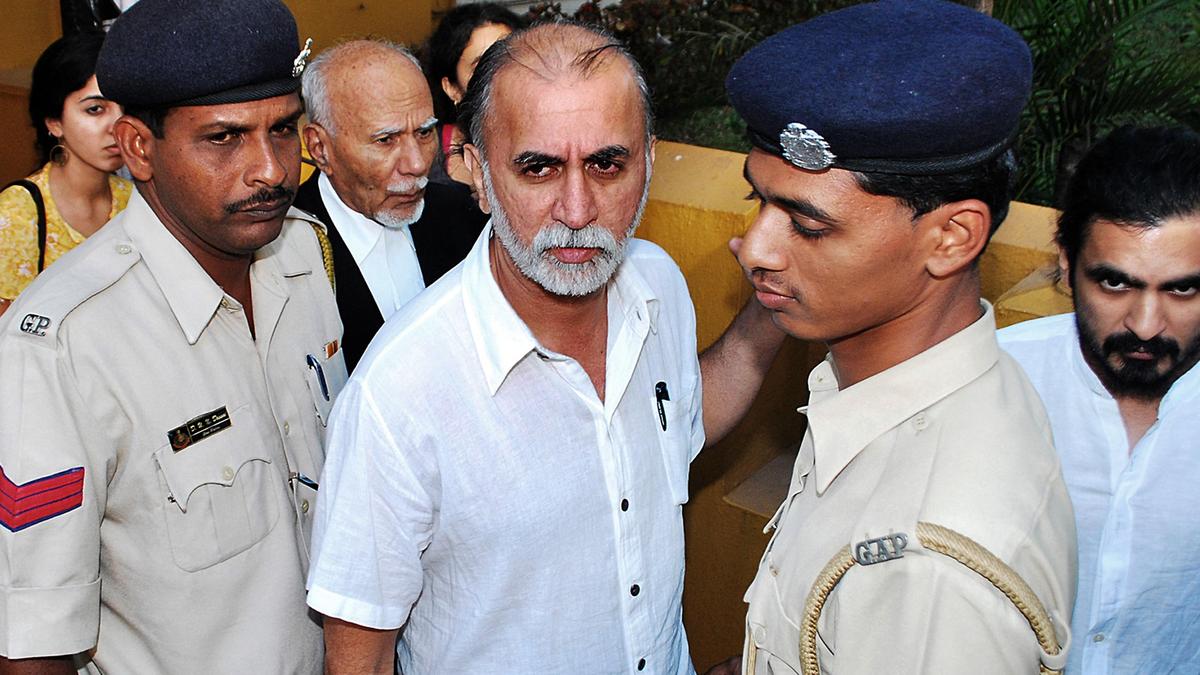
The Bombay High Court on Thursday (August 6, 2026) convicted Tarun Tejpal, former editor of Tehelka magazine, in a 2013 sexual assault case and sentenced him to 10 years of rigorous imprisonment.
The Goa Division Bench of Justice Neela Gokhale and Justice Amit Jamsandekar set aside the trial court’s 2021 judgment that had acquitted Tejpal. Terming the ruling “perverse”, the Bench said that the trial court fell for the notion that a sexual assault complainant must be a “perfect victim” and conduct herself in a certain way to appear credible.
The court ordered Tejpal to surrender within two weeks but extended it to four weeks on a request.
In its 81-page judgment, the court expressed disapproval about the way the defence highlighted the complainant’s personal life, and noted that it found it surprising that the trial court “remained silent and allowed the defence to harass and humiliate her during the cross examination”.
Tarun Tejpal case – a timeline
The court said that the prosecution had established its case “beyond every reasonable doubt” and the victim too had stood firm in her testimony.
The trial court had proceeded with the notion that a sexual assault complainant must behave in a stereotypical manner, the court said.
“The ‘perfect victim’ concept, more formally known as an ‘ideal victim’, described an unspoken cultural archetype where a person is fully believed, sympathised with and granted legitimacy only if they exhibit absolute vulnerability, complete innocence and total passivity,” the court said. When a victim does not fit the description, the trauma is devalued, it added.
The Bench heard arguments on the quantum of sentence from both sides on Thursday. While Solicitor-General Tushar Mehta requested the court to award the maximum sentence, senior advocate Abad Ponda, representing Tejpal, appealed for leniency, stating that this was Tejpal’s first offence and he was 62 years old.
Issues of sexual assault: the Tehelka case
“The accused in this case has shown no remorse whatsoever. He repeated the alleged act the very next day. His attitude was extremely brazen,” Mr. Mehta said before the Bench. He argued that the court’s perspective on the case would be important, as the accused could not be given the benefit simply because the victim was mature.
Mr. Mehta urged the court to send a clear message that “no means no”, regardless of the person involved. He requested the court to consider the deterrent effect while deciding the sentence.
Mr. Ponda submitted that the incident occurred in 2013 and that the appeal had been pending since 2022. He stated that Tejpal had been on bail and had not violated any bail conditions. He informed the court that Tejpal’s passport was deposited with the authorities. Mr. Ponda urged the court to stay the conviction order and grant eight weeks’ time for Tejpal to surrender. He said that Tejpal wished to challenge the High Court order in the Supreme Court.
“Please consider putting a stay on this order for a few weeks. Let me be given an opportunity to approach the Supreme Court,” Mr. Ponda said on behalf of Tejpal. He assured the court that Tejpal was not going to flee from the law.
Tejpal, with permission from the court, addressed the Bench. “For the last 13 years, we have been working to bring facts and truth to light. Obviously, that holds no significance today. I am a father to two daughters, and I have a family. All I want to say is that we now have the option to appeal in a higher court… My lawyer has asked me to appeal to the court for leniency in sentencing,” he said.
The Bench stated that it had heard Mr. Ponda’s submission that the accused had no other criminal cases pending against him and that this was his first offence. The court noted that Tejpal had stated that he was a victim of political vendetta. It observed that Mr. Mehta had argued that the defendant was acting as a guardian to the victim and therefore deserved the maximum sentence.
Mr. Ponda said that Tejpal had complied with court directions and had been present at every hearing. He stated that despite being acquitted by the trial court, he never travelled abroad. Mr. Mehta urged the court to take the accused into custody immediately. He said that after that, if Tejpal wished, he could seek bail in a higher court.
The court convicted Tejpal under Sections 376(2)(f), 376(2)(k), 354A, and 354B of the Indian Penal Code and also imposed a fine of ₹5 lakh under Section 376(2)(f). Under Section 376(2)(k), the court awarded 10 years of rigorous imprisonment and a fine of ₹5 lakh. Under Section 354, the Court sentenced him to one year of rigorous imprisonment and a fine of ₹10,000. Under Section 354A, the Court imposed one year of rigorous imprisonment and a fine. Under Section 354B, the Court awarded three years of imprisonment and a fine of ₹3,000. The sentences will run concurrently.
The six-month custody period previously served by the accused will be taken into account, the Court said. The Bench noted that there were no complaints of misbehaviour or misconduct against Tejpal in prison.
(With inputs from PTI)
Published – August 06, 2026 11:24 am IST
Leave a Reply