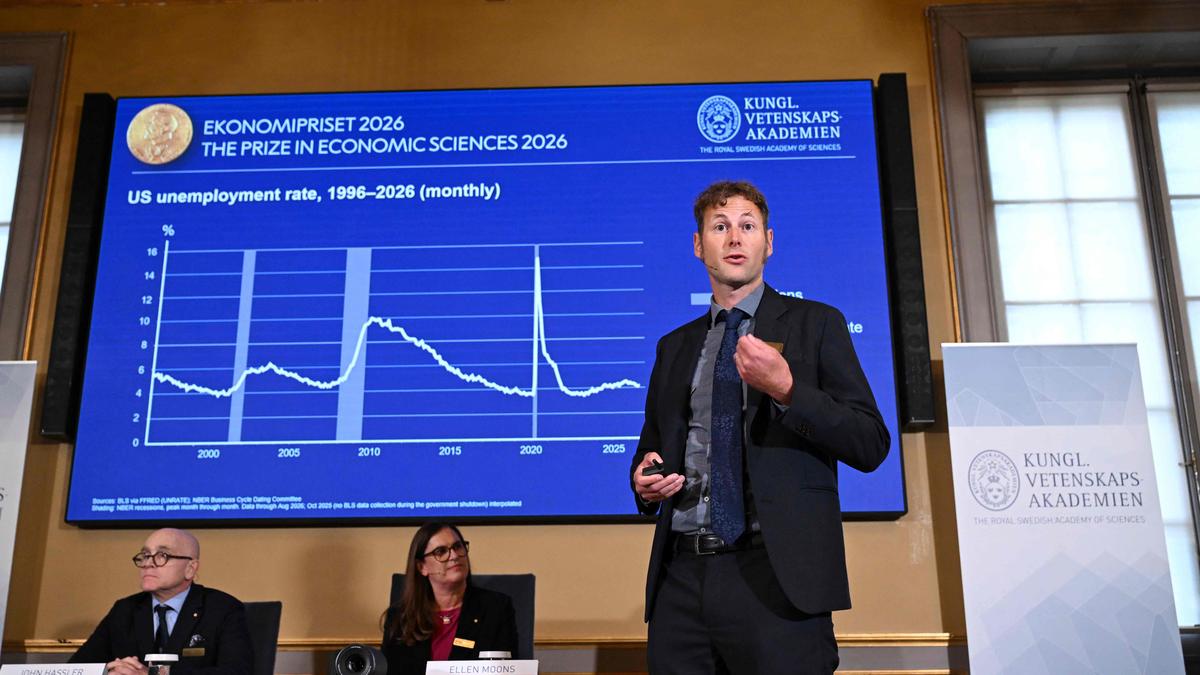
The 2026 Nobel Prize for Economics has been jointly awarded to American economists Robert E. Hall and Michael Woodford for providing an empirical foundation for determining how governments should incorporate the demand behaviour of households and the supply and pricing behaviour of companies when devising policies to stabilise the economy.
According to the citation of the 2026 Sveriges Riksbank Prize in Economic Sciences in Memory of Alfred Nobel, commonly called the Economics Nobel, the two economists were awarded the prize for establishing the “microeconomic foundations of macroeconomic stabilisation”.
The research done by Mr. Hall and Mr. Woodford also provides an empirical basis, as Mr. Woodford himself explained on Monday, for the idea that the effectiveness of economic policy is also determined by how well the government communicates why it is implementing those policies.
Mr. Hall is currently the Robert and Carole McNeil Joint Hoover Senior Fellow and Professor of Economics at Stanford University while Mr. Woodford is the John Bates Clark Professor of Political Economy at Columbia University.
Nobel Prize 2026 Winners | Full List
Why stabilisation needed a change
Stabilisation policy loosely captures the various instruments and steps governments use to control wild swings in growth, output, inflation, unemployment and business cycles.
Through most of the 20th century, the theories of theoretical economic titan John Maynard Keynes held sway, that government policy must step in to stabilise the economy. That is, demand can be boosted through loose monetary policy and increased transfers from governments to households while excess demand can be reined in by tightening such policies.
However, the experience of the U.S. economy in the 1970s showed that this framework was not enough. The attempts by the U.S. government and Federal Reserve to tame inflation and unemployment led to high unemployment and high and accelerated inflation.
Stabilisation policy as a whole came under pressure and some argued it should be abandoned entirely. Mr. Hall and subsequently Mr. Woodford rebuilt this framework.
How households consume
Mr. Hall worked on the demand side and provided an understanding of consumption demand.
The earlier system had assumed a mechanical relationship between aggregate disposable income and aggregate consumption demand. That is, the assumption was that consumption had a direct relationship with higher or lower levels of disposable income.
Mr. Hall found that, while current disposable income matters, expectations about the future path of matters almost as much. That is, if a household is expecting future constraints, this will affect its current spending.
In a paper in 1978, Mr. Hall brought empirical backing to this idea and substantially changed the way consumption theories could be quantified.
How companies set prices
Mr. Woodford, on the other hand, focused on supply, particularly firms and how they set prices, and combined both his work and Mr. Hall’s into a composite.
In a series of papers starting in the 1990s, Mr. Woodford showed that prices set by firms do not adjust on a continuous basis. Instead, firms set the price for a period of time. For example, the price of ice-cream is set at the start of summer and not changed through the season.
Understanding this brought an element of ‘forward-lookingness’ into the supply side. That is, if prices are going to be set for a period of time, companies need to understand what that period of time is going to look like.
Mr. Woodford succeeded in deriving a formula from this theory for how aggregate inflation relates to expectations and current levels of output, and combined this with Mr. Hall’s theory of demand.
He laid out the full framework in a 2003 monograph titled Making Things Happen: A Theory of Causal Explanation. It laid the groundwork for understanding business cycles, what causes them, how they play out, the impact of these on stabilisation policy, and delivered key insights such as the importance of policy transparency.
Why transparency is important
“One of the themes in my work is that government authorities shouldn’t view stabilisation of the economy as an exercise that is simply conducted by people pulling levers to control the economy independently of what people in the economy understand about this,” Mr. Woodford said on Monday during the press conference announcing the Nobel results.
He explained that his work has stressed that the understanding of consumers of what policy is likely to be like in the future is “crucial” to the effects of policy.
“And so, creating a framework that allows governments to talk to the public about what they’re doing, I think is also important,” Mr. Woodford said. “And that was one of the key goals of trying to develop an analytical framework, not simply to use it on people, but to also talk to people about why the things that are being done are being done.”
Published – October 12, 2026 06:05 pm IST
Leave a Reply