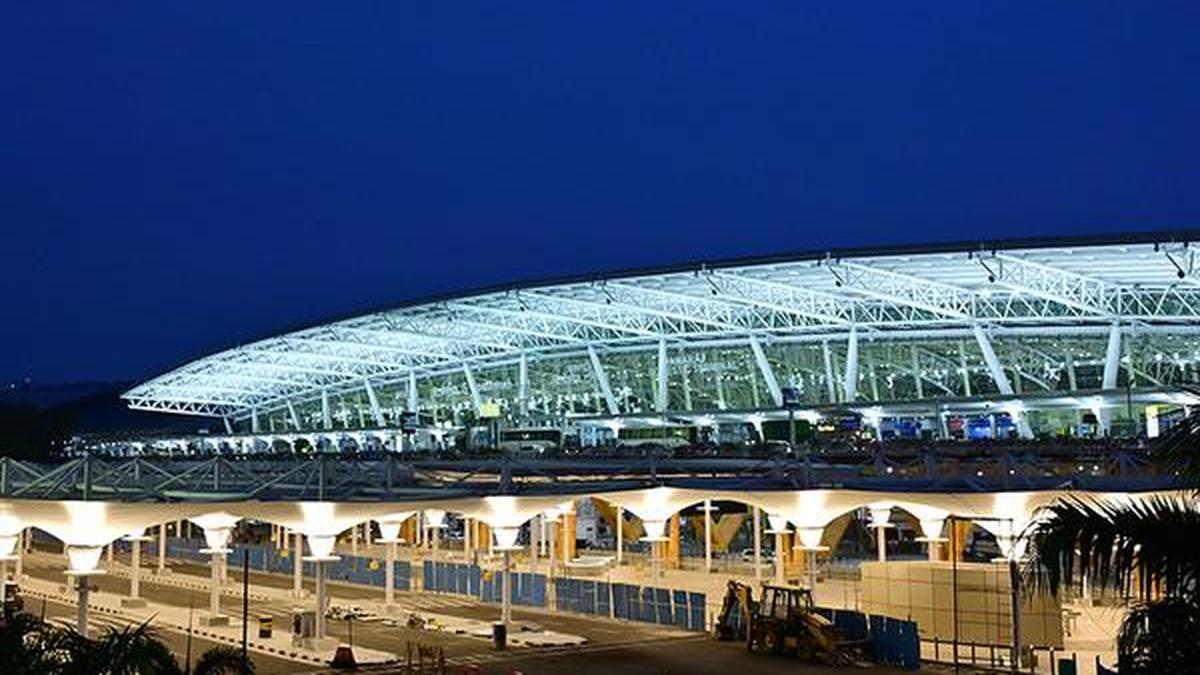
The debate over Chennai’s proposed second airport at Parandur has once again entered a politically sensitive phase. The land acquisition process for the project, which continued under the previous DMK government until a few months before the election announcement, now appears to have slowed down or halted after the new TVK-led government took charge. Although there has been no official announcement, the absence of fresh notifications related to land acquisition suggests that the administration is actively reconsidering or reviewing the project.
Against this backdrop, several voices have emerged in support of the Parandur airport. Construction firms, logistics companies, real estate developers, and industry associations have openly issued statements and held meetings backing the project. Their argument is largely built around one comparison: Chennai airport versus Bengaluru airport.
This comparison is not new. It was first strongly pushed by the government when the Parandur airport announcement was made in 2022. A statement issued by the Tamil Nadu Industries Department on August 20, 2022 said that Chennai’s Meenambakkam airport, which had held the third place in India’s air passenger traffic in 2008, had fallen to the fifth place.

The same statement noted that Bengaluru, which was fifth in 2008, had grown faster after building its new airport. It further claimed that passenger traffic at Bengaluru and Hyderabad airports had grown by 14% and 12% respectively, while Chennai’s growth was only 9%.
At first glance, this argument may sound convincing. According to Airport Authority of India traffic data, Bengaluru airport handled 4.38 crore passengers in 2025, while Chennai airport handled 2.32 crore passengers. Chennai’s passenger traffic is only about 52.9% of Bengaluru’s passenger traffic. But this comparison ignores a crucial fact: Tamil Nadu is not Chennai alone.
Unlike Karnataka, Tamil Nadu has a much more distributed aviation network. Chennai, Coimbatore, Tiruchi, Madurai, and Tuticorin together form a wider aviation ecosystem serving different regions of the State. When passenger traffic across all Tamil Nadu airports is combined, the total reaches 3.05 crore passengers in 2025, or 69.7% of Bengaluru airport’s traffic.
Tamil Nadu airport data (as of 2025)
Passenger traffic across all Tamil Nadu airports combined: 3.05 crore passengers
Chennai’s share in Tamil Nadu’s total air passenger traffic: 76%
Fastest-growing airport in the region: Tiruchirapalli airport
Tamil Nadu’s total airport passenger traffic: 305.33 lakh
The structure of the two States’ aviation systems is very different. In 2025, Chennai airport accounted for 76% of Tamil Nadu’s total air passenger traffic, while the remaining 24% came from airports outside the capital. By contrast, Bengaluru airport accounted for around 94% of Karnataka’s total air passenger traffic. Only about 6% of Karnataka’s passengers used other airports such as Mangaluru, Hubbali, and Mysuru.
Bengaluru therefore functions as Karnataka’s overwhelmingly dominant aviation hub, whereas Chennai is only one part of a broader State-wide aviation network. A fair comparison would be Bengaluru versus all Tamil Nadu airports combined, or Karnataka’s total aviation traffic versus Tamil Nadu’s total aviation traffic.
The growth pattern from 2022 to 2025 reinforces this point. Tiruchirapalli airport grew by 68.5%, making it the fastest-growing airport in the region and even surpassing Bengaluru’s 59.3% growth. Coimbatore airport grew by 49.2%, while Tuticorin grew by 48.7%. Overall, Tamil Nadu’s total airport passenger traffic grew from 213.54 lakh in 2022 to 305.33 lakh in 2025, an increase of 43%.
Karnataka’s aviation growth, by comparison, remains heavily Bengaluru-centric. Mangaluru airport grew by 48.4%, but Karnataka’s other airports remain much smaller. Hubbali grew by 33.7%, while Mysuru airport declined sharply by 48.9% during the same period. Karnataka’s non-Bengaluru airports together handled only 29.97 lakh passengers in 2025, compared to 73.50 lakh passengers handled by Tamil Nadu’s non-Chennai airports.

Supporters of the Parandur airport argue that if Chennai does not get a second airport by 2028, the city and its surrounding industrial regions may lose future growth opportunities. They also point to the economic benefits of aviation. According to a study by the International Civil Aviation Organization, every ₹100 spent on air travel generates around ₹325 in wider economic benefit, while every 100 direct aviation jobs can create around 610 indirect jobs.
The question, however, is whether such growth should be concentrated only around Chennai.
Tamil Nadu’s strength has never come from Chennai alone. One of the main reasons the State has emerged as a leader in economic and social development is its model of distributed growth. Unlike States where one city dominates the entire economy, Tamil Nadu has multiple industrial, educational, healthcare, textile, manufacturing, and export centres spread across regions. Coimbatore, Tiruppur, Erode, Salem, Madurai, Tiruchirapalli, Hosur, Tuticorin, and Vellore all contribute significantly to the State’s economy.
The Parandur airport project risks moving against this long-standing strength. Instead of strengthening regional airports and distributing aviation-linked economic growth, it may further concentrate investment, logistics activity, land conversion, and infrastructure pressure around Chennai.
The environmental concerns are equally significant. A report released by the State Planning Commission in July 2025 highlighted the relationship between urban expansion and rising heat stress in Tamil Nadu. Chennai’s built-up area increased from 48% of its land area in 1985 to 74% in 2015. The report identified this expansion as a major factor behind rising temperatures in and around the city.
Why is the Parandur airport project facing opposition? | Explained
The report also pointed to Sriperumbudur as an example of how wetland destruction and built-up expansion contribute to rising temperatures. Sriperumbudur, Kundrathur, Poonamallee, and Minjur have already emerged as critical heat hotspots. The proposed Parandur airport falls within this broader region.
Of the 2,172.73 hectares required for the airport, 576.74 hectares, or 26.54%, is wetland. If agricultural land is included, around 90% of the total project area consists of wet land. Transforming such a landscape into built infrastructure would permanently alter the ecological character of the region.

Wetlands act as natural flood buffers, absorb excess rainwater, recharge groundwater, support biodiversity, reduce local heat, and help maintain hydrological balance. Replacing them with runways, roads, commercial zones, logistics parks, and real estate development would increase vulnerability to both flooding and heat stress.
The debate on Parandur should therefore not be framed as development versus anti-development. The real question is what kind of development Tamil Nadu needs. Chennai may require additional airport capacity and connectivity. But whether that should come through the conversion of wetlands and agricultural landscapes in a heat-stressed region deserves serious public scrutiny.

Tamil Nadu’s strength lies in its distributed development model. Its aviation strategy should reflect that same philosophy. The question is not whether the state needs aviation growth. It is whether Tamil Nadu should sacrifice its distributed growth model for one more Chennai-centric mega project. That is the real debate Parandur has forced us to confront.
( G. Sundarrajan is coordinator, Poovulagin Nanbargal, and Satheesh Lakshmanan, a core member of the NGO.)
Leave a Reply